
On July 10, 2026, Vietnam introduced a two-part change for Multi-tank Wash Lines: import quota limits were removed, while a new compliance threshold took effect at the same time through QCVN 32:2026. For exporters, buyers, certification parties, and shipment planning teams, the practical issue is no longer only market access in principle, but whether imported equipment can clear customs with verified water-consumption performance and the required recognized documentation.
The rule change is both a relaxation and a new gate
Vietnam's Ministry of Industry and Trade (MOIT) announced on July 10, 2026 that import quota restrictions on Multi-tank Wash Lines were canceled with immediate effect.
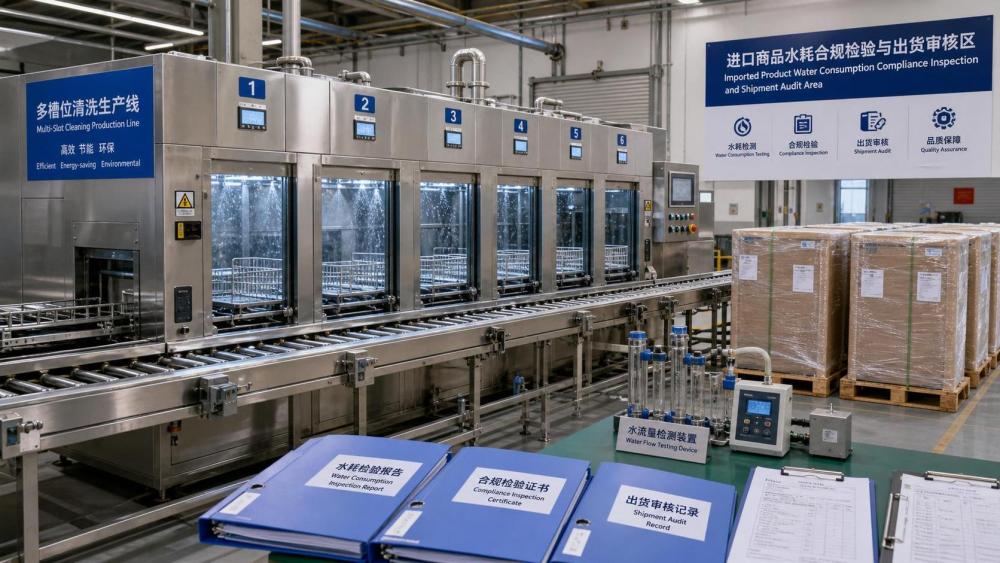
At the same time, the new standard QCVN 32:2026 was implemented. Under that standard, all imported equipment must pass VINAQAS-certified measured verification showing unit washing water consumption of no more than 1.8L/kg of workpieces.
For Chinese exporters, a third-party energy-efficiency test must be completed before shipment, and a report recognized by the Vietnam standards authority TCVN must be submitted. Without that documentation, customs clearance will not be granted.
Where the pressure shifts across the transaction chain
Export orders may move faster, but pre-shipment compliance becomes stricter
For direct export companies, the removal of quota restrictions may reduce one traditional access constraint. Analysis shows, however, that the operational burden shifts upstream into pre-shipment testing and document readiness. The key impact is on order confirmation, factory release timing, and shipment scheduling, because customs clearance now depends on whether the equipment has passed the required measured verification and whether the report is recognized for submission.
Procurement teams need to check technical claims earlier
For buyers and procurement-side decision makers, the relevant change is not only whether supply is available, but whether the selected equipment can demonstrate compliance with the water-consumption threshold under the new rule. What deserves closer attention is the alignment between technical specifications, supplier declarations, and test documentation, especially where procurement decisions are made before shipping documents are finalized.
Testing and certification functions become a critical handoff point
For certification-related companies and testing service providers, the new requirement makes measured verification a practical gateway rather than a supporting document. From an industry perspective, the business risk centers on whether testing can be completed before shipment and whether the resulting report meets the recognition requirement tied to TCVN. Any weakness at that handoff could affect delivery timing and customs release.
Logistics and delivery teams face document-sensitive execution risk
For supply chain service providers and delivery coordinators, the change introduces a sharper dependence on document completeness before goods move. Observably, the customs consequence stated in the rule summary means shipment planning can no longer be separated from compliance preparation. Document review, reporting sequence, and release timing become more exposed points in the delivery process.
What companies should review now
Confirm whether current models can meet the water threshold
Companies involved in exporting or sourcing Multi-tank Wash Lines should first verify whether the equipment can support measured proof of unit washing water consumption at or below 1.8L/kg of workpieces. This is a technical compliance issue that may affect quotations, contract terms, and shipment readiness.
Check the testing and recognition path before shipment
Because the summary states that third-party energy-efficiency testing must be completed before shipment and that a TCVN-recognized report must be submitted, companies should pay closer attention to the sequence of testing, report issuance, and shipping arrangements. The input does not provide the detailed execution workflow, so this should be treated as an area requiring active confirmation rather than an already standardized process.
Review document sets used in sales, tenders, and customs preparation
Exporters, distributors, and project teams should examine whether current technical files, bid materials, and customs document packages adequately reflect the new compliance condition. Analysis shows that a mismatch between product literature and recognized test evidence could become a practical obstacle even where commercial demand remains intact.
Watch for follow-up clarification in execution language
The announced change is already framed as effective immediately, but the input does not provide further detail on interpretive guidance, filing practice, or how closely specific product configurations will be examined. For that reason, companies should continue monitoring official wording, certification practice, and any changes in buyer-side documentation requirements.
Why this looks like an execution signal, not just a policy headline
Observably, this development should not be read only as a liberalization measure because the quota removal is paired with a measurable resource-efficiency condition and a customs-linked documentation requirement. From an industry perspective, that combination matters because it changes the basis of market access from quantity control to verifiable compliance performance.
It is more appropriate to understand this as an already landed rule change with immediate execution implications, while also recognizing that the exact operating standard may still require closer observation through follow-up implementation language, certification practice, and market response.
How the market is likely to read it for now
At this stage, the announcement is best understood as a shift in trade access conditions rather than a simple easing of imports. The practical opening created by quota removal is real in form, but the water-consumption certification requirement introduces a new filter that directly affects pre-shipment preparation, documentation control, and customs risk.
Analysis shows that companies should treat this as a compliance-led market change: already effective in principle, commercially relevant immediately, and still dependent on further observation of how standards, recognized reports, and transaction documents are applied in practice.
Basis of this article and what still needs verification
This article is based on the user-provided news title, event date, and event summary. For developments of this type, relevant source categories typically include official government announcements, regulatory releases, customs or trade authority notices, standard-setting documents, industry association publications, and reporting by authoritative media.
No specific official source link was provided in the input, so the official publication path and any supporting implementation documents still need to be verified on an ongoing basis. What remains worth monitoring includes detailed execution rules, certification interpretation, changes in tender or procurement documents, industry feedback, and how companies carry out testing and submission in actual transactions.