
Why the right cleaning method changes from one metal part to another
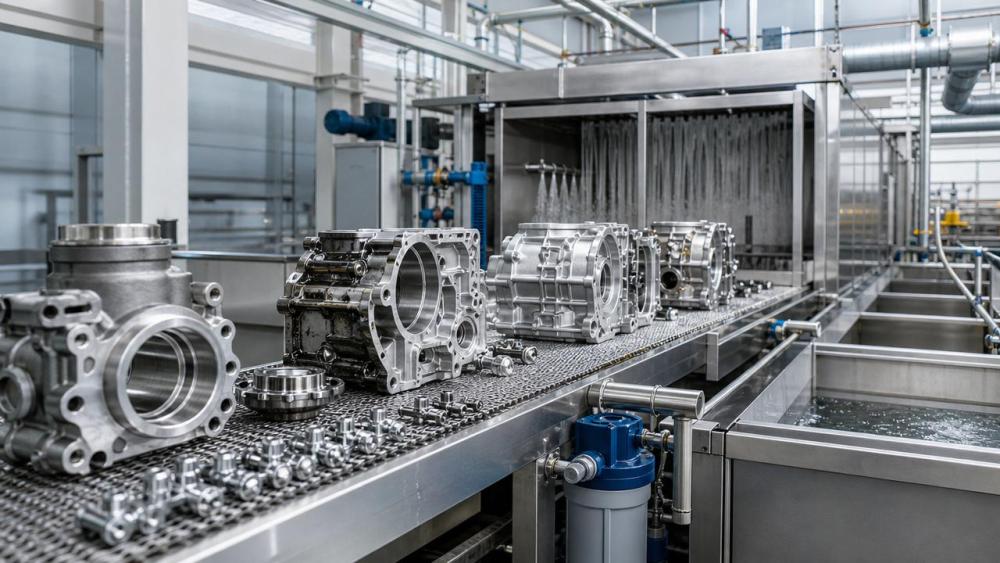
Industrial cleaning technology for metal parts matters long before final inspection. Oils, chips, and burr residue can disrupt assembly fit, coating adhesion, marking quality, and corrosion performance.
In actual production, two parts made from the same alloy may need very different cleaning routes. The difference usually comes from geometry, upstream machining, and downstream process sensitivity.
A stamped bracket with loose chips is not judged like a hydraulic valve body. A gearbox housing after rough machining is also not cleaned like a precision medical fastener.
That is why industrial cleaning technology for metal parts is rarely chosen by equipment type alone. A practical decision starts with contamination behavior, not with a preferred machine category.
This is also where process-support thinking becomes important. On platforms such as GIAS, cleaning is treated as part of wider quality control, traceability, coating readiness, and production consistency.
In real workshops, oils, chips, and burrs do not create the same risk
The most common mistake is to group all contamination together. In practice, residual oil behaves differently from abrasive chips, and both differ from burr fragments trapped in internal features.
Oil removal is usually a chemistry and surface-energy question. Chip removal is more about flushing force, flow path, and whether debris can escape blind holes.
Burr-related cleaning is even more specific. If the burr is still attached, cleaning alone will not solve the problem. The part may need deburring before washing.
A useful way to assess industrial cleaning technology for metal parts is to ask three things first:
- Is the contamination free, smeared, embedded, or attached?
- Can the contamination move out of the part easily?
- What process fails if residue remains?
That last question often changes the answer. If the next step is storage, the cleaning target differs from a part that goes directly into welding, coating, bonding, or leak-sensitive assembly.
When heavy machining oil is the main issue, chemistry and drying usually decide performance
Parts leaving turning, milling, or grinding often carry emulsions, straight oils, and fine metallic dust. Here, industrial cleaning technology for metal parts must separate oil films without leaving detergent residue.
Spray washing works well for open surfaces and robust geometries. It is often chosen for high throughput because cycle times are predictable and automation is straightforward.
Ultrasonic cleaning becomes more suitable when oil sits inside threads, grooves, or intersecting holes. Cavitation reaches areas that direct spray may miss, especially on compact precision components.
However, the decision should not stop at the wash stage. Drying matters just as much. If water remains in internal passages, flash corrosion or later contamination can undo the cleaning result.
A frequent oversight is selecting alkaline chemistry for every oily part. Some alloys, finishes, and downstream coatings require tighter chemical compatibility and rinse control.
Typical fit for oil-dominant parts
- Spray cleaning: better for simple shapes, larger parts, and faster conveyorized lines.
- Ultrasonic cleaning: better for fine cavities, close tolerances, and precision cleanliness targets.
- Vacuum drying support: useful when trapped moisture threatens corrosion or coating defects.
When chips collect in holes and channels, fluid movement matters more than tank size
Chip-heavy components create a different challenge. The issue is not only washing surfaces, but also carrying particles out of ports, galleries, recesses, and intersecting drill paths.
This is common in valve blocks, pump housings, manifolds, and machined structural parts. A clean-looking exterior can hide loose metal inside functional channels.
For these cases, industrial cleaning technology for metal parts should be judged by turbulence, directional flushing, filtration level, and basket orientation during the cycle.
High-pressure spray systems often perform well when chip evacuation paths are clear. If chips are trapped in complex passages, immersion plus ultrasonic agitation may improve release.
But there is a limit. If chip generation upstream is unstable, cleaning equipment becomes a rescue step rather than a controlled process. Tool wear and deburring quality must be reviewed together.
The table shows why industrial cleaning technology for metal parts should be matched to contamination movement. Cleaning force is only useful when debris can actually leave the part.
Burr-sensitive parts need a different judgment than oil-sensitive parts
Burr-related contamination is often misunderstood. Small detached burr particles can be washed away. Attached burr edges cannot be solved by stronger cleaning alone.
This distinction matters in sealing surfaces, threaded features, and parts entering automated assembly. A tiny burr may cause torque variation, O-ring damage, or poor seating in later operations.
In this scenario, industrial cleaning technology for metal parts works best as part of a sequence. Deburring, washing, rinsing, and verification should be treated as one chain.
Ultrasonic cleaning helps remove loose burr fines after mechanical or thermal deburring. It is less effective when the upstream edge condition remains unstable from part to part.
A realistic judgment point is whether the final requirement is cosmetic cleanliness or functional cleanliness. Burr-sensitive parts nearly always fall into the second category.
Precision parts and coating lines usually set stricter limits than general hardware
Not every metal component needs the same cleanliness class. General brackets, welded frames, and transport fixtures usually tolerate more variation than bearing parts, actuator components, or coated decorative surfaces.
Where coating, electrostatic finishing, laser marking, or adhesive bonding follows, residue control becomes stricter. Even a thin oil trace can cause fish-eyes, poor adhesion, or inconsistent code contrast.
This is where industrial cleaning technology for metal parts connects with the broader auxiliary process chain. Cleaning quality affects what happens in surface treatment, traceability, and final appearance.
In more demanding lines, rinse-water quality, particle monitoring, and drying verification deserve as much attention as machine power. A stronger wash does not automatically create a cleaner part.
Different scenarios, different priorities
- Assembly-focused parts prioritize particle removal and dry internal features.
- Coating-focused parts prioritize oil-free surfaces and rinse purity.
- Traceability-focused parts prioritize surface consistency before marking or coding.
- Corrosion-sensitive parts prioritize drying quality and post-clean handling.
Where selection often goes wrong before equipment even arrives
One common misjudgment is to compare only machine specifications. Tank volume, power rating, or conveyor size do not explain whether the process fits the actual residue pattern.
Another mistake is to test a single ideal sample. Real production includes tool wear, oil concentration shifts, mixed part loads, and changing batch intervals.
Industrial cleaning technology for metal parts should also be reviewed against maintenance burden. Filter replacement, chemistry control, sludge handling, and drying energy affect long-term consistency.
It is also easy to ignore what comes after cleaning. If parts are transferred through dusty packaging zones or stored in humid conditions, the effective cleanliness window may be short.
The better approach is to evaluate the whole route: contamination source, cleaning method, verification method, and protection before the next operation.
A practical way to match industrial cleaning technology for metal parts to the job
A useful selection process starts with a contamination map. Record where oil gathers, where chips hide, and whether burr fragments appear after machining or handling.
Then define the real cleanliness target. That target may be particle count, surface energy, corrosion resistance, coating adhesion, or visual finish stability.
Next, compare process routes under normal production variation. Include mixed loads, expected cycle time, chemical carryover, and drying reliability.
For many operations, the best industrial cleaning technology for metal parts is not the most aggressive option. It is the route that stays stable across geometry changes and routine maintenance intervals.
That is also why application-based evaluation remains valuable. In broader industrial support ecosystems such as GIAS, cleaning is viewed alongside surface treatment, vacuum-assisted drying, and marking quality, not as an isolated step.
Before moving forward, it helps to document part geometry, contamination type, cleanliness threshold, downstream risk, and acceptable maintenance effort. That makes comparison clearer and reduces costly trial-and-error later.