
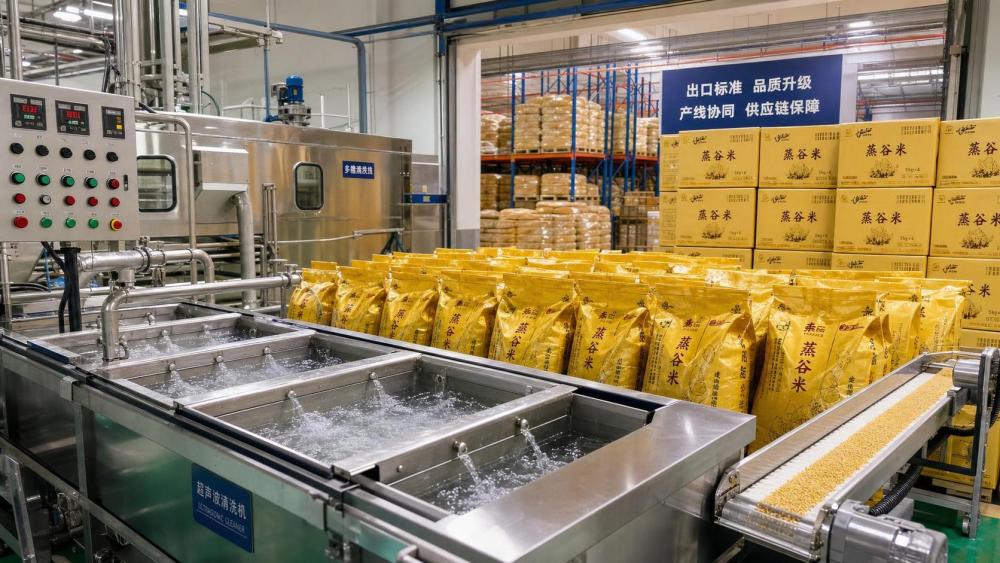
On June 23, 2026, India put a 20% export duty on parboiled rice into immediate effect, adding further pressure to an already tighter rice export environment shaped by earlier restrictions on broken rice and comparable tax treatment for white and brown rice. For companies tied to rice processing and packaging lines in Southeast Asia, the Middle East, and Africa, the development is worth close attention because it may affect not only grain trade flows, but also the delivery rhythm, sourcing cost, and compliance workload around cleaning-related consumables used with multi-tank wash lines and ultrasonic cleaning systems in mill hygiene operations.
A tighter export setting is now confirmed
Based on the information provided, the confirmed change is that the Indian government imposed a 20% export duty on parboiled rice with immediate effect on June 23, 2026. This measure comes on top of a previously noted ban on broken rice exports and the same tax rate already applied to white rice and brown rice. Taken together, these measures significantly tighten rice exports from India.
The provided information also states that this tighter export environment is expected to increase localized delivery pressure for food processing and packaging equipment in Southeast Asia, the Middle East, and Africa, including multi-tank wash lines and ultrasonic cleaning systems used in clean production lines at rice mills. It also points to higher procurement costs and greater customs and compliance complexity for importers of related consumables such as cleaning agents, filter cartridges, and conveyor modules.
Where the pressure may appear along the chain
Equipment projects tied to rice mill cleanliness
From an industry perspective, suppliers and integrators serving rice processing and packaging projects may feel the impact through project execution rather than through the tariff itself. The information provided points to stronger localization pressure in Southeast Asia, the Middle East, and Africa, which suggests that delivery planning for wash lines, ultrasonic cleaning systems, and associated hygiene modules may face tighter timing, coordination, and sourcing constraints.
Consumables importers face a more direct cost issue
Analysis shows that importers of cleaning agents, filter cartridges, and conveyor modules are among the most directly exposed business roles in this development. The reason is clear in the provided summary: procurement costs may rise, while compliance declarations may become more complicated. For these participants, the issue is not only price, but also whether import documentation, classification, and shipment arrangements remain aligned with changing trade conditions.
Regional buyers may need to reassess delivery assumptions
Buyers in Southeast Asia, the Middle East, and Africa that depend on rice-related processing and packaging capacity may need to watch how localized delivery expectations evolve. Observably, the concern is less about a single machine category and more about whether supporting parts and consumables can arrive on time and be cleared smoothly enough to keep hygiene-sensitive production lines operating as planned.
What companies should watch now
Track whether official wording or implementation details shift
What deserves closer attention is the distinction between the announced policy direction and its operational interpretation in trade and customs practice. Companies involved in procurement, delivery, or import declaration should keep monitoring whether any official wording, scope clarification, or implementation detail changes after the June 23, 2026 measure takes effect.
Review high-frequency consumables first
For businesses supporting rice mill cleaning processes, it is more practical to review the most frequently replenished categories first, especially cleaning agents, filter cartridges, and conveyor-related modules specifically mentioned in the provided information. These items are more likely to affect continuity of operations if procurement costs rise or import procedures become less predictable.
Separate policy signal from delivery reality
Analysis shows that a stricter export setting does not automatically produce the same operational impact in every project or market. Companies should distinguish between the policy signal itself and the actual effect on lead times, landed cost, and customs handling in each destination market. This is especially relevant for businesses promising localized delivery in Southeast Asia, the Middle East, and Africa.
Prepare documentation and customer communication in parallel
Service providers, importers, and project teams should pay attention to supplier qualifications, product documents, customs declarations, and contract communication at the same time. In this type of situation, compliance complexity can become a practical bottleneck even before broader supply adjustments are visible in the market.
Why this matters beyond rice trade alone
Observably, this development should not be read only as a grain export measure. The information provided indicates a spillover effect into the operating environment for food processing and packaging equipment linked to rice mill cleanliness. That makes it relevant to a wider set of market participants, including equipment integrators, consumables importers, regional distributors, and procurement teams serving hygiene-sensitive production lines.
It is more appropriate to understand this as a near-term operational signal with possible broader implications, rather than as a fully settled long-term outcome. The immediate policy change is confirmed, but the scale and persistence of its downstream effects on equipment support and consumables trade still require continued observation.
How the market should read this development
At this stage, the industry significance lies in the combination of tighter rice export controls and the resulting pressure on related delivery and sourcing functions. The key point is not to overstate the outcome, but to recognize that a trade policy move in a core agricultural segment can quickly affect adjacent industrial activities, especially where imported consumables and clean-line equipment support are involved.
For now, this is best understood as a development that merits close monitoring rather than a finished market conclusion. The confirmed policy change is immediate, while its full operational impact on equipment localization, consumables costs, and compliance handling is something companies still need to track in real business execution.
Basis of this article and what still needs verification
This article is based on the user-provided news title, event date, and event summary. The summary supplied for this piece states that India raised the export duty on parboiled rice to 20% on June 23, 2026, alongside earlier restrictions that together tightened rice exports and may increase delivery pressure and sourcing complexity for related cleaning-system consumables.
For this type of industry update, commonly relevant source categories may include official government notices, company disclosures, industry association updates, authoritative media reporting, and standard-setting or customs-related documents. A specific official source link was not provided in the input, so further verification remains necessary. What deserves continued attention is whether later official clarification, customs practice, or market execution changes the practical impact on equipment support and consumables procurement.