
How to Choose Industrial Ultrasonic Cleaning for Precision Parts and Multi-Stage Wash Lines
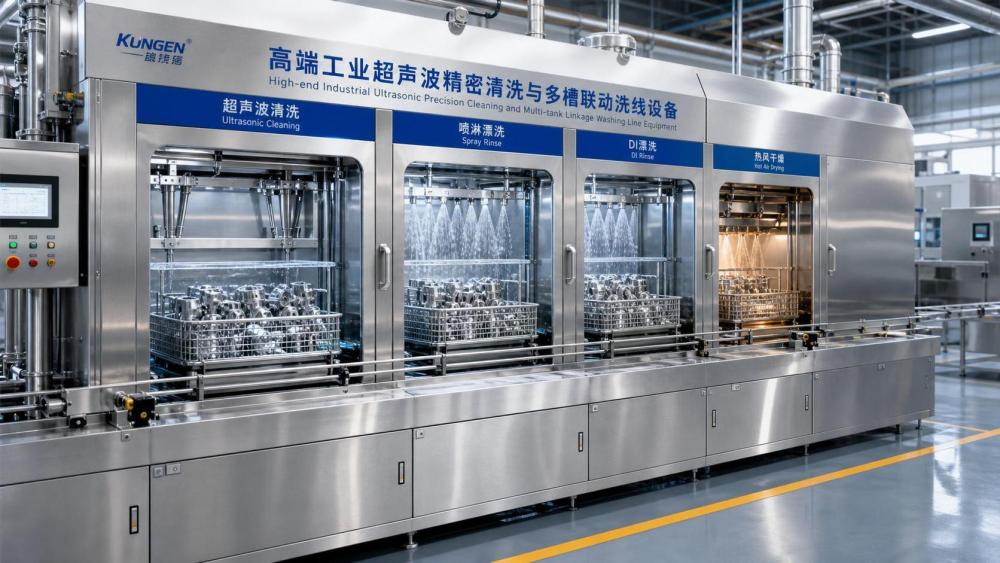
Choosing industrial ultrasonic cleaning is rarely about tank size alone.
The real question is whether the system can remove contamination consistently, without slowing production or risking part damage.
That matters even more when precision parts move through multi-stage wash lines.
A weak cleaning step can reduce coating quality, assembly yield, bonding performance, and traceability reliability downstream.
In practice, industrial ultrasonic cleaning must match contamination type, part geometry, cleanliness target, chemistry, rinse quality, drying method, and automation level.
That is why selection should start from process requirements, not from a brochure headline.
For decision-making, a structured evaluation helps separate useful specifications from marketing noise.
Start with the Cleanliness Requirement
The first step is defining what “clean” actually means for the part.
Some parts only need visible oil removal.
Others need particle control at micron level, ionic residue limits, or surface readiness for plating, welding, coating, or vacuum service.
This distinction changes the whole industrial ultrasonic cleaning configuration.
Useful evaluation questions include:
- What contaminants must be removed: oil, polishing compound, fines, flux, carbon, chips, salts, or bio-burden?
- What verification method will be used: visual inspection, gravimetric test, particle count, conductivity, or contact angle?
- What surfaces are critical: blind holes, threads, capillaries, internal channels, or delicate finished faces?
- What failure happens if cleaning is incomplete: leakage, poor adhesion, cosmetic defects, corrosion, or field failure?
A clear cleanliness target prevents overbuying and under-specifying at the same time.
Match Frequency and Power to Part Risk
Frequency is central in industrial ultrasonic cleaning because it shapes cavitation behavior.
Lower frequencies usually create stronger cavitation and more aggressive cleaning.
Higher frequencies are gentler and better for fine features or fragile substrates.
As a practical guide:
- 25 to 28 kHz often suits heavy oils, machined parts, and robust metal components.
- 35 to 40 kHz is a common balance for general precision cleaning.
- 68 kHz and above fits delicate parts, tiny passages, and reduced erosion risk.
Power density matters too, but more power is not automatically better.
Excess intensity can damage thin walls, soft metals, coated surfaces, or bonded assemblies.
Ask suppliers for validated process windows, not only nominal wattage.
More advanced systems may offer sweep frequency or mixed frequency modes.
These features help reduce dead zones and improve repeatability across different baskets or load patterns.
Evaluate Tank Design, Basket Handling, and Line Flow
Industrial ultrasonic cleaning becomes more complex when integrated into multi-stage wash lines.
A single clean tank may work in a lab, but production usually needs a sequence.
Typical stages may include pre-wash, ultrasonic cleaning, spray rinse, overflow rinse, DI rinse, drying, and unload.
Line design should follow contamination removal logic.
It should not simply stack tanks to look complete.
Key design points include:
- Tank dimensions must fit real part carriers, not only sample parts.
- Basket loading density should allow cavitation and fluid exchange around every critical surface.
- Agitation, filtration, oil separation, and overflow control should be sized for contamination load.
- Transfer time between stages should limit recontamination and drying marks.
- Drying must match the final rinse quality and part geometry.
For high-volume lines, takt time often decides the equipment layout.
That means industrial ultrasonic cleaning should be reviewed as one station inside a total flow model.
Do Not Separate Chemistry from Equipment Choice
Many selection errors happen because chemistry is treated as a later detail.
In reality, chemistry and industrial ultrasonic cleaning performance are tightly linked.
The detergent affects wetting, emulsification, residue profile, foam behavior, corrosion risk, and wastewater burden.
Selection should check chemical compatibility with:
- Base materials such as stainless steel, aluminum, copper, brass, ceramics, engineered plastics, and elastomers.
- Surface finishes including passivation, anodizing, polishing, and micro-coatings.
- Tank materials, seals, pumps, filters, and heat exchangers.
This is also where compliance enters the decision.
Low-residue cleaning may still fail if chemical disposal costs rise or restricted substances trigger export issues.
From a business view, the best process is the one that stays stable in audits and daily operation.
Compare Manual, Semi-Automatic, and Fully Automatic Systems
Automation level changes both consistency and labor demand.
For low-mix, low-volume work, a manual industrial ultrasonic cleaning setup may still be practical.
For regulated industries or higher throughput, repeatability usually matters more than initial price.
Look closely at recipe control, alarm history, barcode linkage, and maintenance access.
A sophisticated line loses value quickly if operators cannot change baskets, filters, or chemistry safely and fast.
Check Process Validation and Operating Stability
A good purchasing decision depends on evidence.
Suppliers of industrial ultrasonic cleaning should support trials using real parts, real contaminants, and realistic basket density.
Lab coupons alone are rarely enough.
Before approval, ask for validation data on:
- Cleaning results before and after process optimization
- Cycle time at target throughput
- Bath life, filter replacement interval, and water consumption
- Temperature stability and ultrasonic output consistency
- Maintenance plan and spare parts availability
This is where total cost becomes clearer.
An apparently lower-cost machine may consume more chemistry, create more rejects, or need more downtime support.
Common Selection Mistakes in Industrial Ultrasonic Cleaning
Several mistakes appear again and again during evaluation.
- Choosing frequency based on habit instead of part sensitivity and soil type
- Ignoring rinse quality while focusing only on the ultrasonic stage
- Using overloaded baskets that block cavitation and fluid renewal
- Skipping contamination analysis before selecting chemistry
- Estimating throughput from ideal cycle time rather than real loading and transfer losses
- Treating data logging and traceability as optional in regulated production
Avoiding these errors usually saves more than negotiating a lower equipment price.
A Practical Evaluation Framework
A reliable industrial ultrasonic cleaning decision should move through a simple sequence.
- Define contamination, cleanliness limit, and downstream process risk.
- Map part geometry, basket design, takt time, and production volume.
- Shortlist frequency, tank sequence, chemistry, and drying options.
- Run trials with actual parts and measurable acceptance criteria.
- Compare total operating cost, compliance impact, and maintenance burden.
- Confirm supplier support for installation, validation, and process tuning.
This approach keeps industrial ultrasonic cleaning tied to production reality.
It also helps teams compare suppliers on process capability, not just on catalog claims.
When precision parts and multi-stage wash lines are involved, the best choice is the system that delivers verified cleanliness, stable throughput, manageable operating cost, and room for future process control improvements.