
Why Tank Choice Matters More Than Many Buyers Expect
In distillery production, fermentation is not just a biological step between mashing and distillation. It is a daily operating system that affects alcohol conversion, batch consistency, cleaning effort, labor rhythm, and downstream scheduling. For that reason, fermentation tanks are not simply storage vessels. Their structure, internal finish, access design, venting approach, and cleanability can influence how much usable product a facility gets from each batch and how reliably the line performs over time.
This issue has gained more attention as producers face tighter quality expectations, more diverse product styles, and stronger pressure to control utility and labor costs. Even in operations that are not expanding capacity, replacing or adding tanks can change production stability in ways that are visible within ordinary daily work: foam handling becomes easier or harder, residue removal takes longer, operator intervention increases, and fermentation variability may become more noticeable.
For buyers, project managers, maintenance teams, and quality personnel, the first question is usually not tank size alone. A more useful starting point is whether the tank design matches the production method, cleaning routine, safety expectations, and staffing reality of the site. A tank that looks acceptable on paper may still create operating friction if the geometry, fittings, and access points are not well aligned with actual use.
How Fermentation Tanks Influence Yield
Yield in a distillery is shaped by many variables, including raw materials, yeast behavior, temperature control, and operator discipline. Tank design does not replace those fundamentals, but it can support or weaken them. Uneven temperature distribution, difficult solids management, or poor drainage may lead to incomplete fermentation, contamination risk, or product loss during transfer and cleaning.
In many distilleries, one of the first practical concerns is whether the vessel helps maintain a stable fermentation environment. If heat accumulates in certain zones, or if mixing behavior is not appropriate for the recipe and process style, yeast performance may drift. That can affect attenuation, flavor development, and the predictability of the run sent to distillation. The result is not always a dramatic failure. More often, it appears as small but repeated inefficiencies across batches.
Another yield-related issue is product recovery. Tank bottom design, outlet placement, and internal surface finish can influence how much liquid remains trapped with sediment or is lost during discharge. Across a single batch the volume may look minor, but over months of operation these losses become commercially meaningful, especially in higher-throughput facilities.
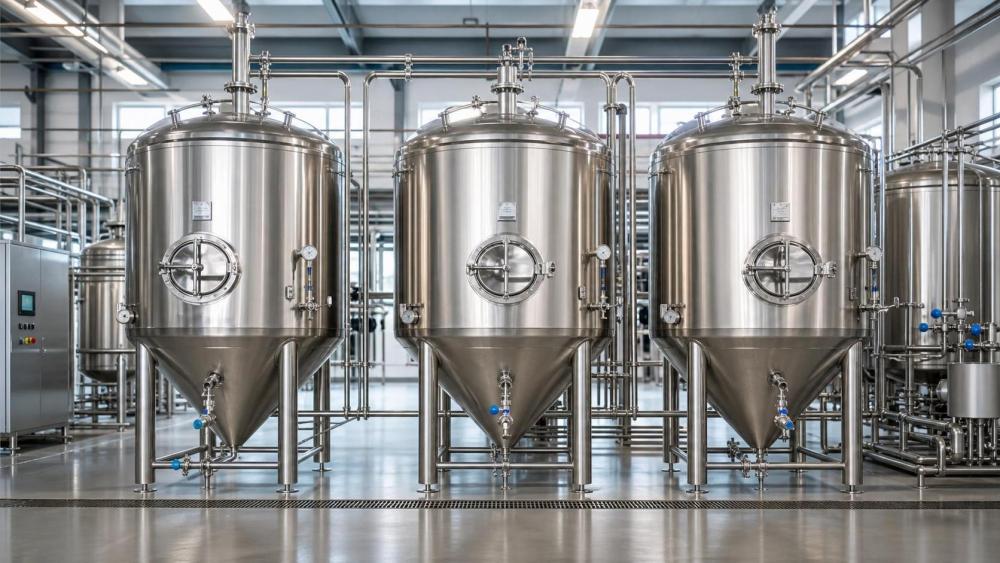
Cleaning Is Not a Secondary Consideration
Cleaning often receives less attention during procurement than capacity, material grade, or price. That is a mistake. In real operations, cleaning frequency and cleaning difficulty affect labor demand, turnaround time, microbiological risk, water consumption, and maintenance exposure. Tanks that are awkward to wash can slow production just as effectively as undersized equipment.
Buyers should examine whether internal surfaces are smooth enough for routine sanitation, whether welds appear consistent, and whether corners, nozzles, or manway areas are likely to collect residue. This matters particularly in processes with solids, fibrous raw materials, heavy foaming, or sticky byproducts. A vessel that is easy to rinse but hard to inspect may still create a hidden hygiene problem.
Cleaning also connects directly to safety management. If routine sanitation requires excessive manual entry, repeated disassembly, or hard-to-reach scrubbing points, the facility may see increased confined-space risk and more variation in cleaning quality between shifts. Quality teams and safety managers therefore have a strong reason to review the tank not only as production equipment, but as a recurring hygiene and work-control interface.
What Daily Operation Reveals About Good or Poor Design
Operators usually detect design strengths before management sees them in reports. Daily operation quickly exposes whether a tank supports efficient work. Questions that matter include how easily the vessel can be filled, vented, monitored, sampled, emptied, and prepared for the next batch. A technically adequate tank may still frustrate the production floor if valve locations are awkward, access openings are too limited, or instrumentation is difficult to verify during routine rounds.
Foam behavior is another practical concern. Some fermentations are more aggressive than others, and the tank configuration should account for that. Headspace, top opening design, and process compatibility with temperature control or observation methods can all influence how manageable the batch remains. Where operators repeatedly need temporary workarounds, that often signals a mismatch between equipment design and process reality.
Maintenance personnel also experience the long-term effects of design choices. If seals, ports, fittings, or welded connections are hard to inspect and service, downtime may increase. Replacement work becomes more disruptive, and small faults can persist longer than they should. For facilities trying to stabilize output, ease of maintenance is part of operational performance, not a separate issue.
What Buyers Should Check First
The most useful early-stage review usually combines process fit, sanitation practicality, and lifecycle workload. For procurement teams comparing distillery fermentation tanks, the strongest decisions are often based on how the vessel will behave in production rather than on nominal volume alone. Material selection, internal finish, access configuration, drainage design, and compatibility with site cleaning practices should all be reviewed before price becomes the deciding factor.
Several points deserve early attention:
- Process style: Open-top and closed configurations support different production habits, cleaning methods, and observation preferences.
- Tank geometry: Bottom shape, height-to-diameter ratio, and outlet placement affect drainage, sediment handling, and cleaning efficiency.
- Surface and weld quality: These can influence hygiene control, residue retention, and long-term corrosion resistance.
- Access points: Manways, top access, and inspection openings should support both sanitation and maintenance without creating unnecessary labor.
- Integration: Connections for transfer, cooling, venting, and instrumentation should match the existing site layout and operating routine.
Common Misjudgments During Evaluation
One common mistake is assuming that a tank suitable for one spirit style will automatically perform well for another. Raw material behavior, solids content, fermentation duration, and cleaning chemistry can vary enough to change what works best. Another mistake is treating hygiene as a specification box rather than an operational practice. A tank may meet basic material expectations yet still be difficult to sanitize consistently under normal staffing conditions.
Buyers also sometimes underestimate the cost of small inconveniences. An extra 20 or 30 minutes in cleaning or batch turnover may not seem important during quotation review, but over time it affects labor planning, water use, scheduling flexibility, and equipment utilization. In facilities with multiple fermenters, that operating burden multiplies quickly.
Different Priorities for Different Stakeholders
Not every team looks at the same tank in the same way. Operators often prioritize visibility, accessibility, and process stability. Quality and safety personnel focus more on cleanability, contamination control, and procedural risk. Maintenance teams care about service access, component durability, and the likelihood of repeated repair points. Project managers tend to weigh installation constraints, supply timing, and compatibility with utilities and layout.
A disciplined buying process should reflect these different concerns early, before final approval. Cross-functional review is especially valuable when tanks are expected to support frequent batch changeovers or when the facility is scaling output without significantly expanding staffing. In those situations, the wrong tank can create recurring friction across several departments at once.
A Practical Evaluation Framework
Closing Perspective
Fermentation tanks affect much more than capacity. They shape how consistently the distillery converts raw material into usable alcohol, how efficiently teams clean and reset the line, and how much avoidable effort appears in normal daily work. For that reason, buyers should treat tank selection as an operating decision with quality, safety, and maintenance consequences, not only a purchasing transaction.
When reviewed carefully, the right tank configuration can support steadier yield, cleaner production routines, and fewer hidden interruptions. In a distillery environment where margins often depend on repeatable execution, those practical advantages are often more valuable than headline specifications alone.