
Ultrasonic process technology sits in an unusual position within manufacturing. It is often treated as a support function, yet it can decide whether a product stays clean, seals correctly, carries stable traceability, or passes final inspection.
That is why it matters across precision parts production, medical devices, electronics, automotive assemblies, packaging, and engineered plastics. Small process variations at the microscopic level often become large quality costs later.
In practical terms, ultrasonic process technology mainly refers to two high-value uses: ultrasonic cleaning and ultrasonic welding. Both rely on high-frequency vibration, but their process goals, material behavior, and decision criteria differ significantly.
Why ultrasonic processing draws sustained industrial attention
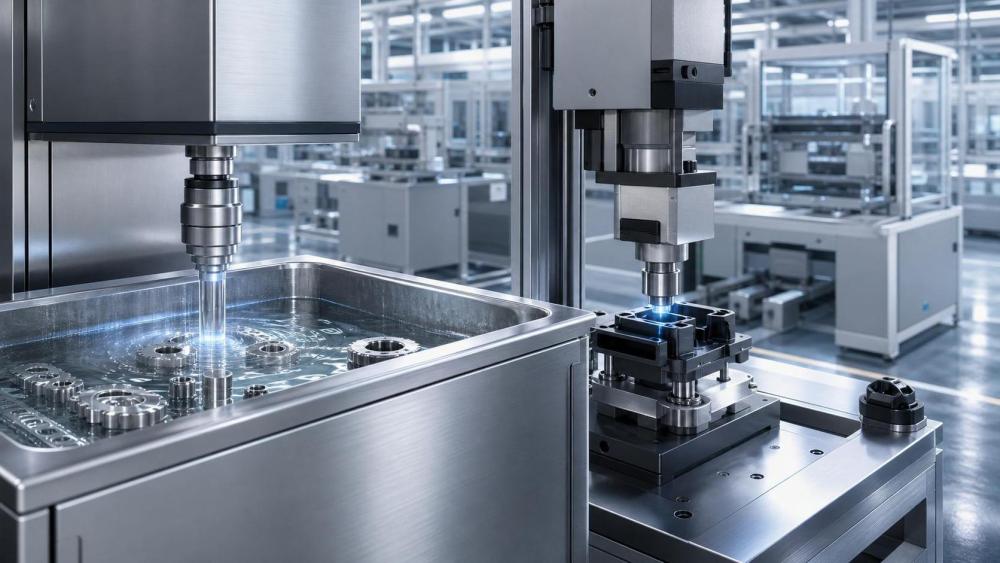
Across advanced manufacturing, auxiliary systems increasingly influence yield, compliance, and consistency. GIAS focuses on this exact reality: production quality is not shaped by primary equipment alone, but also by cleaning precision, joining stability, coding accuracy, vacuum control, and surface condition.
Ultrasonic process technology fits this broader pattern. A contaminated valve body, a weak plastic weld line, or residue trapped in a micro-channel may not be visible at first. Still, each can create leakage, cosmetic defects, assembly failure, or traceability risk.
Interest is also rising because many factories need cleaner, more repeatable processes. Solvent reduction, adhesive avoidance, shorter cycle times, and better validation all make ultrasonic methods more attractive than older mechanical or chemical-only approaches.
The core principle behind ultrasonic process technology
At its simplest, ultrasonic process technology converts electrical energy into high-frequency mechanical vibration. That vibration is transferred into a liquid bath for cleaning or directly into parts for welding.
In cleaning systems, the vibration creates cavitation. Microscopic bubbles form and collapse rapidly. That energy dislodges particles, oils, polishing compounds, and other contaminants from surfaces and hard-to-reach geometries.
In welding systems, the vibration is concentrated at the joint interface. Frictional heat softens thermoplastic material locally, allowing the parts to bond without added fasteners, solvents, or adhesives.
The appeal is precision. The challenge is control. Frequency, amplitude, power density, cycle time, fixture design, liquid chemistry, and part geometry all affect the result.
Best materials and where they perform well
Material response is one of the first filters in any evaluation. Not every substrate reacts equally well, and not every contamination profile is suitable for the same setup.
Materials suited to ultrasonic cleaning
Metals usually respond very well. Stainless steel, aluminum, brass, titanium, and copper alloys are common candidates, especially when parts contain machined features, blind holes, threads, or fine channels.
Ceramics, glass, and many rigid engineering polymers can also perform well, provided the chemistry and frequency are matched to surface sensitivity. Medical instruments, semiconductor carriers, nozzles, and precision bearings often benefit from this approach.
The best cleaning outcomes usually appear when contaminants are small, stubborn, and difficult to reach mechanically. Examples include polishing residue, fine dust, machining oil, carbon deposits, and flux remnants.
Materials suited to ultrasonic welding
Ultrasonic welding works best with thermoplastics rather than thermosets. Amorphous plastics such as ABS, PC, PS, and acrylic often weld more easily because they soften over a broader temperature range.
Certain semi-crystalline materials, including PP, PE, PBT, and nylon, can also be welded successfully. However, they often require more precise joint design and process tuning because of their sharper melting behavior.
Filled materials, blends, and multilayer assemblies need closer review. Glass fiber, mineral filler, flame retardants, and moisture content can change energy transmission and bond quality.
Where the limits appear in real production
Ultrasonic process technology is highly capable, but it is not universal. Many disappointing results come from asking the process to solve a material problem, a design problem, or a contamination problem that sits outside its effective range.
Cleaning limits
Extremely delicate surfaces may suffer erosion, pitting, or finish change if cavitation intensity is too aggressive. Soft coatings, thin films, and highly polished optics need careful qualification.
Another limit involves chemistry. Ultrasound improves cleaning action, but it does not replace proper detergents, rinsing strategy, water quality, or drying. Residue removal is often a system issue, not only a tank issue.
Part loading also matters. Dense baskets, shadowed surfaces, and inconsistent placement can reduce cavitation access and create uneven cleaning outcomes.
Welding limits
Ultrasonic welding is less suitable for very large parts, highly complex energy paths, or assemblies with poor fit-up. Excessive distance from horn contact to joint can weaken energy transfer.
Material incompatibility is another common barrier. Even similar-looking plastics may not bond reliably if melt behavior or chemical compatibility differs too much.
Cosmetic sensitivity can also become a limit. Marking, flash, whitening, or deformation may be unacceptable in visible consumer or medical components unless tooling and process windows are tightly controlled.
Use cases that show real business value
The strongest use cases are rarely defined by technology alone. They are defined by a production problem that needs repeatable control, measurable cleanliness, or stable joining quality.
Precision cleaning scenarios
- Machined metal components with burr dust, oil, and trapped debris in threads or cavities.
- Medical and laboratory parts requiring validated low-residue surfaces before packaging.
- Electronic assemblies and connectors where fine contamination may affect conductivity or sealing.
- Optical, fluid-handling, or nozzle parts with microfeatures that are hard to clean manually.
Plastic joining scenarios
- Automotive interior and under-hood subcomponents needing fast cycle times and clean assembly.
- Medical disposables where adhesives may add contamination or validation concerns.
- Consumer electronics housings, filters, caps, and sensor enclosures with compact weld areas.
- Packaging-related parts where leak resistance and repeatability matter more than visible seam size.
In many of these cases, ultrasonic process technology works best alongside other auxiliary systems. Traceability may depend on laser marking after welding. Surface performance may depend on cleaning before coating. Final quality may still require weighing, inspection, or vacuum-based testing.
What to evaluate before selecting a system
Good selection starts with process evidence rather than brochure claims. A reliable assessment usually compares material behavior, defect modes, throughput targets, and validation requirements together.
Key questions for cleaning systems
- What exactly must be removed: oil, particles, oxides, carbon, flux, or mixed contamination?
- How will cleanliness be measured: visual, gravimetric, particle count, ionic test, or functional test?
- Which frequencies, chemistries, rinse stages, and drying methods fit the substrate?
- How sensitive is the part surface to cavitation intensity or handling damage?
Key questions for welding systems
- Are the resins compatible, and is moisture control required before welding?
- Does the joint design include proper energy directors, shear features, or collapse targets?
- Which outputs matter most: strength, hermeticity, cosmetics, cycle time, or dimensional stability?
- Can fixtures maintain consistent alignment under production variation?
This is where a platform like GIAS becomes useful. Cross-process comparison helps place ultrasonic process technology in context rather than viewing it as an isolated purchase decision.
A practical way to judge fit, risk, and next steps
A sound evaluation path usually begins with sample testing, but it should not end there. Trial success must connect to maintenance needs, process monitoring, utility demand, operator repeatability, and downstream quality checkpoints.
For cleaning, that means defining the contamination standard before choosing tank size or frequency. For welding, it means validating joint design before focusing on headline power ratings.
It is also worth comparing ultrasonic process technology with adjacent options. In some lines, laser marking, vacuum support, surface treatment, or automated inspection may determine whether the ultrasonic step delivers full value.
The next useful move is to build a short decision matrix. Map material type, defect risk, cleanliness or weld criteria, production volume, and compliance needs. That approach makes supplier comparison more objective and turns a promising process into a dependable one.