
Why Industrial Cleaning Engineering Starts with Context
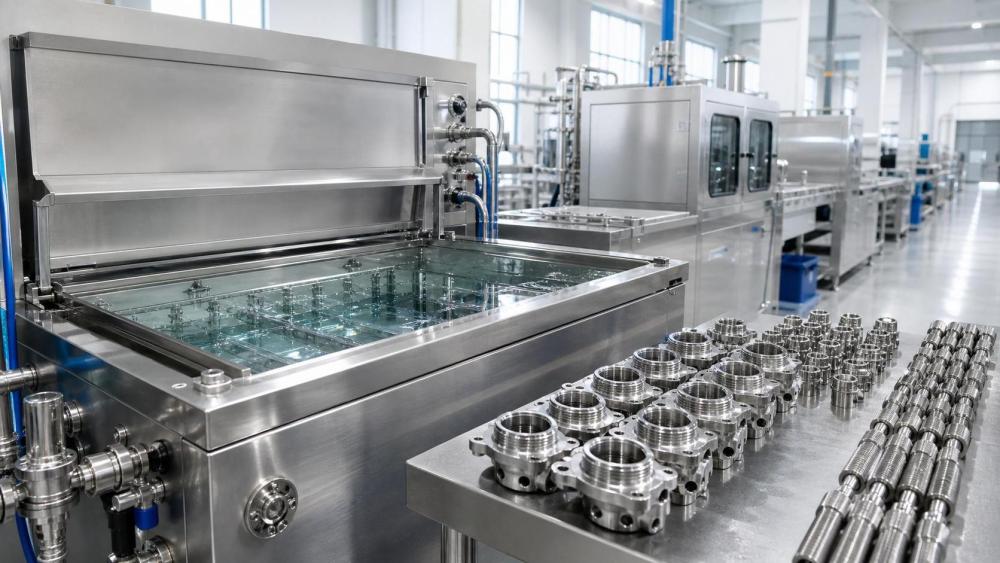
In Industrial Cleaning Engineering, ultrasonic cleaning protects more than surface appearance. It affects assembly fit, coating adhesion, leak integrity, traceable quality, and the stability of downstream processes.
That is why the same tank specification can perform very differently across precision parts. Geometry, contamination type, material sensitivity, and required cleanliness level change the real evaluation standard.
In practice, Industrial Cleaning Engineering ultrasonic cleaning is judged by what happens after washing. A part may look clean, yet still fail bonding, marking, vacuum sealing, or corrosion tests.
Across advanced manufacturing, auxiliary systems are often assessed together. Cleaning, marking, batching, vacuum handling, and surface treatment form a chain where microscopic variation becomes visible in final product quality.
This is also the logic behind GIAS content. It treats ultrasonic cleaning as part of broader process control, not as an isolated machine category with generic specifications.
The First Check Changes with the Part and the Process
Different scenarios create different risks. Fine metal components usually raise questions about embedded oil, burr dust, and oxidation residue. Medical or electronic parts often shift attention toward ionic contamination and particle redeposition.
A machined valve seat, a stamped connector, and a coated optical holder should not be evaluated with one checklist. Their contamination sources and acceptance limits are not equivalent.
A useful starting point is to identify four conditions before comparing equipment:
- What residue must be removed, including oils, abrasives, salts, polishing compounds, or flux.
- Which surfaces are hardest to clean, such as blind holes, threads, internal channels, or porous features.
- What downstream process will reveal cleaning failure, including coating, laser marking, assembly, testing, or packaging.
- How cleanliness is verified, whether by visual check, gravimetric test, particle count, conductivity, or process qualification.
Without these points, Industrial Cleaning Engineering ultrasonic cleaning can look acceptable on paper while creating instability on the line.
When Tight Geometry Drives the Decision
Precision parts with narrow channels, threaded recesses, and cross-drilled holes are a common challenge. Here, ultrasonic cleaning is valued for cavitation reach, but reach alone is not the whole story.
The more relevant question is whether the process removes trapped contaminants without pushing them deeper or redepositing them during rinse and drying.
For this kind of Industrial Cleaning Engineering ultrasonic cleaning, the check points usually include bath frequency selection, part orientation, basket density, fluid circulation, and rinse purity.
Lower frequencies may deliver stronger cavitation for heavy residues. Higher frequencies are often preferred when fine features and delicate surfaces need gentler treatment. Mixed-frequency designs can help, but only if process validation supports them.
A frequent misjudgment is focusing on generator power while ignoring loading pattern. Overpacked baskets block energy distribution and create shadow zones that no specification sheet will clearly show.
What usually matters more than nominal power
- Uniform cavitation across the working zone.
- Repeatable positioning for complex parts.
- Effective rinsing after contaminant release.
- Drying that prevents water marks and residue return.
Oils and Polishing Compounds Need a Different Evaluation
Some production lines deal less with particles and more with tenacious films. Machining oils, buffing paste, drawing lubricants, and carbonized residues do not respond to ultrasonic cleaning in the same way.
In these cases, chemistry and temperature can be as important as transducer design. A strong bath may clean faster, yet create compatibility risks for aluminum alloys, plated layers, or sensitive seals.
The practical check is not simply whether residue disappears. It is whether the selected chemistry leaves the part ready for the next operation without corrosion, discoloration, or film interference.
Industrial Cleaning Engineering ultrasonic cleaning in mixed-material environments should always confirm material compatibility, detergent carryover control, wastewater handling, and changeover discipline between product families.
Clean Enough for Assembly Is Not Always Clean Enough for Validation
A recurring issue appears when a part passes manual inspection but fails later in testing. That gap usually comes from using visual cleanliness as the main acceptance tool.
For sealing parts, sensor housings, battery components, or vacuum-related assemblies, invisible residue can still affect performance. Ionic traces, fibers, and fine particles may remain below the threshold of visual confirmation.
This is where Industrial Cleaning Engineering ultrasonic cleaning should be tied to measurable verification. Depending on the application, that may mean particle extraction, non-volatile residue testing, conductivity monitoring, or downstream functional testing.
In lines that also rely on laser marking, adhesive bonding, or electrostatic coating, cleaning quality has a visible follow-on effect. Weak marking contrast, coating defects, or unstable bond strength often point back to incomplete surface preparation.
Batch Stability Often Tells More Than Peak Cleaning Performance
A successful trial run does not always translate into stable production. In real plants, contamination load changes during shifts, operators vary loading habits, and bath chemistry ages.
That is why Industrial Cleaning Engineering ultrasonic cleaning should be reviewed as a controlled process window. The key question is not the best result achieved once, but the worst acceptable result after repeated use.
Useful checks include bath life limits, filtration effectiveness, overflow design, conductivity trends in rinse stages, dryer consistency, and preventive maintenance intervals for generators and transducers.
This perspective fits broader auxiliary system thinking. The same discipline used in industrial weighing, vacuum control, or coding traceability also applies here: process drift matters as much as nominal capability.
Signs the process window is too narrow
- Cleaning results change sharply with minor load variation.
- Rinse contamination rises early in the shift.
- Drying defects appear only on dense batches.
- Qualification passes, but routine production shows scatter.
Where Compliance and Documentation Become Part of Cleaning
Some environments require more than technical cleanliness. They also require documented repeatability, chemical control, and traceable change records.
This becomes relevant when precision parts enter regulated export chains, quality-certified production, or sectors where contamination can trigger warranty disputes and audit findings.
In these cases, Industrial Cleaning Engineering ultrasonic cleaning should be checked for parameter logging, recipe control, calibration routines, chemical handling records, and validation support documents.
The equipment itself may clean effectively, yet still create compliance risk if process evidence is weak. Documentation is not a secondary layer. For many operations, it is part of the cleaning requirement.
Common Misreads Before a System Goes Live
One common mistake is assuming similar parts share the same cleaning profile. A change in machining fluid, alloy finish, or packaging standard can alter the required process more than the drawing suggests.
Another is comparing systems only by purchase price. Industrial Cleaning Engineering ultrasonic cleaning also carries costs in chemical consumption, water quality management, maintenance access, validation effort, and rejected parts.
A third misread is evaluating the washer without considering adjacent systems. If drying is weak, if coded parts need higher surface consistency, or if coated parts need stronger adhesion, cleaning should be assessed with those links in mind.
That broader view is especially relevant in multi-process factories, where auxiliary technologies interact more than line diagrams suggest.
How to Build a Better Fit Before Final Selection
A practical next step is to build a scenario-based check sheet before confirming any Industrial Cleaning Engineering ultrasonic cleaning setup. Keep it short, but specific enough to expose process gaps early.
- Define the critical residue and the hardest-to-clean feature.
- Link cleanliness targets to downstream performance, not appearance alone.
- Test loaded baskets, not single ideal samples.
- Confirm rinse, drying, and contamination control together.
- Review maintenance, bath change timing, and verification records in advance.
When these points are clear, ultrasonic cleaning becomes easier to compare on real process value. The result is not just a cleaner part, but a more reliable production chain with fewer hidden failures.