
How Microscopic Physical Cleaning Removes Fine Debris From Precision Metal Parts
Microscopic physical cleaning for metal parts is essential when precision components must meet strict requirements for surface quality, assembly reliability, and contamination control. Fine particles, polishing residues, oils, and embedded debris can compromise coatings, welding, measurement accuracy, and downstream performance. This is especially true where a component’s functional surfaces include narrow passages, threaded holes, blind bores, sealing faces, micro-machined channels, or closely controlled bearing interfaces.
The problem is rarely that a part looks dirty. A machined aluminum housing may appear clean while retaining chips in an internal oil gallery. A stamped steel part may carry fine abrasive particles that later affect paint adhesion. A precision-turned component can pass visual inspection but release particles during final assembly, creating leakage, noise, electrical failure, or accelerated wear. For technical evaluators, the question is not simply whether a cleaning machine has enough power. It is whether the complete cleaning process can detach, transport, capture, and prevent the redeposition of contaminants at the required cleanliness level.
Cleaning at Micron Scale Is a Controlled Physical Process
Fine debris adheres to metal surfaces for different reasons. Some particles are loosely deposited after machining or handling. Others are held in place by residual coolant, oil films, static attraction, capillary forces, burrs, surface roughness, or the geometry of a recess. A cleaning process must overcome those attachment forces without damaging the substrate, altering a critical finish, driving contaminants deeper into cavities, or leaving chemistry behind.
That distinction matters because “physical cleaning” is not synonymous with aggressive cleaning. It describes the mechanical action used to dislodge contamination: cavitation, fluid shear, spray impact, turbulence, immersion agitation, rotation, air-assisted flow, or combinations of these methods. Cleaning chemistry may still be present to emulsify oils, reduce surface tension, and help wet difficult geometries. Yet chemistry alone does not reliably remove hard particulate from hidden areas. The physical component determines whether the fluid reaches the surface and applies enough localized force to release contamination.
In practice, successful microscopic cleaning has four linked stages: detachment of particles from the component, transport away from the surface, filtration or separation from the working fluid, and rinsing or drying that does not return contamination to the part. Neglect any one stage and an apparently capable process can produce inconsistent results.
Why Ultrasonic Cavitation Reaches Where Conventional Washing Does Not
Ultrasonic cleaning is widely used for parts with complex shapes because high-frequency sound energy creates alternating pressure cycles in a liquid. Under suitable conditions, microscopic vapor-filled cavities form and collapse. This phenomenon, known as cavitation, creates localized mechanical effects in the liquid near the part surface. These effects can disrupt contaminant films, loosen small particles, and improve cleaning action in corners, holes, recesses, and other areas that are difficult to reach with a direct spray.
The useful point for an evaluator is not that cavitation is powerful; it is that it is highly dependent on process conditions. Frequency influences bubble behavior and the type of cleaning action obtained. Lower ultrasonic frequencies are often associated with stronger, more forceful cavitation, while higher frequencies may be considered where finer features or more delicate surfaces require a less aggressive action. Neither approach is universally better. Material type, surface finish, contamination profile, part geometry, bath chemistry, loading density, and target cleanliness all affect the appropriate selection.
Cavitation also does not occur evenly everywhere in a tank. Part position, basket design, transducer arrangement, liquid level, degassing condition, and the presence of trapped air can change the result. A component placed in a dense stack may shadow adjacent parts. A blind bore facing upward may retain an air pocket that blocks the cleaning liquid. These are process-design issues, not minor operating details.
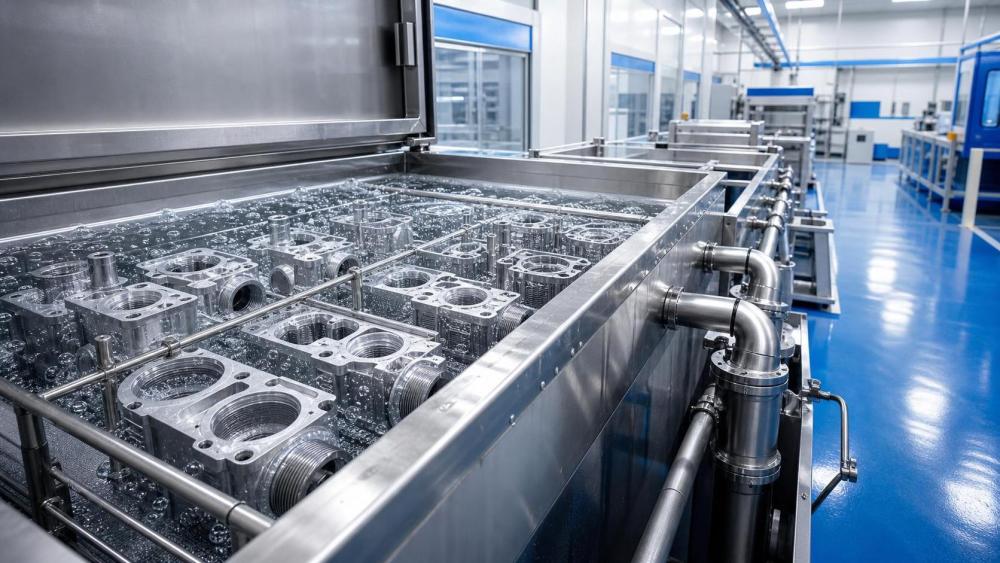
For this reason, ultrasonic equipment should be assessed as part of a system rather than as an isolated bath. The handling method, orientation fixtures, circulation path, filtration arrangement, rinse stages, and drying method often determine whether ultrasonic energy becomes a repeatable production process or merely an intermittent cleaning aid.
Other Mechanical Actions Have a Place
Ultrasonics are not the only route to microscopic physical cleaning for metal parts. High-pressure or targeted spray systems can be highly effective for accessible surfaces, large chips, and channels where directed flow can flush debris outward. Spray impingement is often easier to integrate into automated production lines, but it depends heavily on nozzle placement, pressure stability, spray angle, and the ability to drain contaminants rather than move them from one internal feature to another.
Immersion cleaning with agitation, rotation, or oscillation can improve fluid exchange around complex parts. These movements help expose new surfaces to the cleaning medium and release trapped air. In some applications, pulsed flow or alternating fill-and-drain sequences are used to improve flushing of internal passages. Mechanical brushing or abrasive methods may remove tenacious residues from robust surfaces, but they are usually unsuitable for high-cleanliness precision parts unless the risk of generating additional particles, changing roughness, or damaging edges has been carefully controlled.
The most reliable lines often combine methods. A prewash may remove bulk oil and chips; an ultrasonic stage addresses attached particulate; one or more rinses reduce chemistry carryover; and controlled drying prevents water spots, oxidation, or airborne recontamination. The sequence should reflect the actual contaminant load, not a generic equipment layout.
The Debris Must Leave the System, Not Just the Part Surface
One common mistake is to judge cleaning effectiveness solely by the first moments of particle removal. Once debris is detached, it enters the bath or rinse fluid. If it is not removed from circulation, it can settle in the tank, collect in baskets, migrate to later stages, or redeposit on parts. A cleaning process therefore needs a deliberate contamination-management strategy.
Filtration media should be selected with both particle size and fluid compatibility in mind. However, nominal filter rating alone does not describe the full result. Flow rate, filter loading, bypass behavior, pressure differential, particle shape, and the proportion of soft versus hard debris all influence capture performance. Oils can also alter filter behavior and reduce the effectiveness of a bath intended primarily for particulate control. Skimming, settling, coalescing, or oil separation may be needed where lubricant carryover is significant.
Rinse quality deserves equal attention. A dirty final rinse can erase the benefit of an effective wash stage. Conductivity, dissolved solids, bath age, fluid turnover, and the cleanliness of the part-transfer system may all matter, depending on the specification. Drying is part of the same chain: residual droplets can concentrate dissolved materials, while poorly filtered air can place particles back on a freshly cleaned surface.
How Technical Teams Define “Clean Enough”
There is no universal visual threshold for precision cleanliness. Acceptance criteria should connect contamination to component function. A hydraulic valve body, an EV battery component, a medical device part, a semiconductor-related fixture, and an automotive transmission component can all require very different particle limits, material restrictions, extraction methods, and inspection conditions.
Technical teams commonly define requirements around particle count, particle size distribution, total residual mass, particle material, nonvolatile residue, surface condition, or functional testing. In the automotive supply chain, VDA 19 and ISO 16232 are frequently referenced for technical cleanliness principles and particle-analysis methods. Their relevance should be confirmed against the customer’s current drawing, specification, and agreed validation procedure; citing a standard does not by itself establish that a cleaning process is acceptable.
A meaningful cleanliness specification should clarify more than a maximum particle size. It should identify the component area or extraction volume, the extraction method, the measurement technique, permitted particle classes where relevant, and the conditions under which the sample is handled. Otherwise, two laboratories can report different results for the same part because they used different extraction energy, fluid volume, filtration conditions, or microscopy rules.
Questions That Expose Process Risk Early
- Which contaminants are present before cleaning: loose chips, abrasive fines, carbonaceous residue, oil, salts, polishing compound, or mixed contamination?
- Where are contaminants likely to remain: cross-drilled passages, blind holes, threads, porous castings, grooves, weld seams, or contact faces?
- Can the selected fixture allow full drainage and fluid access, or does it trap air and retain particles?
- What prevents cross-contamination between dirty incoming parts and validated cleaned parts?
- How will bath condition, filter replacement, rinse quality, and verification results be monitored over a production shift?
Part Geometry Can Override Nominal Equipment Capability
A cleaning system may perform well on representative coupons and still fail on production components. Real parts introduce geometry-dependent complications: narrow slots restrict liquid exchange; complex assemblies create shadow zones; lightweight stampings can vibrate or move in the basket; and sensitive finished surfaces may be vulnerable to contact marks. In mixed-material assemblies, chemical compatibility and galvanic considerations may add further limits.
Fixtures are therefore a quality-control element. They should support the part without blocking key surfaces, allow consistent orientation, enable drainage, and prevent part-on-part contact where damage or particle transfer is possible. A good fixture is not simply a carrier. It is an engineered part of the cleaning process.
This is also why trials should use actual production geometry and realistic contamination wherever possible. A clean sample intentionally seeded with a convenient test soil may be useful for comparison, but it cannot fully represent machining residues embedded in coolant films or particles caught behind burrs after upstream operations.
Connecting Cleaning to the Rest of the Manufacturing Chain
Cleaning should not be treated as a stand-alone utility placed between machining and packing. It affects laser marking readability, coating adhesion, welding consistency, leak-test stability, dimensional inspection, vacuum processing, and final assembly. It can also be undermined by these same operations if parts are exposed to dust, cutting fluid, handling residues, or unfiltered compressed air afterward.
For example, metal surfaces intended for coating need cleaning that removes both particulate and residues that interfere with wetting. Parts entering controlled vacuum environments may require closer attention to oils and volatile residues, not only visible debris. Where permanent identification is applied after cleaning, the marking process and handling route should be reviewed for particulate generation or surface changes. Process-support technologies interact more often than production teams assume.
This broader view is central to the work covered by Global General Industrial Auxiliary Systems (GIAS). Ultrasonic cleaning, vacuum systems, laser marking, industrial batching, surface treatment, and electrostatic coating are often evaluated as separate equipment categories. On the factory floor, however, their output quality is connected. The relevant question is whether each auxiliary process preserves the condition required by the next one.
A Practical Basis for Equipment Evaluation
When comparing cleaning approaches, technical evaluators should request process evidence rather than relying on broad claims about “precision” or “deep cleaning.” Useful evidence may include a proposed cleaning sequence, part orientation concept, bath-management plan, filtration arrangement, expected inspection method, and a clear statement of assumptions about contaminant type and throughput. It is also reasonable to ask how the system handles changeover, maintenance access, fluid replacement, fault detection, and traceability of critical operating conditions.
The strongest solution is not necessarily the one with the most intense cleaning action. It is the one that consistently meets the agreed cleanliness requirement while protecting the part, controlling operating variation, and fitting the practical realities of loading, validation, maintenance, and downstream handling. Microscopic physical cleaning for metal parts succeeds when the entire route—from incoming contamination to final packaging—has been designed around the component’s actual functional risk.