
Cleanroom Cleaning Contamination Control Starts with Risk Mapping
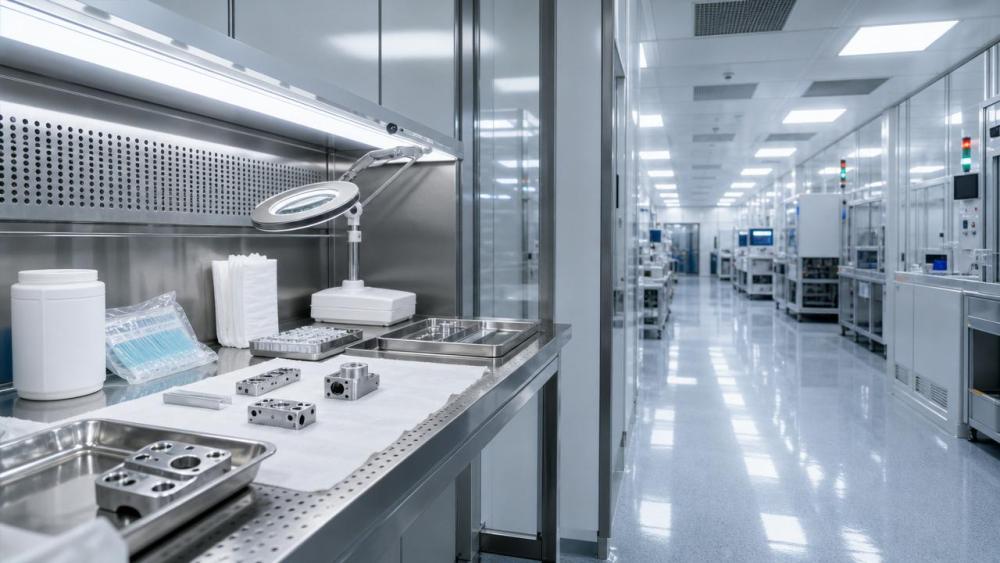
In precision manufacturing, contamination rarely begins with one dramatic failure. It usually builds through small, repeated gaps in cleaning discipline, material flow, and environmental control.
That is why cleanroom cleaning contamination control should start with risk mapping, not with random extra wiping or stronger chemicals.
When residue remains on tools, fixtures, parts, gloves, or carts, it becomes a transfer source. When particles settle on surfaces, they can enter products during assembly, filling, packaging, or inspection.
A practical cleanroom cleaning contamination control plan identifies where contaminants originate, how they move, and which process steps are most sensitive.
In actual operations, four sources appear again and again: people, materials, equipment, and cleaning methods that leave their own residue behind.
More importantly, not every area carries the same risk. Entry zones, pass-through points, wet cleaning stations, and final inspection tables often deserve tighter control than general circulation areas.
This also means contamination control decisions should follow product sensitivity. A cosmetic panel, a medical component, and a semiconductor part do not share the same tolerance.
Once the map is clear, teams can shift from reactive cleaning to preventive cleanroom cleaning contamination control that supports stable output and fewer surprises.
Control Residue Before It Becomes a Hidden Defect
Residue is tricky because it may not look serious at first. A surface can appear clean while still carrying ionic films, detergent traces, oils, or dissolved process chemicals.
These residues can affect bonding, coating adhesion, weld quality, marking readability, corrosion resistance, and downstream cleanliness verification.
Effective cleanroom cleaning contamination control depends on matching the cleaning method to the contamination type. A general wipe-down is rarely enough for mixed residues.
For example, water-based residues may need controlled rinsing and drying. Oils may require validated solvents or ultrasonic cleaning supported by residue testing.
At the same time, the cleaning agent itself can create a new risk. If it evaporates poorly or is over-concentrated, it may leave a film that causes later defects.
A stronger process usually includes these controls:
- Define residue classes by source, such as oil, flux, detergent, powder, or operator contact.
- Set approved chemistries, dilution ranges, and contact times for each class.
- Use purified water where rinse quality directly affects cleanliness results.
- Control drying to avoid watermarking, spotting, or redeposition.
- Verify cleaned surfaces through swab tests, conductivity, TOC, or application-specific methods.
From a quality perspective, residue prevention works best when cleaning parameters are treated like process settings, not housekeeping habits.
Reduce Particle Risks Through Smarter Process Discipline
Particle risk is often easier to see than residue, but harder to control consistently. Particles come from garments, packaging, paper, worn tools, moving equipment, and incoming components.
In many facilities, the bigger issue is not one dirty event. It is repeated shedding, poor transfer practice, and incorrect cleaning motion that redistributes contamination.
Good cleanroom cleaning contamination control reduces particle generation before it focuses on particle removal.
That means reviewing how operators enter, how materials are unpacked, where carts pause, and whether surface cleaning moves from clean to dirty or the other way around.
A simple discipline upgrade can make a measurable difference:
- Separate incoming materials by cleanliness status before entry.
- Remove outer packaging outside critical zones whenever possible.
- Use low-lint wipes, approved mops, and particle-controlled consumables.
- Clean from top to bottom and from cleaner zones toward dirtier zones.
- Replace worn wheels, seals, mats, and contact surfaces before they shed.
- Limit unnecessary movement near exposed product or open process stations.
Airflow matters too. If cleaning action disturbs settled particles without capturing them, the contamination simply relocates to another critical surface.
This is why cleanroom cleaning contamination control should align with HVAC behavior, pressure differentials, and recovery time after people or materials enter the room.
Build Validation into Cleanroom Cleaning Contamination Control
Cleaning is only reliable when it is verifiable. Without validation, a procedure may look complete on paper while still failing in real production conditions.
A solid cleanroom cleaning contamination control program connects each cleaning task with measurable acceptance criteria.
That could include particle counts, non-volatile residue limits, bioburden checks, visual standards, rinse quality, or product-specific performance results.
The key is to validate under realistic conditions. Test the actual tools, actual chemistries, actual operators, and actual drying sequence used in the plant.
In practice, validation is stronger when it includes worst-case conditions, such as delayed cleaning, heavy contamination load, or difficult geometries.
A useful validation framework usually covers:
- What must be cleaned and why it affects product risk.
- Which contamination types are expected at each process step.
- Which methods, tools, and consumables are approved.
- How success is measured and how often it is rechecked.
- What happens when results drift or fail acceptance limits.
This creates a traceable system, not just a cleaning routine. It also supports audits, customer inquiries, deviation handling, and cross-site process alignment.
For many manufacturers, validation is where cleanroom cleaning contamination control shifts from experience-based judgment to controlled, repeatable evidence.
Standardize People, Equipment, and Monitoring
Even strong procedures fail when people interpret them differently. Standardization closes that gap and makes contamination control less dependent on individual habits.
Training should focus on why each step matters, not only on which form to sign. Operators tend to follow controls better when defect links are visible.
Equipment also needs attention. Cleaning carts, ultrasonic systems, vacuum equipment, rinse tanks, and drying stations must stay within defined performance windows.
If a filter degrades, a nozzle pattern changes, or a tank chemistry drifts, cleanroom cleaning contamination control may weaken long before anyone notices visible fallout.
That is why ongoing monitoring should combine environmental data with process data. Looking at only one side can hide the real cause.
A practical control table helps teams respond faster:
Over time, this kind of discipline makes cleanroom cleaning contamination control easier to sustain, especially in multi-shift production.
Turn Prevention into a Daily Operating Habit
The most effective contamination strategy is not emergency cleaning after a defect spike. It is daily prevention built into movement, handling, cleaning, verification, and review.
For that reason, cleanroom cleaning contamination control should be reviewed whenever a material changes, a supplier changes, a product mix shifts, or yield starts drifting.
Recent manufacturing trends make this even more important. Smaller tolerances, tighter traceability demands, and cleaner surface requirements leave less room for invisible contamination.
A practical next move is to audit one critical process path from material entry to final pack. Track every touchpoint where residue or particles can be introduced.
Then match each risk point with one preventive action, one verification method, and one owner. That keeps the program clear and easier to maintain.
When cleanroom cleaning contamination control is tied to real product risks, it stops being a support task and becomes a direct quality safeguard.
That is usually where defect reduction, compliance confidence, and process consistency begin to improve in a way that lasts.