
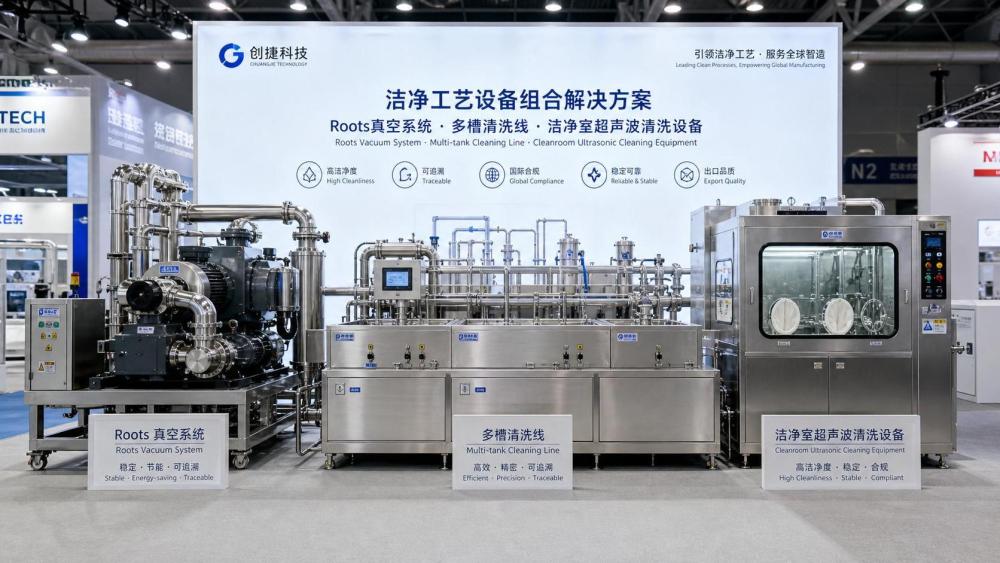
On June 22, 2026, the fourth China International Supply Chain Promotion Expo opened in Beijing’s Shunyi venue, where 676 chain-leading and specialized enterprises appeared, including a delegation of 24 manufacturers from Shanxi. The event matters beyond exhibition activity because the featured Roots vacuum systems, cleanroom ultrasonic cleaning equipment, and multi-tank wash lines were presented as industrial support systems aligned with European and U.S. GMP and ISO 14644 requirements, highlighting how export readiness in high-cleanliness and high-traceability equipment is increasingly tied to standards-based procurement, certification review, technical documentation, and delivery assurance.
What the Expo Presentation Confirms
According to the provided event information, the fourth China International Supply Chain Promotion Expo opened on June 22, 2026, at the Shunyi venue in Beijing. A total of 676 global chain-leading and specialized enterprises participated. Shanxi organized 24 enterprises to appear at the event. The group focused on presenting Roots vacuum systems, Cleanroom Ultrasonic cleaning equipment, and Multi-tank Wash Lines. These industrial auxiliary systems were described as meeting European and U.S. GMP and ISO 14644 standards, and the presentation emphasized China’s export delivery capability in process equipment requiring high cleanliness and strong traceability.
Why Standards Alignment Now Matters More Across the Chain
For export-facing equipment suppliers
Analysis shows that manufacturers offering vacuum, cleaning, and related process-support equipment may face closer scrutiny not only on product performance but also on whether their systems can be documented against GMP and ISO 14644-related expectations. The practical impact is likely to fall on technical files, validation-related materials, traceability records, and the consistency between sales claims and export delivery documents.
For buyers and project procurement teams
From an industry perspective, procurement teams sourcing high-cleanliness industrial systems may place greater weight on standards alignment during vendor screening and technical bid review. What deserves closer attention is whether supplier qualification materials, testing references, and equipment descriptions are sufficiently clear for use in tenders, internal compliance reviews, or cross-border purchasing decisions.
For certification and testing-related service providers
Observably, service providers involved in inspection, testing, certification support, or document verification may see rising demand where exporters need to demonstrate that cleanroom-related and traceability-sensitive equipment claims are substantiated. The main business effect would likely appear in document review, conformity support, and preparation for customer-side audits rather than in any single mandatory outcome confirmed by this event alone.
For delivery and after-sales coordination
Companies involved in logistics, installation support, and after-sales service should also note the signal. Where equipment is marketed on the basis of cleanliness control and traceability capability, downstream attention may increasingly extend to packaging integrity, installation records, maintenance documentation, and service response records that support the original compliance positioning of the exported system.
What Companies Should Watch in the Next Stage
Check whether standards claims are audit-ready
Analysis shows that exporters should closely review how GMP and ISO 14644 references appear in brochures, quotations, contracts, and technical submissions. If standards alignment is highlighted in market-facing materials, supporting evidence should be organized in a way that can withstand buyer review and reduce the risk of mismatch between commercial language and compliance documentation.
Prepare stronger technical and traceability files
What deserves closer attention is the quality of documents accompanying products such as vacuum systems and ultrasonic cleaning equipment. Enterprises may need to keep specifications, testing references, process descriptions, component traceability information, and delivery records in better alignment, especially where buyers use compliance-oriented procurement filters.
Track how procurement language evolves
Observably, one practical area to monitor is whether future tender documents, supplier onboarding materials, or project specifications place more explicit weight on cleanroom compatibility, traceability capability, or standards-based system descriptions. The current event does not confirm a uniform rule change, but it does suggest that these factors are gaining visibility in market access and supplier comparison.
Watch the handoff from exhibition signal to execution standard
From an industry perspective, companies should pay attention to whether the standards language seen in exhibition settings is later reflected in customer qualification steps, acceptance criteria, or post-delivery documentation requirements. At this stage, it is more prudent to treat this as a signal to strengthen readiness rather than proof of a fully settled execution framework.
How This Event Should Be Interpreted
Analysis shows that this development is better understood as an execution signal than as confirmation of a newly issued standalone rule. The prominence of equipment described as meeting European and U.S. GMP and ISO 14644 requirements suggests that export competitiveness in this segment is being framed through compliance credibility, documentation depth, and delivery reliability. At the same time, no specific new regulation, enforcement notice, or formal policy text was provided in the input, so any conclusion about uniform market-wide implementation should remain cautious.
What the Market Can Reasonably Take From It
It is more appropriate to understand this event as a visible indicator that standards-referenced process equipment is gaining importance in cross-border industrial supply discussions. For the industry, the immediate takeaway is not that a new binding regime has been fully defined, but that procurement, qualification, and delivery conversations may increasingly revolve around cleanliness control, traceability support, and evidence-backed compliance positioning. Further market feedback will be necessary before treating this as a settled shift in execution practice.
Basis of This Article and What Still Needs Verification
This article is generated from the user-provided news title, event date, and event summary. For events of this kind, relevant source types usually include official expo announcements, regulator or trade authority releases, customs or trade administration information, industry association updates, standards organization documents, and reporting by authoritative media. No specific official source link was provided in the input, so the exact official reference chain remains to be verified. Observably, follow-up attention should remain on later policy detail, certification interpretation, tender document changes, industry feedback, and how enterprises translate exhibition-stage standards claims into actual export execution.