
In precision production, hidden contamination often causes visible failure later. Residues lodged in blind holes can disturb fit, sealing, bonding, coating, conductivity, and traceable quality verification.
That is why blind-hole contaminant removal ultrasonic processes matter across advanced manufacturing. They target particles, oils, polishing compounds, and trapped films that ordinary spraying or immersion may leave behind.
For operations focused on consistency, the issue is not only whether a part looks clean. The real question is whether narrow internal features are cleaned deeply, repeatedly, and without damaging precision surfaces.
Why blind holes create a different cleaning problem
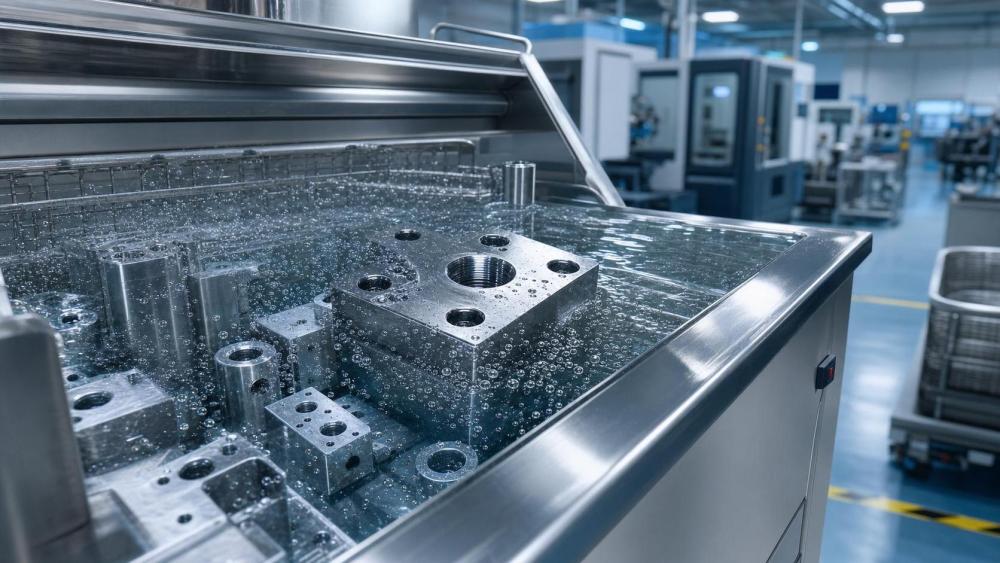
A blind hole is enclosed at one end. That geometry restricts fluid exchange and can trap air, machining debris, coolant, rust inhibitor, and fine abrasive residue.
In many parts, contamination is not evenly distributed. It settles at the bottom radius, clings to sidewalls, or packs into small diameter features after drilling, honing, or threading.
This is where blind-hole contaminant removal ultrasonic technology stands out. Cavitation and fluid movement can reach recessed features more effectively than manual wiping, pressure rinsing, or basic tank soaking.
The process is especially relevant when cleanliness links directly to downstream quality. In sectors tracked by GIAS, microscopic process control often determines whether a finished product meets yield, safety, and compliance targets.
What effective ultrasonic cleaning really depends on
Blind-hole contaminant removal ultrasonic performance is shaped by several interacting variables. Looking at power alone gives an incomplete picture and often leads to poor equipment comparisons.
Frequency
Lower frequencies generate larger cavitation bubbles and stronger implosion energy. They remove stubborn soils well, but may be too aggressive for delicate finishes or fragile micro-features.
Higher frequencies create finer cavitation. That usually improves access to small blind holes and reduces surface risk, though removal of heavy residues may become slower.
Power density and uniformity
Adequate power is necessary to break contaminant adhesion and refresh liquid inside the cavity. Yet uneven tank energy can leave some parts overcleaned and others still contaminated.
Uniform acoustic distribution matters more when parts are densely loaded. Blind holes facing different directions can receive very different cleaning intensity in the same batch.
Degassing and wetting
Air trapped in a blind hole blocks cavitation. A well-degassed bath and suitable wetting chemistry help liquid displace air and contact the full internal surface.
This point is often underestimated during trials. A process may seem effective on open surfaces while internal cavities remain partially shielded by residual gas pockets.
Temperature, chemistry, and time
Heat lowers viscosity and can improve detergent activity. The correct range depends on the soil type, substrate, coating sensitivity, and whether the residue is oil-based, particulate, or oxidized.
Cycle time should be set by cleanliness results, not by habit. Longer exposure does not always improve blind-hole contaminant removal ultrasonic outcomes, especially when redeposition begins.
Parameters worth comparing during technical evaluation
A useful evaluation framework connects cleaning physics to production reality. The table below highlights the parameters that usually deserve closer scrutiny.
This kind of structured comparison aligns with the GIAS approach. Auxiliary systems are best judged by measurable effects on process quality, not by headline specifications alone.
Where blind-hole contaminant removal ultrasonic brings the most value
The strongest value appears in components where internal cleanliness influences function, traceability, or later surface treatment. Several sectors show this clearly.
- Machined metal parts with drilled oil passages, threads, and sealing recesses
- Medical and laboratory components requiring low residue in hidden features
- Electronics and precision assemblies with small cavities before coating or bonding
- Automotive and aerospace parts where particles can affect flow, wear, or fatigue
- Battery and energy components needing controlled cleanliness before joining or finishing
In these environments, blind-hole contaminant removal ultrasonic processing is not an isolated cleaning step. It supports stable coating adhesion, reliable marking readability, assembly repeatability, and lower reject rates.
That broader process perspective matters. GIAS regularly frames auxiliary equipment as interconnected quality enablers, and ultrasonic cleaning fits that logic closely.
Common mistakes in trials and line transfer
Many cleaning trials look successful because they use simple coupons or lightly contaminated samples. Production parts often behave differently once geometry, load density, and mixed soils are introduced.
One frequent mistake is testing with unrealistic orientation. A blind hole facing upward in a lab basket may release trapped air, while the same part in production holds a stable bubble.
Another problem is focusing on visual inspection only. Blind-hole contaminant removal ultrasonic results should be checked with suitable methods such as gravimetric analysis, particle extraction, fluorescence, conductivity, or endoscopic inspection.
Rinse quality is also decisive. If loosened contamination remains in the system, hidden cavities can be recontaminated before drying. In practice, rinsing often separates acceptable cleaning from dependable cleaning.
Drying must be matched to geometry as well. Residual moisture at the bottom of a blind hole can carry dissolved solids, promote corrosion, or interfere with later vacuum, coating, or assembly processes.
A practical way to judge process fit
A useful review starts with the part, not the machine. Hole diameter, depth-to-diameter ratio, base material, surface finish, and contaminant type should define the cleaning target.
Then the process window can be mapped. Frequency, chemistry, temperature, exposure time, basket design, rinsing sequence, and drying method should all be validated together.
For blind-hole contaminant removal ultrasonic decisions, the most credible evidence usually includes three layers:
- Repeatable cleanliness data from real production parts
- Documented limits for loading pattern and process stability
- Clear maintenance controls for bath condition, filtration, and transducer performance
This approach helps separate a promising demonstration from a scalable manufacturing solution. It also supports better comparison between integrated cleaning lines and stand-alone ultrasonic tanks.
What to examine next
Blind-hole contaminant removal ultrasonic technology earns attention because it addresses a small feature with large consequences. Internal cleanliness can influence yield, compliance, product life, and process credibility far beyond the cleaning station.
The next step is usually to define a measurable cleanliness requirement for the actual cavity geometry. From there, equipment capability, chemistry choice, validation method, and operating cost become easier to judge.
For teams comparing process-support systems across manufacturing lines, it is worth reviewing blind-hole contaminant removal ultrasonic performance alongside rinsing, drying, traceability, and downstream surface requirements. That wider view tends to produce better long-term decisions than a cleaning test viewed in isolation.