
What Causes the Cavitation Effect in Industrial Systems and How Can You Control It?
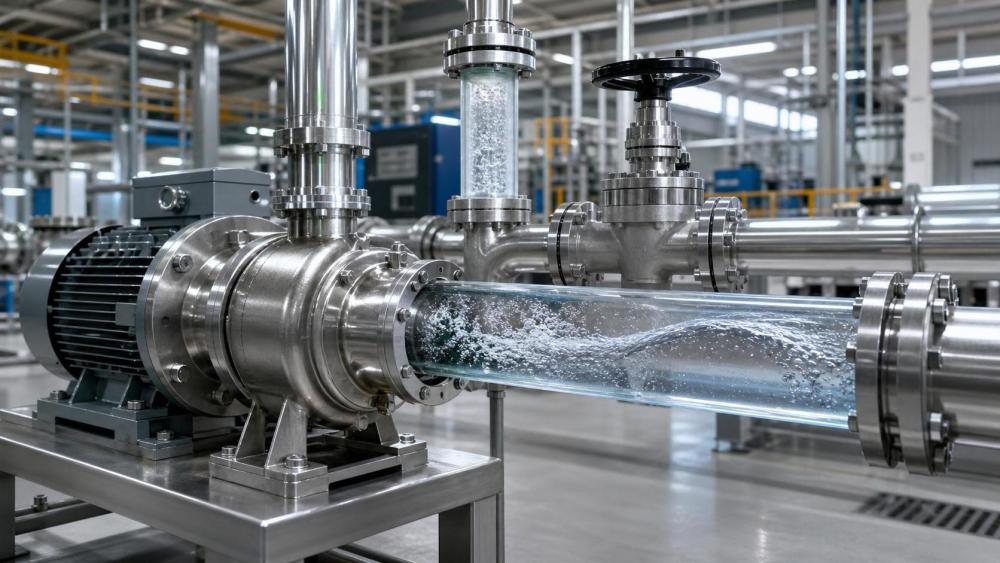
The cavitation effect can start quietly and become expensive fast.
It often appears in pumps, valves, pipelines, and liquid handling systems.
At first, the symptoms may look minor.
A little noise, some vibration, or a small drop in flow may be ignored.
Over time, the cavitation effect can erode metal, damage seals, and reduce process stability.
In advanced manufacturing, that matters more than many teams expect.
Auxiliary systems support cleaning, dosing, vacuum preparation, coating, cooling, and transfer operations.
If liquid movement becomes unstable, product quality and uptime can suffer together.
That is why the cavitation effect is not only a maintenance issue.
It is also a reliability, efficiency, and risk evaluation issue.
What the Cavitation Effect Really Means
The cavitation effect happens when local liquid pressure drops below vapor pressure.
Small vapor bubbles form in low-pressure zones inside the system.
When pressure rises again, those bubbles collapse violently.
That collapse releases shock energy against nearby surfaces.
This is the destructive part of the cavitation effect.
The result can include pitting, surface fatigue, and material loss.
The impeller inlet is a common damage point.
Valve trims, elbows, and narrow restrictions can also be affected.
The cavitation effect is most often discussed in pumps.
Still, any liquid system with pressure changes can face the same mechanism.
Main Causes of the Cavitation Effect in Industrial Systems
The root cause is simple.
Pressure becomes too low at a critical point in the liquid path.
In practice, several conditions create that pressure drop.
Insufficient NPSH Available
This is one of the most common technical triggers.
If net positive suction head available is too low, the cavitation effect becomes likely.
The pump needs more inlet energy than the system can provide.
Long suction lines, clogged strainers, and undersized pipes make this worse.
High Liquid Temperature
Warmer liquids have higher vapor pressure.
That means bubble formation starts more easily.
Hot water loops, chemical baths, and wash systems need close attention.
Excessive Flow Demand
Running beyond design flow can pull pressure down at the inlet.
This often happens after process expansion or control changes.
The cavitation effect then appears because the hydraulic balance has shifted.
Poor Suction Piping Design
Sharp elbows near the pump inlet create turbulence and losses.
Air pockets, high points, and poor line routing also increase risk.
In many plants, the cavitation effect starts with layout compromises.
Valve Restrictions and Control Instability
Partially closed valves can create localized low-pressure zones.
Control valves are especially sensitive at high differential pressure.
Here, the cavitation effect may damage trims before larger failures appear.
Entrained Gas or Poor Priming
Air leaks on suction lines can confuse diagnosis.
Gas entrainment is not always cavitation, but the symptoms can overlap.
Poor priming can also create unstable flow and repeated bubble collapse.
How to Recognize the Cavitation Effect Early
Early detection saves parts, energy, and downtime.
The problem is that the cavitation effect is often mistaken for something else.
A practical inspection routine should include these signals.
- A crackling or gravel-like sound near the pump or valve.
- Unusual vibration, especially during load changes.
- Flow instability or lower than expected discharge performance.
- Rising maintenance frequency on impellers, seals, and bearings.
- Visible pitting on metal surfaces during teardown.
- Unexpected pressure fluctuations on suction or discharge gauges.
More advanced systems may show the cavitation effect through condition monitoring trends.
That includes vibration spectra, power draw changes, and pressure profile shifts.
Why the Cavitation Effect Matters in Process Quality
The damage is not limited to pump hardware.
The cavitation effect can disturb the process itself.
In industrial cleaning, unstable circulation can reduce cleaning precision.
In coating lines, uneven liquid delivery can affect finish quality.
In batching or dosing systems, pressure variation can hurt recipe consistency.
In vacuum support systems, upstream liquid instability may affect overall performance.
This also changes how equipment should be evaluated.
The cavitation effect is a process reliability issue, not just a component issue.
Practical Ways to Control the Cavitation Effect
Control starts with system design, then continues with operation and maintenance.
The most effective actions are usually straightforward.
- Increase suction pressure where possible.
- Reduce suction line losses by enlarging pipe size or shortening the route.
- Keep strainers, filters, and inlets clean.
- Lower fluid temperature if the process allows it.
- Operate closer to the pump best efficiency point.
- Review valve positioning and avoid unnecessary throttling.
- Use pumps designed for the actual duty, not only the nominal duty.
- Select cavitation-resistant materials for severe services.
When the cavitation effect is already visible, design correction is often better than repeated repair.
That may mean changing impeller diameter, speed, piping geometry, or control logic.
What to Check During Technical Evaluation
A good review should test whether the system can resist the cavitation effect under real operating conditions.
Supplier documents often show ideal performance.
The stronger signal comes from application detail.
- Required NPSH versus available NPSH at actual temperature.
- Fluid properties, including vapor pressure, viscosity, and solids content.
- Expected operating range, not only the design point.
- Suction piping layout, fittings, and elevation conditions.
- Valve strategy and control response during startup and load changes.
- Historical failure records from similar industrial systems.
If the cavitation effect risk is high, request a more detailed hydraulic review.
That is especially important in coating, cleaning, batching, and thermal process systems.
A Simple Decision Framework for Cavitation Effect Control
For day-to-day decisions, a short framework helps.
- Confirm the symptom using sound, vibration, and pressure data.
- Separate cavitation effect signs from air entrainment or mechanical imbalance.
- Calculate whether suction conditions meet real duty requirements.
- Identify whether the problem is operational or structural.
- Correct the pressure condition before replacing parts repeatedly.
- Track results after changes to verify that the cavitation effect is controlled.
This approach keeps the response practical and measurable.
Conclusion
The cavitation effect starts with pressure imbalance, but its consequences spread across the entire process.
It reduces efficiency, shortens component life, and weakens production consistency.
The good news is that the cavitation effect is usually controllable.
Better suction conditions, sound hydraulic design, and realistic operating reviews make the biggest difference.
When evaluating industrial systems, treat cavitation risk as a core reliability indicator.
That perspective leads to better equipment choices, lower lifecycle cost, and more stable manufacturing performance.