
Why do Industrial Auxiliary Technology traceability systems matter so much now?
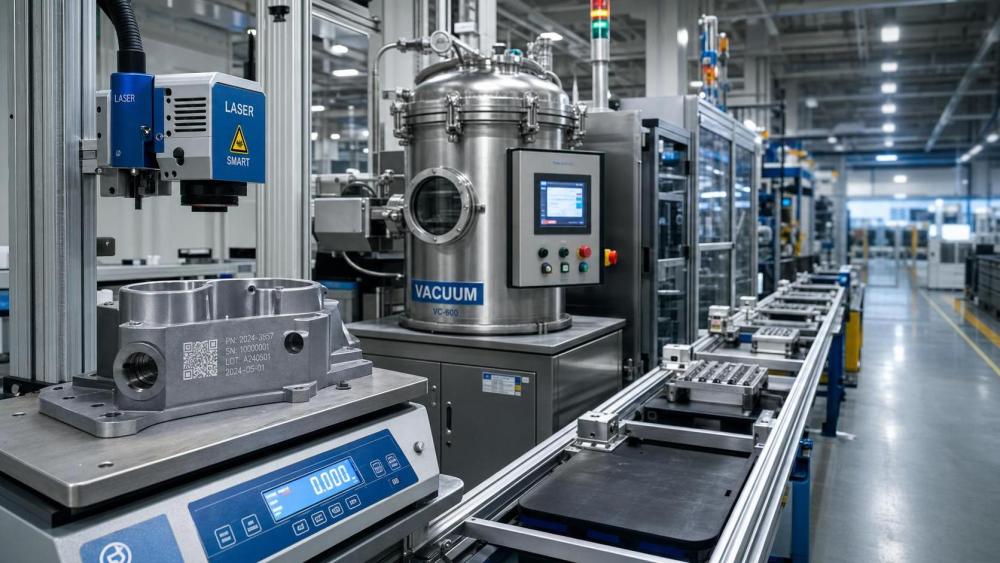
Industrial production is no longer judged only by output speed.
It is judged by proof.
Factories need to show what was made, how it was processed, which settings were used, and whether each step met control standards.
That is where Industrial Auxiliary Technology traceability systems become important.
In simple terms, these systems connect product identity with process evidence.
They link codes, marks, batch data, cleaning records, weighing values, vacuum conditions, coating results, and inspection history.
The result is not just better documentation.
It is stronger control over quality consistency, compliance exposure, rework costs, and product accountability.
This matters across advanced manufacturing.
Laser marking and inkjet coding support permanent identification.
Ultrasonic cleaning supports cleanliness verification for precision parts.
Industrial weighing and batching confirm recipe accuracy.
Vacuum systems help record stable processing conditions.
Surface treatment and electrostatic coating add measurable protection and finish data.
Platforms such as GIAS have made this easier to understand by organizing auxiliary system knowledge around real process outcomes, not just equipment names.
What exactly do these traceability systems record?
A common misunderstanding is that traceability starts and ends with a serial number.
In practice, Industrial Auxiliary Technology traceability systems are broader.
They usually combine identification, process status, operator actions, equipment parameters, and quality checkpoints.
For example, a laser-marked component may carry a code tied to:
- production date and batch number
- material source or formulation record
- weighing and batching values
- ultrasonic cleaning cycle confirmation
- vacuum pressure range during processing
- coating thickness or curing conditions
- final inspection status and release history
This is why the system is useful even when the auxiliary equipment is not the main machine.
Auxiliary steps often decide whether the final product is clean enough, stable enough, readable enough, or compliant enough.
A useful way to read the topic is to separate “identity data” from “process data.”
Identity data tells you which unit is which.
Process data tells you whether it was made under acceptable conditions.
Without both, traceability stays shallow.
A quick judgment table helps clarify the difference
Which manufacturing situations benefit most from Industrial Auxiliary Technology traceability systems?
The strongest use cases appear where product failure is expensive, hard to detect, or highly regulated.
That includes sectors with strict cleanliness, dosing, sealing, surface durability, or identification requirements.
In electronics and semiconductor-related work, vacuum conditions and contamination control often need documented stability.
In food, pharmaceuticals, and chemicals, weighing and batching data is often central to quality release.
In automotive and industrial parts, readable codes and reliable surface treatment can determine warranty handling later.
Anti-counterfeit protection is another common driver.
If a product must be authenticated in distribution, identification technology becomes part of traceability, not just packaging.
More broadly, these systems help when production includes multiple suppliers, multiple shifts, or multiple export markets.
The more handoffs involved, the more valuable connected records become.
This is one reason industry portals like GIAS focus on auxiliary technologies as decision-critical infrastructure.
They shape consistency behind the scenes.
How are these systems different from ordinary production tracking?
Ordinary tracking often answers a scheduling question.
Where is the order, and has it moved to the next step?
Industrial Auxiliary Technology traceability systems answer a quality question.
What happened to the product, under what conditions, and can that evidence be verified later?
That difference matters during complaints, recalls, audits, and root-cause investigation.
A tracking system may show that a batch passed through cleaning.
A traceability system should show the cleaning cycle, time, settings, and link to the exact product group.
The same logic applies to weighing, marking, coating, and vacuum-based steps.
So the practical difference is depth.
Tracking is about movement.
Traceability is about defensible evidence.
When companies compare systems, this distinction is worth checking early.
Many tools can print a code.
Far fewer can connect that code to usable process intelligence.
What should be checked before choosing or implementing one?
Selection usually fails when the project starts with software features instead of traceability logic.
The first question is not which dashboard looks better.
It is which process events must be captured without gaps.
A solid evaluation normally includes these points:
- Which auxiliary steps create quality-critical evidence?
- Is the product ID permanent, readable, and resistant to wear?
- Can weighing, cleaning, vacuum, or coating data be linked automatically?
- How long must records be stored for audit or claim handling?
- Can the system support multiple plants, lines, or export rules?
- What happens when equipment is offline or data capture is interrupted?
Integration is usually the hidden cost.
Marking equipment, coding devices, scales, vacuum sensors, and coating controls often come from different vendors.
If those systems do not speak the same language, traceability becomes fragmented.
That is why application-based comparisons are more useful than feature lists alone.
Sources that map technology to process reality, such as GIAS, are especially useful at this stage.
Where do projects usually go wrong?
The most common mistake is assuming that more data automatically means better traceability.
It does not.
If records are inconsistent, unreadable, or disconnected from the product identifier, the system becomes difficult to trust.
Another weak point is poor marking quality.
If a code fades after coating, cleaning, transport, or field use, the traceability chain breaks at the worst possible time.
There is also a process risk.
Some teams record final inspection but ignore earlier auxiliary conditions that caused the defect.
That makes root-cause analysis slower and less accurate.
A better approach is to define “must-have evidence” before rollout.
For one line, that may be batching accuracy and marking permanence.
For another, it may be cleanliness validation and vacuum stability.
Industrial Auxiliary Technology traceability systems work best when the data model follows the real failure risks.
So what is the practical value in everyday manufacturing?
The practical value is clarity under pressure.
When a defect appears, the system should help narrow the cause quickly.
When an audit happens, it should provide evidence without manual reconstruction.
When products move across regions, it should support consistent records and easier compliance review.
That is why Industrial Auxiliary Technology traceability systems are used for more than recordkeeping.
They support quality discipline across cleaning, coding, weighing, vacuum processing, and surface protection.
They also make technical decisions easier to compare, because process evidence becomes visible instead of assumed.
A sensible next step is to map one product family from identification to final release.
List every auxiliary step that can change quality, compliance, or product authenticity.
Then check whether each step creates a reliable record, whether that record is linked to the product ID, and whether it can be retrieved when needed.
That exercise usually shows where traceability is strong, where it is only partial, and which auxiliary technologies deserve closer evaluation next.