
A vacuum system rarely fails because of a single bad component. It usually underperforms because sizing assumptions were too optimistic, conductance was ignored, or piping layout worked against the pump. In advanced manufacturing, that gap matters. Vacuum stability affects coating uniformity, drying speed, package integrity, degassing quality, and process repeatability across many auxiliary systems.
That is why vacuum system design deserves careful review early, before equipment is released, purchased, or integrated. The practical question is not only how much pumping speed a catalog shows, but how much effective speed actually reaches the chamber under real operating conditions.
Why vacuum system design has become a closer evaluation point
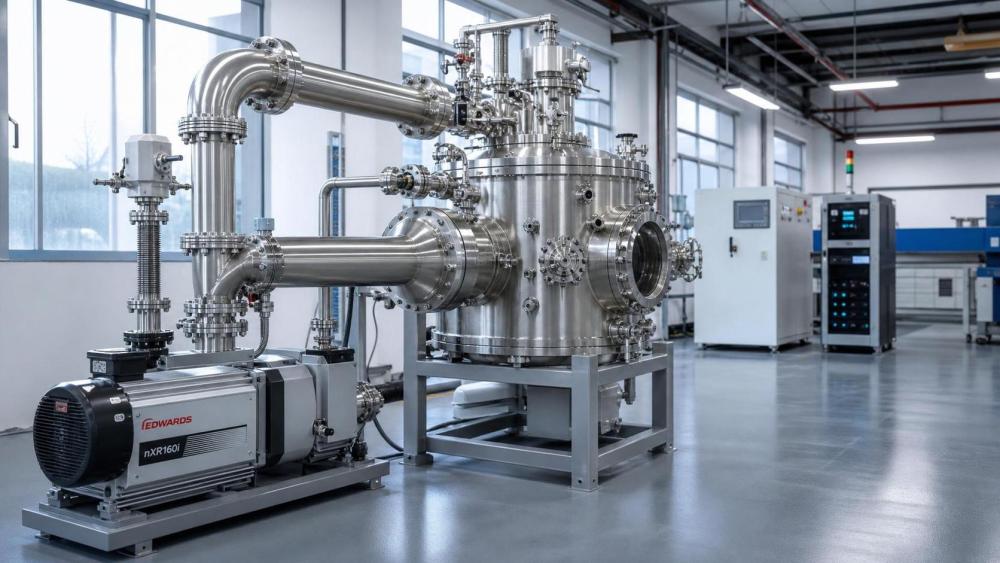
Across semiconductor support, packaging, freeze-drying, surface treatment, and precision coating, process windows have narrowed. Throughput targets are higher, contamination tolerance is lower, and energy use is under more scrutiny.
Vacuum equipment now sits inside a broader quality chain. GIAS often highlights this wider pattern across industrial auxiliary systems: small process variables influence final product performance more than many line managers expect.
In that context, vacuum system design is not an isolated mechanical exercise. It affects traceability, compliance, coating performance, cleaning precision, and long-term production consistency. Poor sizing can create unstable cycle times, difficult maintenance, and uneven product quality.
The core idea: installed pump speed is not delivered pump speed
The starting point is simple. A pump may be rated at a certain speed, yet the chamber sees less because gas must travel through valves, fittings, elbows, filters, traps, and piping restrictions.
This is where conductance enters the picture. Conductance describes how easily gas flows through the connection between the chamber and the pump. Lower conductance means lower effective pumping speed at the chamber.
A useful relationship is often expressed this way: effective speed depends on both pump speed and line conductance. If either one is too small, system performance drops. Adding a larger pump alone may not solve the problem.
That is one of the most common vacuum system design mistakes in industrial projects. The specification looks strong on paper, but the installed layout creates pressure loss and slow pump-down behavior.
What should be sized first
Good vacuum system design begins with the process, not the pump model. Before comparing hardware, the operating target must be defined in business terms and technical terms.
Pressure range and base pressure
A packaging chamber, a coating line, and a degassing tank do not need the same pressure range. Required pressure level determines pump technology, sealing approach, materials, and acceptable leakage rate.
Pump-down time
Cycle time matters as much as final pressure. A system that eventually reaches target vacuum may still be unsuitable if it delays throughput or creates unstable takt time.
Gas load during operation
Static empty-chamber calculations are not enough. Real systems see outgassing, moisture, vapor, leaks, process gas inflow, and load-dependent releases from products or fixtures.
Process sensitivity
Some applications tolerate pressure fluctuation. Others do not. Thin-film coating, semiconductor support, and certain drying steps can be highly sensitive to even moderate instability.
How to think about pump sizing without oversimplifying
Pump selection in vacuum system design should match both pressure regime and gas composition. A dry screw pump may fit one process well, while a liquid ring pump or roots booster combination may fit another.
The right question is not, “Which pump is strongest?” It is, “Which pump maintains required pressure, under expected gas load, within the required time, and with manageable operating cost?”
This becomes especially important in systems exposed to solvent vapor, condensable moisture, particulates, or corrosive gases. Nominal speed alone says little about durability or service interval under those conditions.
- Check the real operating pressure range, not only ultimate vacuum.
- Review pump performance curves at the pressure where the process actually runs.
- Include startup load, upset conditions, and cleaning cycles.
- Confirm compatibility with vapor, dust, and chemical exposure.
- Estimate maintenance burden together with energy demand.
Piping layout can quietly decide the result
In many installations, piping has more influence than expected. Long lines, small diameters, frequent elbows, unnecessary reducers, and restrictive valves all reduce conductance.
For that reason, vacuum system design should treat pipework as part of the pumping system, not as secondary hardware added after the pump is chosen.
Diameter usually matters more than minor speed upgrades
A wider, shorter line can improve chamber performance more than moving to a slightly larger pump. This is often the most cost-effective correction in underperforming systems.
Layout should support flow, drainage, and service access
Vapor-heavy processes need attention to condensation and liquid accumulation. Poor routing can create contamination traps, unstable pressure, or difficult maintenance shutdowns.
Well-considered routing also supports inspection and troubleshooting. When sensors, valves, traps, and isolation points are hard to access, system reliability falls over time.
Where conductance becomes a practical business issue
Conductance is sometimes treated as a specialist calculation, but its business impact is straightforward. Lower conductance extends evacuation time, reduces usable pump capacity, and increases variation from batch to batch.
That can affect coating adhesion, drying consistency, package seal quality, or degassing effectiveness. In sectors that depend on process traceability and repeatable quality, these shifts become cost issues, not only engineering issues.
This is one reason GIAS frames vacuum performance alongside other auxiliary technologies. Precise control at the support-system level often determines whether the main process stays within specification.
Typical application differences worth separating early
Not every vacuum system design should be judged by the same criteria. The intended process changes what “good design” means.
A practical review checklist before approval or purchase
A useful vacuum system design review does not need to be overly theoretical. It needs to test whether the proposed configuration reflects actual operating conditions.
- Compare chamber volume, gas load, and target pressure against required cycle time.
- Ask for effective pumping speed at the chamber, not only pump nameplate speed.
- Review piping diameter, total line length, elbows, valves, and filters.
- Check whether booster stages or buffer volumes are justified by process behavior.
- Confirm instrumentation points for pressure measurement and troubleshooting.
- Look at maintenance access, contamination management, and spare parts logic.
- Validate assumptions with test data where the process is high-risk.
When those points are documented clearly, vacuum system design becomes easier to compare across suppliers and easier to defend during technical review.
What to do next with a vacuum system design decision
A strong decision usually starts with a clean demand profile: target pressure, gas load, cycle time, process sensitivity, contamination risk, and layout constraints. From there, pump sizing and conductance checks become much more meaningful.
For projects moving from concept to sourcing, it helps to compare proposals on chamber-side performance, not catalog claims alone. For existing lines, the first improvement step is often a conductance review of piping and restrictions before replacing major equipment.
That approach fits the wider logic behind GIAS coverage of industrial auxiliary systems: process quality is usually won or lost in the supporting details. Vacuum system design is one of those details that deserves direct, quantified evaluation before it becomes an operating problem.