
The vacuum process for degassing removes trapped air, dissolved gases, moisture, and light volatiles from liquids, pastes, polymers, and porous materials. In production, that matters because small bubbles rarely stay small. They turn into coating pinholes, weak bonds, unstable batches, and visible surface defects.
Across advanced manufacturing, degassing under vacuum is less about spectacle and more about control. It supports cleaner reactions, steadier material behavior, and more predictable quality, which is why it continues to attract attention in sectors where microscopic defects create expensive downstream problems.
Why vacuum degassing remains a practical quality tool
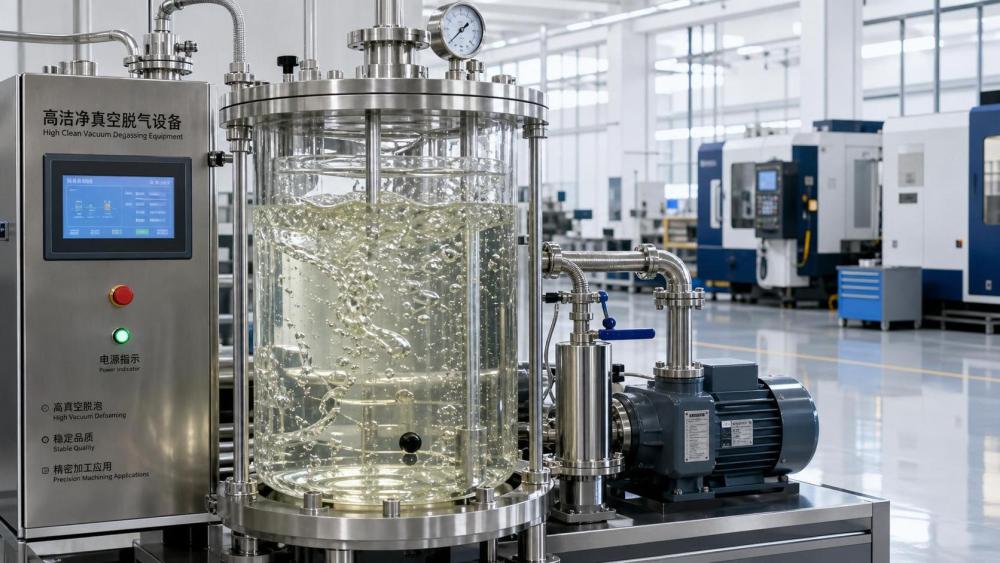
A vacuum process for degassing works by lowering pressure around a material. When pressure drops, dissolved or trapped gases expand, separate, and escape more easily. Moisture and volatile residues may also evaporate faster, depending on temperature and material chemistry.
That simple principle shows up in many industrial settings. It supports resin preparation, battery slurry mixing, coating formulation, adhesive conditioning, oil purification, pharmaceutical processing, food packaging, and vacuum-assisted casting.
The wider relevance is easy to see on platforms such as GIAS, where auxiliary systems are evaluated not by visibility on the production line, but by their effect on traceability, consistency, cleanliness, and final product reliability.
What actually happens during the vacuum process for degassing
In most setups, the material enters a sealed chamber or vessel connected to a vacuum pump. Pressure falls to a defined level. Bubbles nucleate, grow, rise, and break at the surface. The chamber may include mixing, heating, or staged pressure control.
The exact response depends on viscosity, temperature, surface tension, solids content, and gas solubility. Thin liquids release gas quickly. Heavy compounds may foam first, then clear more slowly. Sensitive formulations often need gradual pressure reduction to avoid overflow or material damage.
In practical terms, a successful vacuum process for degassing is not defined by the lowest possible pressure. It is defined by the right balance between vacuum level, dwell time, temperature, agitation, and throughput.
Core equipment elements
System design influences results as much as pump capacity. Even a strong pump can underperform if the chamber leaks, the seals degrade, or vapor loads exceed system tolerance.
- Vacuum pump and control valves determine pressure stability and cycle repeatability.
- Chamber geometry affects foam expansion, bubble travel distance, and cleaning access.
- Heating jackets or temperature control shorten degassing time for viscous materials.
- Mixing systems help expose trapped gas, but too much shear can create new bubbles.
- Condensers or traps protect pumps when moisture or solvents are present.
Where product quality improves most clearly
The value of the vacuum process for degassing becomes visible when defects are otherwise hard to explain. A product may pass dimensional checks yet still fail because gas remained in the material or process stream.
These gains are rarely isolated. Better degassing often improves coating adhesion, process cleanliness, and filling accuracy at the same time. That is why auxiliary systems are frequently reviewed together rather than as separate purchases.
When the process makes the biggest business difference
Not every material needs aggressive vacuum treatment. The strongest case appears when defects are expensive, rework is limited, or quality must remain stable across long production runs.
This is especially relevant for precision coatings, electronics packaging, medical components, optical materials, specialty chemicals, and high-value composites. In these areas, one hidden bubble can affect insulation, appearance, mechanical strength, or long-term performance.
A vacuum process for degassing also becomes more valuable when upstream steps introduce air. High-speed mixing, pumping, recirculation, and manual transfer all increase the chance of entrainment. Degassing then acts as a corrective stage before coating, dispensing, curing, or sealing.
Signals that suggest degassing should be reviewed
- Repeated pinholes or bubbles after coating or potting.
- Measured batch viscosity changes without clear formulation shifts.
- Irregular dispensing, splashing, or bead interruption.
- Unexpected reject rates after curing, drying, or sealing.
- Frequent complaints tied to appearance or internal voids.
How to judge the right setup instead of chasing deeper vacuum
The common mistake is assuming deeper vacuum always means better degassing. In reality, process fit matters more than headline numbers. A material that foams excessively under rapid pressure drop may lose consistency or contaminate the chamber.
A useful evaluation starts with the material itself. Is the issue dissolved gas, free air, moisture, or solvent residue? Each one changes equipment choice, cycle design, and pump protection requirements.
From there, it helps to compare process conditions in a structured way.
Why degassing should be viewed with the wider process
In many factories, the vacuum process for degassing is only one link in a larger quality chain. Upstream cleaning affects contamination levels. Mixing accuracy affects gas entrapment. Surface treatment affects adhesion. Marking and coding support traceability when defects must be tracked by lot.
That broader view explains the value of industrial intelligence platforms that connect vacuum systems with weighing, coating, cleaning, and compliance topics. A bubble problem is not always a vacuum problem alone. Sometimes it begins with formulation control, material storage, or equipment maintenance.
Seen this way, degassing is not an isolated technical trick. It is part of process discipline, especially where export quality, certification, or long-term field reliability are under review.
A practical next step for evaluation
A useful next step is to map quality defects against the exact point where air, moisture, or volatiles may enter the process. Then compare current vacuum level, hold time, temperature, and material behavior rather than focusing on equipment labels alone.
If the goal is to improve coating finish, reduce voids, or stabilize sensitive formulations, the vacuum process for degassing deserves a closer look within the full auxiliary system. Better decisions usually come from linking defect evidence, material properties, and process data before selecting or changing equipment.
That approach creates a more reliable basis for comparing solutions, setting quality targets, and deciding whether vacuum degassing is simply helpful or genuinely necessary.