
Vacuum degassing for resin is one of those quiet process steps that often determines whether a part looks clean and performs reliably. In casting, coating, potting, and encapsulation, trapped air and dissolved gas can turn into bubbles, voids, hazing, or weak spots during cure.
That matters across advanced manufacturing because resin quality is rarely judged by chemistry alone. Surface finish, dimensional stability, electrical insulation, optical clarity, and long-term consistency are all affected by how well the material is prepared before it reaches the mold, cavity, or substrate.
Within the broader world of industrial auxiliary systems, vacuum handling sits beside cleaning, marking, batching, and surface treatment as a supporting technology that shapes final product quality. For that reason, vacuum degassing for resin deserves attention well beyond niche lab use.
What vacuum degassing for resin actually does
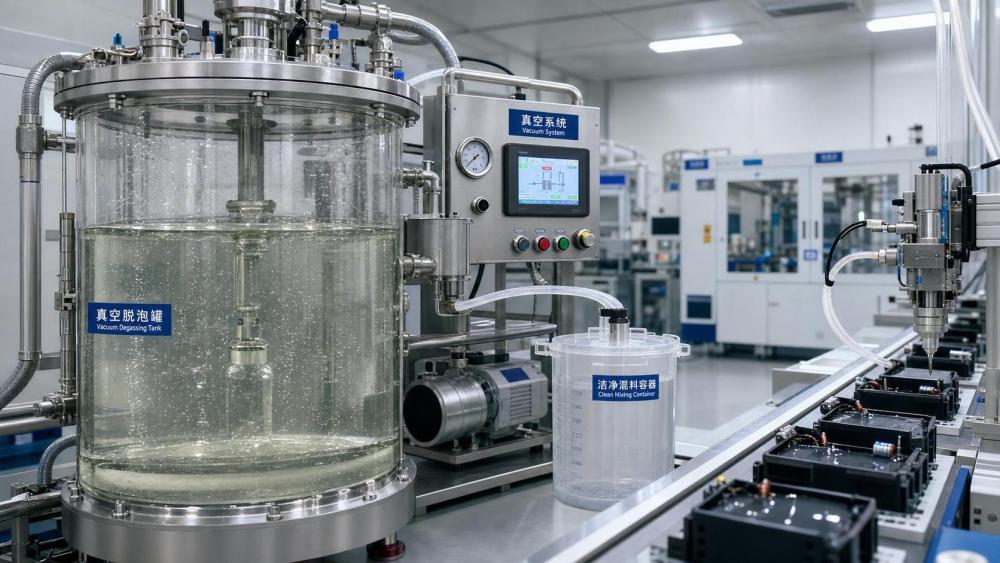
At a basic level, vacuum degassing for resin lowers the surrounding pressure so trapped air can expand, rise, and escape. It also helps remove part of the dissolved gas that may come out later during mixing, pouring, or curing.
The process sounds simple, yet the effect is highly practical. A resin that looks smooth in a mixing cup may still carry countless microbubbles. Under normal pressure, they stay hidden. Under vacuum, they swell, break, and release.
This is why vacuum degassing for resin is commonly linked to visual quality, but the real value goes further. Removing air reduces internal voids, improves wetting around inserts, and supports more predictable curing behavior.
How the sequence usually works
In most operations, resin and hardener are first measured and mixed. The mixture is then placed in a vacuum chamber. As pressure drops, the resin foams upward because the trapped gas expands.
After the foam rises and collapses, the material is held briefly at the target vacuum level. It is then returned to atmospheric pressure in a controlled way. Only after that is the resin poured, injected, or dispensed.
In some lines, the resin is degassed before mixing. In others, both components are degassed separately and again after blending. The right sequence depends on viscosity, pot life, filler loading, and production speed.
Why bubble control is getting more attention
Manufacturing quality has become more microscopic. Small defects that once seemed acceptable now affect optical appearance, sealing reliability, electrical insulation, and even traceability when marked surfaces or coated finishes must stay clear and uniform.
This shift fits the larger GIAS perspective on auxiliary systems. A production line may be built around molding, assembly, or coating, yet the supporting process controls often decide yield. Vacuum stability, accurate batching, surface cleanliness, and controlled curing now work together.
Vacuum degassing for resin becomes especially relevant when defects are costly to detect late. Once a part is cured, painted, marked, sealed, or shipped, a hidden bubble is no longer a minor cosmetic issue. It can become scrap, rework, or field failure.
Defects that often trace back to poor degassing
- Visible surface bubbles in clear castings or decorative coatings
- Internal voids in potting compounds around electronics
- Pinholes after curing, machining, or finishing
- Weak bonding at corners, edges, or around inserts
- Cloudiness that reduces optical or aesthetic quality
- Unstable dimensions caused by uneven gas release during cure
When vacuum degassing for resin prevents bubbles most effectively
Vacuum degassing is not equally critical in every resin process. Its value becomes clearer when the material, part geometry, or quality target makes bubble formation more likely or more damaging.
In these cases, vacuum degassing for resin is often less about perfection and more about risk reduction. It improves the chance that the cured part will match design expectations without hidden defects.
Limits, trade-offs, and common misunderstandings
Vacuum degassing for resin is useful, but it is not a universal fix. If bubbles are introduced during aggressive mixing, poor dispensing, or turbulent mold filling, some defects may appear after degassing is already finished.
Material behavior also matters. Very fast-curing systems may not leave enough time for a proper vacuum cycle. Highly filled compounds can foam differently, and some low-viscosity resins may reabsorb air if handling afterward is uncontrolled.
Temperature adds another layer. Warmer resin usually flows better and releases air more easily, but it may also shorten pot life. Colder resin stays thicker, which makes bubble removal harder. The process window is usually a balance, not a single setting.
A few mistakes seen in practice
- Using a chamber that is too small for foam expansion
- Pulling vacuum too quickly and causing overflow
- Releasing vacuum too fast, which can disturb the resin again
- Assuming degassing can compensate for inaccurate mix ratios
- Ignoring moisture, contamination, or poor substrate preparation
How to evaluate the process in real operations
A useful way to assess vacuum degassing for resin is to connect material behavior with the final quality requirement. Not every line needs the same depth of control, but every line benefits from clearer decision criteria.
Start by looking at the end-use standard. Is the resin expected to remain optically clear, electrically stable, structurally sound, or cosmetically uniform? The stricter the requirement, the more important degassing becomes.
Then review the process itself. Mixing method, vessel design, batch size, viscosity, vacuum level, hold time, and pour technique all influence results. Degassing should be evaluated as part of a chain, not as an isolated machine function.
Practical checkpoints worth comparing
- Foam rise behavior during vacuum pull-down
- Time needed to reach stable bubble collapse
- Repeatability across different batch sizes
- Compatibility with resin pot life and curing schedule
- Post-cure defect rate in inspection or downstream finishing
This is also where broader auxiliary system thinking becomes useful. Accurate weighing, controlled mixing, clean containers, and stable vacuum equipment work together. If one step varies, the benefit of vacuum degassing for resin may be limited.
Where this fits in supplier research and process planning
For anyone comparing process options, the question is rarely whether vacuum degassing sounds beneficial. The better question is how much control is actually needed for the target part, defect tolerance, and production volume.
A small prototype workflow may only need a basic chamber and disciplined handling. A production environment may require integrated vacuum systems, repeatable recipes, and validation against inspection data. The equipment choice follows the process need, not the other way around.
That evaluation approach aligns with how GIAS presents industrial support technologies: not as isolated products, but as quality-enabling systems. Vacuum degassing for resin is most useful when reviewed alongside mixing accuracy, cleaning standards, coating demands, and final application risk.
A sensible next step is to map where bubbles appear, when they appear, and what they cost. From there, it becomes easier to compare resin behavior, vacuum parameters, chamber capacity, and handling methods with a more reliable technical baseline.