
Comparing a vacuum degassing machine with traditional degassing methods starts with a simple question: is air removal the only goal, or is stable production the real target?
In many industrial processes, trapped gas affects appearance, bonding strength, filling accuracy, coating quality, and downstream reliability.
That is why the choice matters across advanced manufacturing, where auxiliary systems often determine whether a process remains repeatable under commercial pressure.
For evaluation work, the better comparison is not modern versus old. It is controlled performance versus acceptable variability, measured across cost, risk, and product quality.
What the comparison really involves
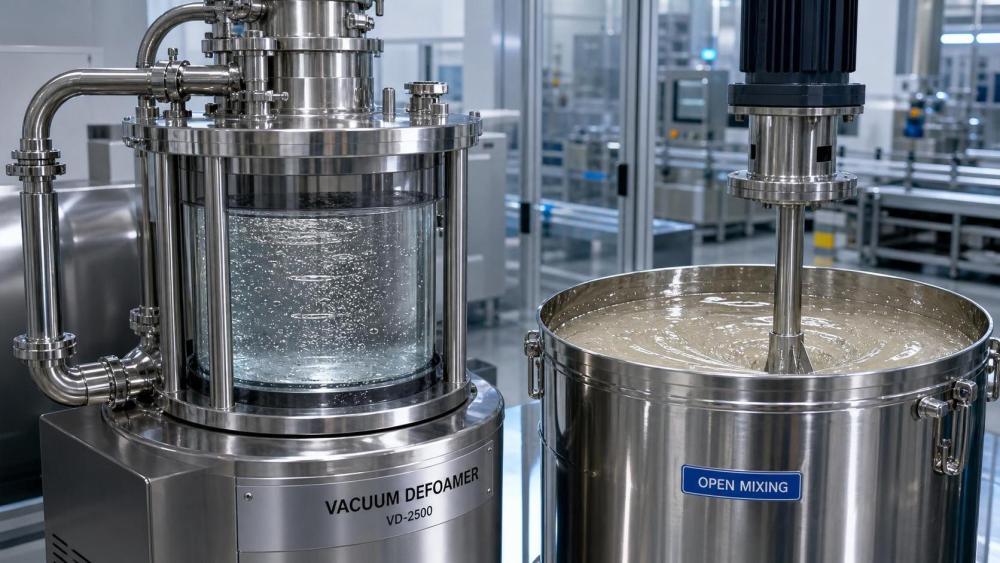
A vacuum degassing machine removes dissolved or trapped gases by lowering pressure inside a controlled chamber or vessel.
Traditional methods usually rely on standing time, manual stirring, heating, open-tank settling, or low-control mechanical agitation.
Both approaches can reduce bubbles. The difference appears when process consistency, contamination control, and cycle predictability become commercially important.
This is especially relevant in sectors covered by GIAS, where vacuum systems support packaging, coating, semiconductor-related processing, and other precision-dependent operations.
In those environments, degassing is rarely an isolated step. It affects dosing, sealing, curing, surface finish, and traceable quality outcomes.
Why buyers are paying closer attention
Tolerance windows are narrowing across chemicals, electronics, medical components, batteries, food packaging, and high-value industrial materials.
At the same time, production teams are under pressure to reduce scrap, document process stability, and avoid hidden variability.
A bubble that seems minor during mixing can later appear as a void, weak bond, uneven coating, or failed inspection result.
That is why a vacuum degassing machine is increasingly evaluated as part of a wider quality-control strategy, not just as a utility purchase.
GIAS often frames auxiliary equipment this way: small process controls can strongly influence final product reliability, compliance readiness, and export confidence.
The main decision criteria
A practical comparison should focus on operating results, not only equipment price or headline vacuum level.
The table shows why direct price comparisons can be misleading. Lower initial cost may hide higher process risk.
Process stability matters more than nominal vacuum
The most useful question is whether the same recipe produces the same result every shift, not whether the chamber reaches an impressive number.
A well-designed vacuum degassing machine controls pressure change, dwell time, foam behavior, and release timing.
Material compatibility can change the answer
Some resins, adhesives, slurries, oils, coatings, and liquid foods respond well to vacuum treatment. Others may foam aggressively or lose volatile components.
Traditional methods may suit robust materials with broad quality tolerance. Sensitive formulations usually need tighter control.
Where traditional methods still make sense
Traditional degassing is not automatically obsolete. In some cases, it remains a rational operational choice.
- Low-viscosity materials release air easily with short settling time.
- Product value is modest, and occasional cosmetic defects are acceptable.
- Batch sizes are small, irregular, or used for development work.
- Production speed is not a major constraint.
- Validation, traceability, and contamination control are limited requirements.
In these settings, a vacuum degassing machine may offer less economic advantage, even if it performs better technically.
Where a vacuum degassing machine creates clearer value
The value becomes easier to justify when bubbles lead to measurable loss, warranty exposure, or compliance concerns.
Typical examples include potting compounds, battery materials, encapsulation media, sealants, inks, specialty chemicals, and precision coating liquids.
In these processes, the vacuum degassing machine supports more than appearance. It can protect density, conductivity, adhesion, fill integrity, and shelf stability.
This is closely aligned with the GIAS view of auxiliary systems: process-support equipment often has an outsized effect on final manufacturing performance.
Quality costs often decide the issue
A rejected batch, field failure, or rework loop can erase the savings gained from simpler degassing.
When defects are difficult to detect before shipment, stronger degassing control becomes even more valuable.
Questions that improve the business case
A good evaluation framework should connect technical fit with operating economics.
- What defect rate is currently linked to entrained air or dissolved gas?
- How much time is lost through waiting, rework, retesting, or manual correction?
- Does the process need parameter logging for audits or customer approval?
- Will the material portfolio change toward higher-viscosity or higher-value products?
- Can the selected vacuum degassing machine integrate with mixing, dosing, or transfer systems?
- What maintenance support exists for pumps, seals, filters, and control components?
These questions help separate a justifiable capital decision from a speculative upgrade.
Operational details that are easy to overlook
The best comparison goes beyond lab performance or supplier brochures.
For example, some materials expand strongly under vacuum. Without enough chamber headspace, the process becomes messy and unstable.
Pump type also matters. Oil-sealed, dry, and liquid-ring configurations bring different maintenance, cleanliness, and lifecycle implications.
Control architecture is another factor. A vacuum degassing machine with recipe storage and alarm logging supports faster repeatability across batches.
Traditional methods can be flexible, but they often rely on tacit operator knowledge that is difficult to scale.
How to move from comparison to decision
The most reliable path is to compare methods against actual production conditions, not generic claims.
Start with the material family, target throughput, acceptable defect level, and required documentation standard.
Then assess whether a vacuum degassing machine reduces risk enough to justify equipment cost, utilities, and upkeep.
For many operations, the decisive issue is not whether traditional degassing works sometimes. It is whether it works predictably at commercial scale.
A structured review of defect data, material behavior, and system integration points usually reveals the better path more clearly than headline pricing alone.
That makes the next step straightforward: define the process risks first, then compare degassing options against those risks with measurable criteria.