
Choosing a vacuum degassing chamber is rarely a simple sizing exercise. In resin processing, the chamber directly affects bubble removal, material stability, cycle time, and downstream quality. When production targets are tight, the right balance between chamber size, vacuum level, and resin type matters more than a headline specification.
That is why this topic draws attention across advanced manufacturing. A vacuum system may sit in the background, yet it influences casting quality, potting consistency, encapsulation reliability, and scrap rates. For operations that value traceability and process control, vacuum degassing deserves the same disciplined evaluation as cleaning, coating, marking, or batching equipment.
Why vacuum degassing matters in production
A vacuum degassing chamber removes entrapped air and volatile gases from mixed resin before molding, casting, impregnation, or encapsulation. The basic goal is simple. Reduce voids before they become visible defects or hidden failure points.
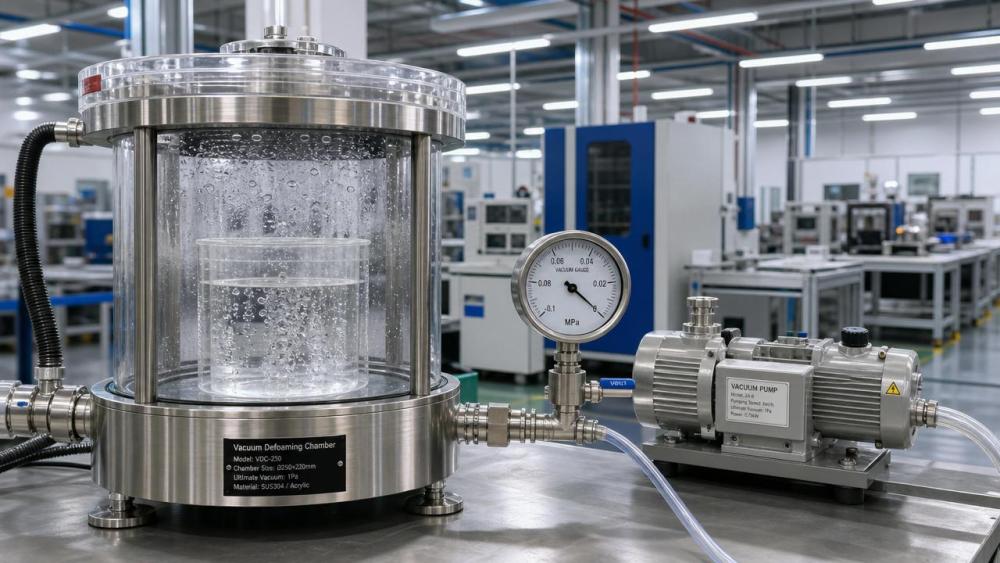
In practical terms, better degassing improves surface finish, dielectric integrity, bond strength, dimensional repeatability, and visual quality. In electronics, this can mean fewer insulation failures. In composites, it can mean less porosity. In decorative casting, it often means a cleaner final appearance.
This fits the broader industrial logic seen across GIAS-covered systems. Microscopic process control, whether in ultrasonic cleaning or vacuum stability, often determines final product performance more than the main machine alone.
The three variables that shape chamber selection
Most selection mistakes come from treating all resins the same. A vacuum degassing chamber should be matched to the material behavior, batch geometry, and required throughput. Three variables usually drive the decision.
Chamber size is about usable process volume
The internal chamber dimension must accommodate more than the container itself. Resin expands during degassing, sometimes aggressively. If the vessel is filled too high, foaming can overflow and contaminate the chamber.
A useful rule is to evaluate the total headspace above the resin, not only the footprint of the mixing cup or mold. For fast-rising materials, extra vertical clearance is often more valuable than extra diameter.
Vacuum level defines how effectively bubbles escape
Deeper vacuum generally improves gas removal, but only up to the point where the resin remains controllable. Some materials respond well to strong vacuum. Others foam excessively, boil off volatiles, or shift viscosity in ways that hurt the process.
Selection should consider achievable ultimate vacuum, pump-down speed, leak tightness, and the ability to hold a stable vacuum level during the full cycle. Stability is often more important than chasing the lowest possible pressure.
Resin type determines process behavior
Epoxy, polyurethane, silicone, acrylic, and filled compounds behave differently under vacuum. Viscosity, pot life, filler content, moisture sensitivity, and solvent content all affect how the material degasses.
A vacuum degassing chamber suitable for low-viscosity casting resin may be a poor fit for highly filled thermal interface material. The chamber and pump package must reflect the real chemistry, not an idealized lab sample.
How chamber size affects workflow and quality
An undersized chamber creates obvious bottlenecks, but an oversized chamber is not automatically better. Larger internal volume increases pump-down time unless the vacuum system is sized accordingly. That can extend cycles and reduce effective output.
The best chamber size usually reflects four operational questions:
- How much resin is processed per batch or per shift?
- How much temporary foaming occurs during evacuation?
- Will degassing happen before dispensing, after filling, or both?
- Does the process require trays, multiple cups, fixtures, or molds?
In pilot production, a compact vacuum degassing chamber may support flexibility and quick changeovers. In continuous or multi-product lines, a larger chamber can reduce handling frequency, but only if loading and unloading stay efficient.
It also helps to consider maintenance access. A chamber that fits the batch but is difficult to clean, seal, or inspect may raise long-term operating cost.
Matching vacuum level to resin behavior
Vacuum performance should be judged by process result, not only by a number on a specification sheet. Two systems with similar rated pressure can behave very differently in real operation because of seal quality, hose layout, pump capacity, and contamination control.
For many resin applications, the main concern is controlled air removal without triggering runaway foaming. That means the vacuum degassing chamber should support gradual evacuation, clear observation, and repeatable hold time.
When volatile components are present, deeper vacuum can create side effects. Resin may outgas more than expected, moisture may flash off suddenly, or formulation balance may shift. In those cases, process tuning is just as important as equipment selection.
Resin type changes the selection logic
Low-viscosity resins release bubbles more easily. High-viscosity compounds often need more time, stronger vacuum support, or temperature control to improve flow. Filled resins present another challenge because particles can trap air and change foaming behavior.
Silicone systems may expand dramatically before settling. Polyurethane can be sensitive to moisture and may require careful environmental control. Epoxy compounds used in electronics often demand repeatable degassing because voids affect insulation and thermal performance.
This is why a vacuum degassing chamber should not be evaluated in isolation. Material data, mixing method, ambient conditions, and downstream cure profile all shape the right specification.
Typical material-led questions
- Does the resin foam rapidly under initial vacuum?
- How short is the workable pot life after mixing?
- Are fillers abrasive, sedimenting, or air-trapping?
- Is moisture or solvent release a process risk?
- Will warming the resin improve degassing consistency?
Where selection problems usually appear
Many projects specify a vacuum degassing chamber after reviewing only vessel dimensions and nominal pump rating. That approach misses the operational details that drive success on the factory floor.
Common failure points include poor lid sealing, limited visibility, weak chemical resistance, difficult gasket replacement, and pump contamination from resin vapor. A chamber may perform well in trials yet become unreliable under repetitive industrial use.
Another issue is integration. If the degassing stage slows mixing, dispensing, or curing, overall productivity suffers. In broader auxiliary-system planning, the best equipment is usually the option that protects total process balance rather than one isolated parameter.
A practical framework for comparing options
A useful comparison starts with the real process window. Instead of asking which vacuum degassing chamber is strongest, ask which one fits the full operating requirement with acceptable risk.
- Define batch size, container geometry, and resin expansion allowance.
- Set the target vacuum range based on material testing, not assumption.
- Check cycle time against upstream mixing and downstream curing steps.
- Review chamber materials for chemical compatibility and easy cleaning.
- Confirm pump protection, spare parts access, and maintenance routine.
- Compare observation features, controls, and repeatability under load.
This kind of structured review supports better procurement decisions and lowers the chance of redesign after installation. It also aligns with how industrial platforms such as GIAS present auxiliary equipment: by linking specifications to process outcomes and long-term reliability.
What to evaluate before the next decision
A vacuum degassing chamber should be judged as part of a controlled production system. Chamber size, vacuum level, and resin type are the core variables, but the real decision sits at their intersection with throughput, defect tolerance, maintenance, and changeover needs.
The next step is usually to turn process knowledge into a shortlist. Map the resin family, expected batch profile, vacuum target, and acceptable cycle time. Then compare chambers against those conditions, not against generic claims.
When the selection criteria are clear, a vacuum degassing chamber becomes easier to evaluate, easier to justify, and more likely to deliver stable results across real industrial use.