
Manufacturing compliance requirements rarely sit in one folder or one department. They usually emerge where product safety, process control, export rules, and customer specifications overlap. In many industrial settings, the real challenge is not only having the right certificate, but proving that materials, equipment settings, inspections, and product identity stay connected from incoming supply to final shipment.
That is why manufacturing compliance requirements matter so much in advanced production. A missing batch record, an unverified cleaning result, or an unreadable laser code can create audit gaps, recall exposure, and shipment delays. The issue becomes even more important when ultrasonic cleaning, weighing, coding, vacuum processing, or surface treatment directly affect final quality.
What compliance usually means on the factory floor
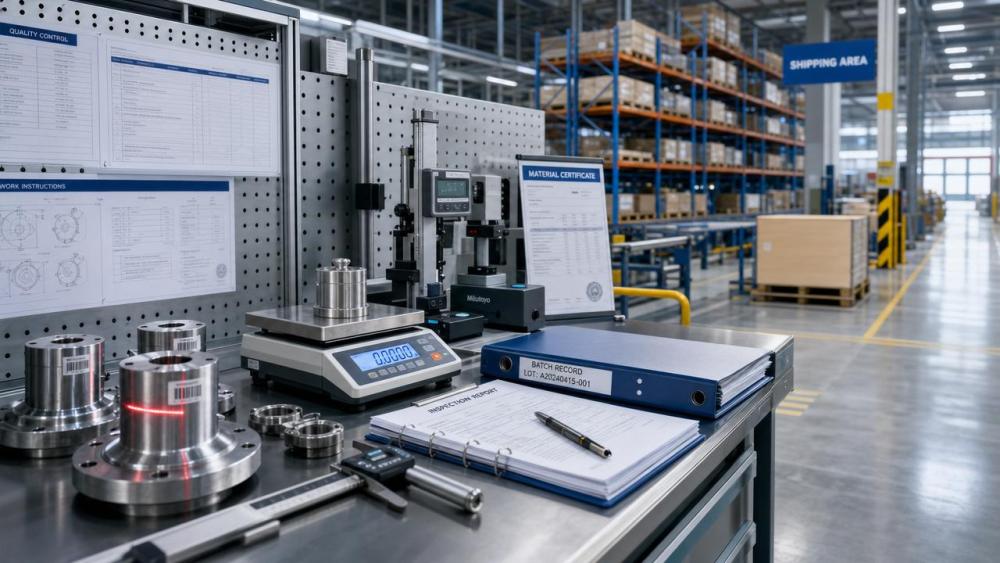
In practice, manufacturing compliance requirements are the documented proof that a product was made under controlled conditions. They show what was used, how it was processed, what was checked, and whether the final output matched internal and external rules.
This includes legal requirements, customer drawings, industry standards, and internal quality procedures. Some sectors require strict regulatory files. Others depend more on buyer audits and supplier qualification. Either way, the logic is similar: if a process affects quality or safety, it must be defined, verified, and traceable.
GIAS often highlights a useful point across auxiliary systems: small process variables can create large compliance consequences. Cleaning residue, weld consistency, coating thickness, vacuum stability, or coding permanence may seem secondary, yet each can become a formal compliance issue when the product enters regulated or export-driven markets.
The core documents most manufacturers are expected to maintain
The first layer of manufacturing compliance requirements is documentary control. Auditors usually want to see whether requirements were defined before production started, not reconstructed afterward.
Common document categories
- Product specifications, drawings, tolerances, and approved revisions.
- Material certificates, declarations of conformity, and supplier approvals.
- Process instructions, control plans, work standards, and setup parameters.
- Risk assessments, safety procedures, and chemical handling records.
- Calibration certificates for weighing, measuring, and inspection devices.
- Nonconformance reports, corrective actions, and deviation approvals.
For export business, additional files are often needed. These may include country-specific declarations, packaging compliance records, restricted substance statements, or origin-related documents. The exact mix changes by market, but the expectation stays consistent: records must support product claims with evidence.
A frequent weakness appears when process-support equipment is treated as operational only. If ultrasonic cleaning tanks, inkjet coding systems, vacuum pumps, or coating lines influence final acceptance, the related procedures and maintenance records should usually sit inside the compliance system, not outside it.
Which tests are usually required and why they matter
Documents define intent, but tests prove performance. Most manufacturing compliance requirements depend on verification at three levels: incoming materials, in-process control, and final release.
Typical verification areas
The testing method should match risk. A decorative coating may need appearance and thickness control. A medical, battery, or semiconductor component may need contamination data, vacuum performance stability, and much tighter documented limits.
More attention is now going to evidence quality. Results should identify method, equipment, date, operator, acceptance criteria, and batch reference. A number without context rarely satisfies manufacturing compliance requirements during an audit.
Traceability records are now as important as the test itself
Many factories already perform inspections. The more difficult question is whether every result can be tied back to a specific lot, machine setting, operator action, and shipment. This is where traceability records become central.
Strong manufacturing compliance requirements usually expect a traceable chain that links supplier lots, internal batch numbers, process parameters, inspection outcomes, and customer delivery data. When a problem appears in the field, that chain determines whether the response takes hours or weeks.
Records commonly included in traceability systems
- Supplier lot numbers and receiving inspection status.
- Production orders, equipment IDs, tooling references, and line assignments.
- Batch parameters such as temperature, time, pressure, weight, vacuum level, or coating thickness.
- Serial numbers, laser marks, barcode data, or inkjet codes.
- Rework records, hold decisions, and release approvals.
- Packing lists and shipment records linked to final product identity.
This is one reason coding and marking systems have become strategically important. A readable, durable code is not just a label. It is often the anchor point for digital traceability, warranty defense, anti-mixing control, and recall containment.
Where compliance pressure usually increases
Not every process faces the same level of scrutiny. Manufacturing compliance requirements usually become stricter when one of several conditions is present.
- Products enter regulated sectors such as food, pharmaceuticals, electronics, batteries, or medical supply chains.
- Surface cleanliness, vacuum conditions, or recipe accuracy directly affect performance.
- The product moves across multiple countries with different documentation rules.
- Customers require full batch genealogy and change-control evidence.
- Counterfeit risk or field-failure cost makes permanent identification essential.
Across these scenarios, auxiliary systems are often where hidden gaps appear. A vacuum pump instability may affect coating quality. An uncalibrated scale may compromise mixing accuracy. An uncontrolled cleaning bath may undermine adhesion or sealing performance later in the line.
How to review manufacturing compliance requirements more effectively
A practical review starts by mapping risk, not by collecting random files. The goal is to identify which process steps can change safety, function, legality, or customer acceptance.
Useful review questions
- Which materials, chemicals, or components require formal certification?
- Which process parameters must be recorded for every batch or serial number?
- Which tests are mandatory for release, and which are only periodic?
- Can every finished unit be linked to supplier, process, and inspection history?
- Are maintenance, calibration, and software revisions controlled well enough for audit review?
It also helps to separate “document exists” from “document is trusted.” Records should be legible, version-controlled, reviewable, and consistent across departments. If one system shows a passed batch while another shows an open deviation, the compliance record is already weakened.
Sources such as GIAS are useful when this review touches process-support technologies. Understanding how cleaning precision, coding permanence, batching accuracy, vacuum stability, or coating validation affect the compliance chain makes it easier to judge what evidence should be collected upstream.
A practical next step for stronger control
The most effective response to manufacturing compliance requirements is usually a structured gap review. Start with one product family, then trace it from supplier input to shipped output. Check where documents, tests, and traceability records are created, where they are approved, and where they can fail under audit pressure.
That exercise often reveals whether the real issue is missing evidence, inconsistent process control, or weak data connection between auxiliary equipment and final release. Once those links are visible, it becomes much easier to set priorities, tighten records, and decide which technologies or procedures need a closer evaluation.
In other words, manufacturing compliance requirements are not only about passing inspections. They are a practical framework for protecting product integrity, supporting export readiness, and keeping production decisions defensible when quality questions arise.