
Vacuum packaging extends the usable life of meat by removing much of the air surrounding the product and sealing it inside a low-permeability package. The immediate effect is reduced oxygen exposure, which slows oxidative rancidity, limits discoloration associated with oxygen-driven reactions, and suppresses the growth of many aerobic spoilage organisms. It does not sterilize meat, eliminate all microorganisms, or replace chilled storage. Its value comes from controlling the package environment while preserving a reliable cold chain from sealing through distribution.
The result depends on the relationship between product condition, residual oxygen, packaging film, seal integrity, storage temperature, and handling after packing. A package with a strong visual vacuum can still lose shelf-life potential if the meat was warm at sealing, the seal channel contains fat or moisture, or the film admits oxygen during extended storage. For this reason, vacuum packaging technology for meat should be assessed as a controlled process rather than as a single machine setting.
What changes after air is removed
Fresh meat contains pigments, fats, moisture, proteins, and naturally occurring microorganisms. Exposure to oxygen affects each of these components differently. In red meat, oxygen can support a bright red surface color for a limited period, but prolonged exposure also promotes pigment oxidation and fat oxidation. Under vacuum, the surface often develops a darker purplish-red appearance because the pigment is in a low-oxygen state. This color is frequently mistaken for spoilage even when the product remains wholesome and properly stored. When the package is opened and the meat is exposed to air, color can bloom again if the pigment system is still capable of doing so.
Vacuum also changes the microbiological balance. Aerobic spoilage bacteria are disadvantaged when oxygen is scarce, so the dominant flora can shift toward organisms that tolerate reduced-oxygen conditions. This is why vacuum packaging slows spoilage rather than stopping it. The package atmosphere, refrigeration temperature, salt level, curing ingredients, pH, product moisture, and storage duration must be considered together. A vacuum pack is not a reason to relax sanitation controls or use a longer storage period without validation for the specific product and process.
Fatty cuts, ground meat, and processed meat deserve separate consideration. Fat oxidation can create stale or rancid notes even before microbial spoilage becomes obvious. Ground meat has a much larger exposed surface area and more handling history than an intact cut, so initial contamination control and rapid chilling have greater influence. Cured or salted products may respond differently because formulation changes water activity and microbial selection. Treating all meat categories as though they have the same vacuum-pack performance leads to unreliable shelf-life decisions.
Residual oxygen is useful, but it is not the whole answer
Residual oxygen measurement is often used to verify evacuation performance. It is a valuable process indicator, especially after equipment changes, film changes, maintenance, or seal-setting adjustments. Yet a low reading alone does not prove that every pack will remain protected. Oxygen may enter later through a weak seal, a puncture, a channel caused by product contamination in the seal area, or transmission through a film that is unsuitable for the intended storage period.
The vacuum level displayed by a chamber machine also requires careful interpretation. It reflects conditions in the chamber during evacuation, not necessarily the final gas state at every part of the product. Meat can release gases, liquid can boil under reduced pressure if product temperature is too high, and irregular product shapes can trap air between folds or around bone contours. A very high vacuum setting may therefore create undesirable effects without materially improving pack performance.
- Warm product: moisture may be drawn toward the seal area, purge losses can increase, and boiling under vacuum can interfere with a clean closure.
- Bone-in cuts: sharp edges can abrade or puncture film during compression, stacking, or transport even when the original seal is sound.
- Soft or highly marbled products: excessive compression can distort appearance and force exudate into the sealing zone.
- Uneven pack geometry: folds, trapped air pockets, and bridging film prevent the package from conforming closely to the product.
A stable packing process therefore balances evacuation depth, dwell time, sealing conditions, and product presentation. The preferred setting is not simply the maximum available vacuum. It is the setting that repeatedly produces a well-formed package, a clean seal, and product condition consistent with the defined shelf-life study.
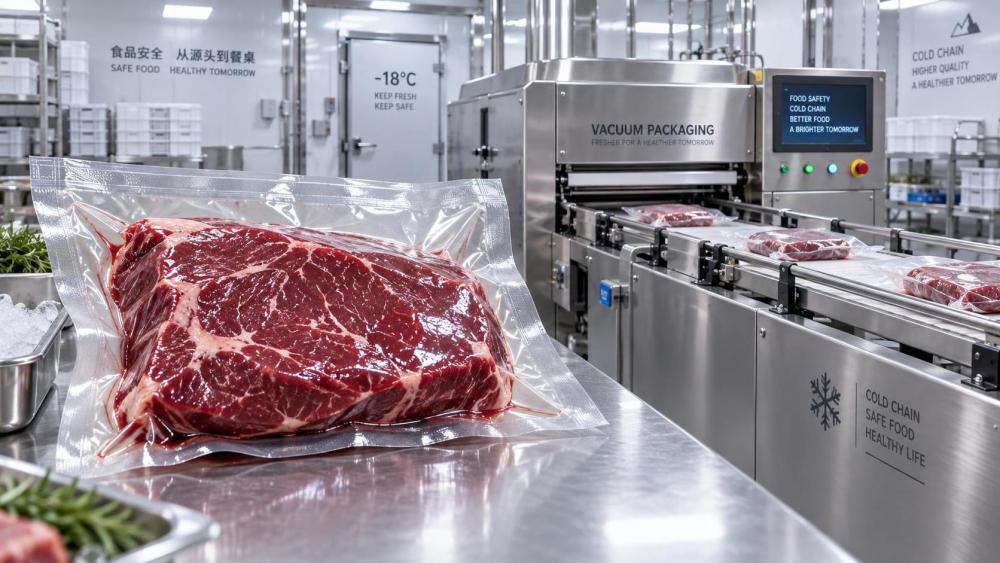
The package is a barrier system, not a bag
Vacuum packaging films are selected for more than thickness. Oxygen transmission rate, water-vapor transmission, puncture resistance, sealability, stiffness, shrink behavior, and compatibility with the packaging machine all affect performance. A film with excellent gas barrier properties can still fail if it does not seal reliably through the expected level of moisture or if its mechanical strength is inadequate for bone-in products. Conversely, a durable film with weak oxygen barrier may be adequate for a short chilled holding period but unsuitable for a longer distribution route.
Multilayer films are common because no single polymer offers every required property. Barrier layers limit gas transfer, while sealant layers are designed to form a closure within a controlled temperature range. Outer layers contribute strength, printability, or abrasion resistance. Material selection must account for the actual distribution environment: refrigeration, stacking pressure, handling frequency, sharp product features, and whether packs will be placed in a secondary carton or transported loosely in totes.
Seal width and seal cleanliness matter as much as film specification. Fat, protein residue, brine, blood, wrinkles, or small fragments of product in the seal area can create channels too narrow to see during a quick visual check. Some channels cause immediate loss of vacuum; others permit a gradual leak that becomes evident only after storage. Seal verification should include representative packs from normal production conditions, not only packs made during a clean and controlled machine trial.
Appearance defects need diagnosis before disposition
A loose package is a clear signal that requires investigation, but it does not identify the cause. A package may appear loose because of an incomplete seal, a puncture, trapped air, product outgassing, or normal redistribution of purge. These conditions have different implications. An incomplete seal or puncture creates a barrier failure. Trapped air may point to loading technique, product geometry, or inadequate evacuation time. Purge inside a tightly sealed package can reflect raw-material condition, freeze-thaw history, mechanical handling, or storage temperature rather than a failure of vacuum itself.
Color should be interpreted with the same discipline. Darkening under vacuum can be a normal low-oxygen pigment response. Green, iridescent, or unusually dull areas may have other causes, including surface chemistry, lighting, muscle variation, or microbial deterioration. Odor evaluation after opening must allow the package atmosphere to dissipate briefly; a confined-package odor should not automatically be treated as evidence of spoilage. Product disposition should be based on the validated specification, storage record, package integrity, sensory assessment, and relevant microbiological controls rather than one visual observation.
Cold-chain control defines the practical shelf-life limit
Vacuum packaging slows several deterioration pathways, but refrigeration determines how effectively that advantage is retained. Small temperature excursions can change microbial behavior and increase purge, especially where packs are repeatedly moved between cold rooms, staging areas, loading docks, and transport. The product core temperature at packing is more meaningful than an ambient room reading because a chilled room can contain meat that has not yet cooled uniformly.
Temperature records should be interpreted alongside handling events. A short deviation may have a different significance for a newly packed intact cut than for a product near the end of its defined storage period. Repeated warming and recooling can be more damaging than a single stable condition at the same average temperature because condensation, purge movement, and microbial recovery are influenced by the sequence of exposure. Packaging performance and thermal control are inseparable in shelf-life management.
Freezing creates a separate set of considerations. Vacuum packaging can reduce freezer burn by limiting contact with air and reducing moisture loss, but it does not prevent damage caused by slow freezing, temperature cycling, or rough handling. If a frozen product is later thawed, the packaging specification must still tolerate purge and maintain seal integrity through the entire intended route. A film that performs well around a chilled fresh product may crack or become vulnerable when flexed at low temperature.
Control points around the vacuum chamber
Before packing, meat surfaces and packaging contact areas need to be managed to reduce carryover of contamination and prevent seal interference. Product should enter packaging at the established chilled condition, with cut dimensions and loading patterns that match the machine and pouch size. Overfilling a pouch leaves too little clean film for sealing. Underfilling may create excessive folds that trap air or leave vulnerable corners.
During the cycle, attention should focus on repeatability rather than a single successful pack. Chamber gaskets, lid alignment, vacuum pump performance, filters, oil condition where applicable, and sealing bars affect evacuation and closure. A declining pump can lengthen cycle times or prevent the target vacuum from being reached consistently. Worn sealing components can produce variable seal strength across the bar, creating intermittent defects that are difficult to detect from machine settings alone.
After packing, visual inspection is useful for gross defects: wrinkles across the seal, trapped product, open corners, obvious punctures, incomplete shrink, or an unusually loose pack. It should be paired with a defined package-integrity method appropriate to the product and material. Seal-strength testing, burst or creep testing, leak detection, dye penetration where suitable, and residual oxygen monitoring answer different questions. Selecting a test because it is convenient rather than because it detects the expected failure mode leaves blind spots.
Validation should reflect the real product route
A shelf-life claim cannot be transferred automatically from one cut, package size, or distribution pattern to another. Validation needs to represent the intended meat type, formulation, starting condition, package material, machine settings, storage temperature, and expected handling. A trial based only on ideal refrigeration and flawless packs may establish little about routine production variation.
Sampling plans should capture beginning, middle, and end-of-run packs because equipment temperature, seal-bar condition, loading pace, and product temperature can shift during a production period. Where packs are coded, the code must remain legible and durable after refrigeration, moisture exposure, abrasion, and secondary packing. Traceability is most useful when it connects the package to a packing date, line, material lot, process conditions, and storage history rather than serving only as a date mark.
Changes that appear minor can require renewed evaluation. A substitute film, altered pouch dimensions, new vacuum pump, modified seal bar, different meat source, revised trimming practice, or longer transport route can change the process outcome. The correct response is not necessarily a full redesign. It is a focused review of which protective mechanism has changed: evacuation, barrier performance, seal formation, mechanical resistance, product condition, or thermal exposure.
When vacuum packaging is controlled as part of the wider preservation system, it protects quality in ways that are visible and measurable: less oxidative damage, reduced aerobic spoilage pressure, improved protection from dehydration, and a more consistent product condition through distribution. Its limits remain equally important. Intact packaging, verified storage conditions, hygienic processing, and product-specific shelf-life evidence are the controls that turn a vacuum pack into dependable protection rather than a visual impression of freshness.