
Choosing powder coating for metal requires more than selecting a color, gloss level, or popular resin family for production.
Technical teams must match coating chemistry and application quality with humidity, chemicals, sunlight, temperature, abrasion, impact, and maintenance expectations.
The best coating is therefore the one that survives the actual service environment while meeting appearance, compliance, process, and lifecycle requirements.
This guide provides a practical framework for evaluating coating types, specifying performance, and reducing premature failure during industrial production.
Start With the Service Environment
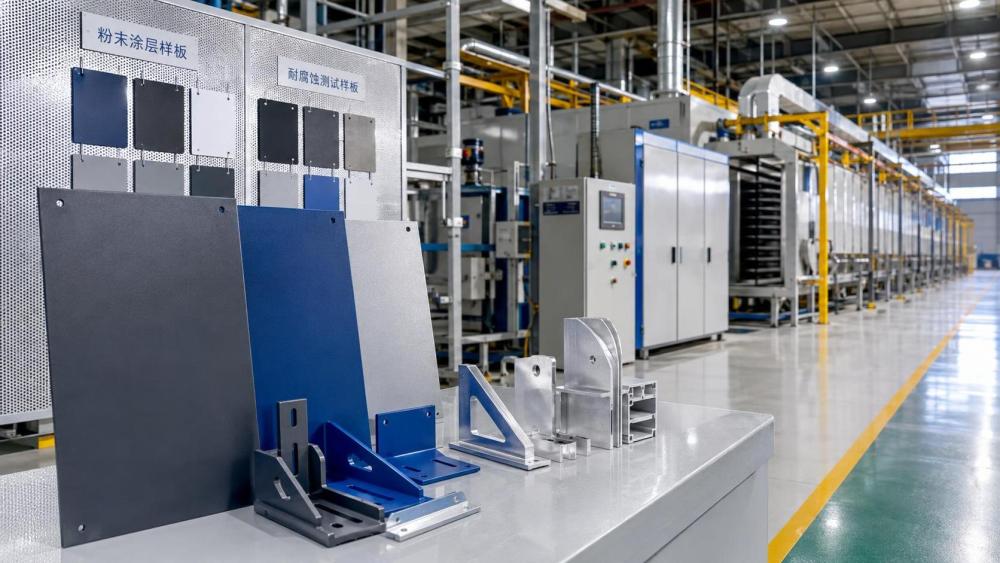
Before comparing suppliers, define what the coated metal will experience during transport, installation, operation, cleaning, storage, and maintenance.
A coating suitable for indoor office furniture may fail quickly on outdoor machinery exposed to salt spray, ultraviolet radiation, and standing water.
Likewise, a finish designed for general factory equipment may not tolerate solvents, acids, alkaline cleaners, or repeated thermal cycling.
Technical evaluation should begin with a written service profile rather than a preferred coating brand or familiar powder formulation.
Record operating temperatures, humidity, chemical exposure, sunlight intensity, mechanical loading, cleaning methods, and expected service duration for each component.
Also identify whether the substrate is steel, galvanized steel, aluminum, cast metal, or a mixed assembly requiring special pretreatment.
These details establish the performance baseline and prevent purchasing decisions based only on initial price, color availability, or supplier recommendations.
Match Resin Chemistry to Exposure
Different powder coating resin systems provide different balances of corrosion resistance, weatherability, flexibility, hardness, chemical resistance, and cost.
Epoxy powder coatings generally provide strong adhesion, hardness, and chemical resistance, making them useful for indoor industrial components and primers.
However, epoxy surfaces can chalk, fade, or lose appearance under prolonged ultraviolet exposure, limiting their suitability for exterior applications.
Polyester powder coatings usually offer better outdoor durability, color retention, and ultraviolet resistance for architectural and general exterior metalwork.
For demanding exterior environments, super-durable polyester grades can provide longer color and gloss retention than standard polyester formulations.
Hybrid epoxy-polyester powders combine selected properties from both chemistries and are commonly used for indoor equipment, shelving, appliances, and electrical enclosures.
Polyurethane powders can deliver smooth appearance, good weatherability, and chemical resistance, although formulation, curing control, and cost require careful evaluation.
Fluoropolymer powder coatings support high-end architectural durability, but their value depends on exposure severity, appearance expectations, and project lifecycle.
Evaluate Corrosion Protection Beyond the Powder
Powder coating for metal cannot compensate for poor substrate preparation, contaminated surfaces, sharp edges, inadequate film thickness, or trapped moisture.
Corrosion performance depends on the complete system, including cleaning, conversion coating, primer selection, powder chemistry, curing, and part design.
For carbon steel, pretreatment may include degreasing, rinsing, phosphating, zirconium conversion, or another qualified surface preparation process.
Galvanized steel requires compatible pretreatment and suitable outgassing control because zinc surfaces can release gases during oven curing.
Aluminum often requires cleaning and conversion treatment designed specifically for its oxide layer and alloy composition.
Ask suppliers for salt spray data, humidity resistance results, cyclic corrosion testing, and test-panel conditions relevant to the intended application.
Laboratory test hours should never be treated as a direct prediction of field life without considering substrate, edge design, pretreatment, and exposure.
For severe environments, a duplex system combining primer and topcoat may provide a more reliable barrier than a single decorative powder layer.
Consider Chemicals and Cleaning Procedures
Chemical exposure is often underestimated because equipment may contact diluted cleaners, process residues, oils, disinfectants, or occasional spills.
Identify every chemical used during normal operation, sanitation, maintenance, and emergency cleaning before approving a coating specification.
Review concentration, contact time, temperature, frequency, and whether the chemical remains wet on the surface after application.
Epoxy systems may perform well against many industrial chemicals, but specific acids, solvents, and alkaline solutions can still cause degradation.
Polyester coatings may offer stronger outdoor durability, while their chemical resistance depends heavily on formulation, cure, and exposure conditions.
Do not rely solely on generic statements such as “chemical resistant” because resistance is always related to a defined test environment.
Request immersion, spot-test, or wipe-test data using the actual cleaning agents whenever the coating supports food, pharmaceutical, chemical, or laboratory production.
Coating evaluators should also check whether aggressive cleaning causes gloss loss, softening, blistering, discoloration, swelling, or adhesion failure.
Account for Temperature and Thermal Cycling
Temperature affects coating hardness, flexibility, adhesion, chemical resistance, curing behavior, and long-term appearance during service.
Confirm both continuous operating temperature and short-duration peak temperature, including heat generated by motors, ovens, lamps, or process fluids.
Repeated heating and cooling can create stress differences between the metal substrate and the cured coating film.
Those stresses may produce cracking, delamination, loss of adhesion, or visible changes around welds, bends, and fasteners.
Standard powder coatings often tolerate moderate industrial temperatures, but high-temperature applications require specially formulated systems and validated cure schedules.
Thermal performance should be evaluated alongside film thickness because excessive thickness can increase internal stress and reduce flexibility.
When components operate near their coating limits, conduct accelerated thermal cycling using representative parts rather than relying on resin data alone.
Also verify whether the coating must withstand hot-water cleaning, steam exposure, sterilization, or rapid temperature changes during production.
Measure Mechanical and Abrasion Requirements
Coated parts may experience impacts, vibration, sliding contact, stacking, transport damage, tool contact, or repeated handling during service.
Hardness alone does not indicate durability because a very hard coating may be less flexible and more vulnerable to impact cracking.
Evaluate impact resistance, flexibility, adhesion, abrasion resistance, and edge durability according to the component’s actual mechanical risks.
For brackets, frames, guards, cabinets, and material-handling equipment, coating flexibility can be as important as surface hardness.
Sharp corners and cut edges typically receive less uniform film coverage, making them common starting points for corrosion and mechanical damage.
Improve part geometry where possible by reducing sharp edges, improving drainage, and avoiding pockets that retain water or contaminants.
For high-wear applications, consider thicker films, textured finishes, primers, or alternative surface treatments where standard decorative coatings are insufficient.
Testing should use production substrates, production pretreatment, specified film thickness, and representative impact or abrasion equipment.
Specify Appearance Without Sacrificing Performance
Appearance requirements often include color, gloss, texture, hiding power, orange peel, metallic effect, and visual consistency across production batches.
These requirements should be defined separately from performance requirements because an attractive finish may not provide adequate environmental protection.
Gloss can change because of resin selection, cure temperature, film thickness, substrate roughness, and oven uniformity.
Metallic powders may require controlled application techniques because gun settings, reclaim ratios, grounding, and operator practices affect visual uniformity.
Textured finishes can conceal minor substrate defects, but they may complicate cleaning, touch-up, and inspection of small surface damage.
Establish approved color panels, acceptable tolerance ranges, viewing conditions, and measurement methods before production approval.
Use instrumental color and gloss measurements where brand consistency or multi-site manufacturing makes subjective inspection unreliable.
Appearance approval should never replace adhesion, corrosion, thickness, cure, and chemical resistance verification.
Control Application and Curing Quality
Even the correct resin system can fail when application equipment, grounding, film thickness, or oven conditions are poorly controlled.
Electrostatic powder application depends on clean air, stable powder feed, suitable gun settings, and effective electrical grounding.
Insufficient grounding can reduce transfer efficiency, create uneven deposition, and increase risks associated with poor coating coverage.
Film thickness should be measured at representative locations, including edges, recesses, welds, corners, and difficult-to-reach surfaces.
Too little powder can reduce barrier protection, while excessive thickness may cause sagging, brittleness, pinholes, or dimensional problems.
Curing must be based on metal temperature and time at temperature rather than oven air temperature alone.
Different part masses and geometries heat at different rates, so production validation should include the heaviest and most thermally difficult components.
Track oven temperature profiles, powder batch details, line speed, film thickness, defects, rework, and inspection results for process traceability.
Build a Practical Evaluation and Test Plan
A structured test plan helps technical teams compare coating systems using consistent evidence instead of supplier claims or isolated samples.
Begin with a written specification covering substrate, pretreatment, coating chemistry, color, gloss, thickness, cure, and environmental exposure.
Require suppliers to identify the exact product grade, recommended application range, storage requirements, and technical data revision.
Test adhesion after curing and after relevant environmental conditioning, because immediate post-cure results may not reveal later weakness.
Use corrosion testing appropriate to the application, including salt spray, humidity, cyclic corrosion, or field exposure panels.
For chemical environments, test actual cleaning agents at realistic concentrations, temperatures, contact times, and repetition rates.
Include visual inspection, color measurement, gloss measurement, thickness mapping, impact testing, and microscopic review of critical defects.
Define acceptance criteria before testing begins, including allowable blistering, rust creep, adhesion loss, discoloration, chalking, and gloss change.
Compare Lifecycle Cost and Supplier Capability
The lowest powder price does not necessarily produce the lowest total cost over the equipment or product lifecycle.
Consider pretreatment chemicals, powder utilization, reclaim limitations, curing energy, rejects, rework, maintenance, field repairs, and replacement costs.
A slightly more expensive coating may be economically preferable when it reduces corrosion claims, cleaning failures, or repainting frequency.
Supplier capability also matters because formulation consistency, technical support, color control, and batch documentation affect production reliability.
Evaluate whether the supplier can provide application assistance, troubleshooting support, regulatory documentation, and stable international supply.
For exporters, confirm product labeling, safety data sheets, restricted-substance declarations, packaging quality, and destination-market compliance.
Procurement teams should compare suppliers using identical technical requirements and lifecycle assumptions to avoid misleading price comparisons.
Supplier audits may examine laboratory resources, batch traceability, complaint handling, change-control procedures, and technical response times.
Common Selection Mistakes to Avoid
One common mistake is selecting an indoor hybrid coating for outdoor equipment because its color, price, and sample appearance seem acceptable.
Another is choosing standard polyester for severe chemical exposure without testing the actual cleaning and process environment.
Many failures also result from approving flat panels while ignoring welds, edges, recesses, fasteners, and complex production geometries.
Overlooking substrate contamination can create adhesion problems that are incorrectly blamed on the powder formulation.
Using oven air temperature as the only curing reference may produce under-cured or over-cured films on variable part loads.
Technical teams should avoid treating salt spray hours as a universal service-life guarantee across different products and environments.
Color approval without defined measurement conditions can create disputes between factories, suppliers, customers, and inspection teams.
Finally, failing to document process parameters makes recurring defects difficult to diagnose and weakens traceability during customer complaints.
Make the Final Coating Decision
The final selection should connect service conditions, coating chemistry, pretreatment, application controls, test evidence, compliance, and lifecycle economics.
For mild indoor environments, an epoxy-polyester hybrid may provide an efficient balance of appearance, adhesion, and cost.
For outdoor exposure, polyester or super-durable polyester is generally more appropriate when ultraviolet stability and color retention matter.
For chemical, thermal, or high-wear environments, the decision should rely on application-specific testing rather than generic resin descriptions.
When corrosion risk is high, evaluate the entire protective system, including substrate design, pretreatment, primer, topcoat, and inspection.
Manufacturers should also confirm that their coating line can repeatedly achieve the specified thickness, cure, transfer efficiency, and finish.
Technical evaluators can then rank options by performance evidence, process robustness, supplier reliability, and expected cost of ownership.
This approach makes powder coating for metal a controlled engineering decision rather than a purely visual or price-based purchase.
Conclusion
Choosing powder coating for metal starts with service conditions and ends with verified performance under realistic production and operating stresses.
Resin chemistry, substrate preparation, film thickness, curing, surface design, cleaning exposure, and supplier capability must be evaluated together.
Technical teams that define these factors early can reduce corrosion, rework, inconsistent appearance, maintenance expense, and customer quality disputes.
The most reliable specification is not the coating with the broadest marketing claims, but the system supported by relevant evidence.
By combining exposure analysis, application control, structured testing, and lifecycle evaluation, buyers can select coatings that remain dependable throughout service.