
Why does the powder coating process for steel begin before the spray booth?
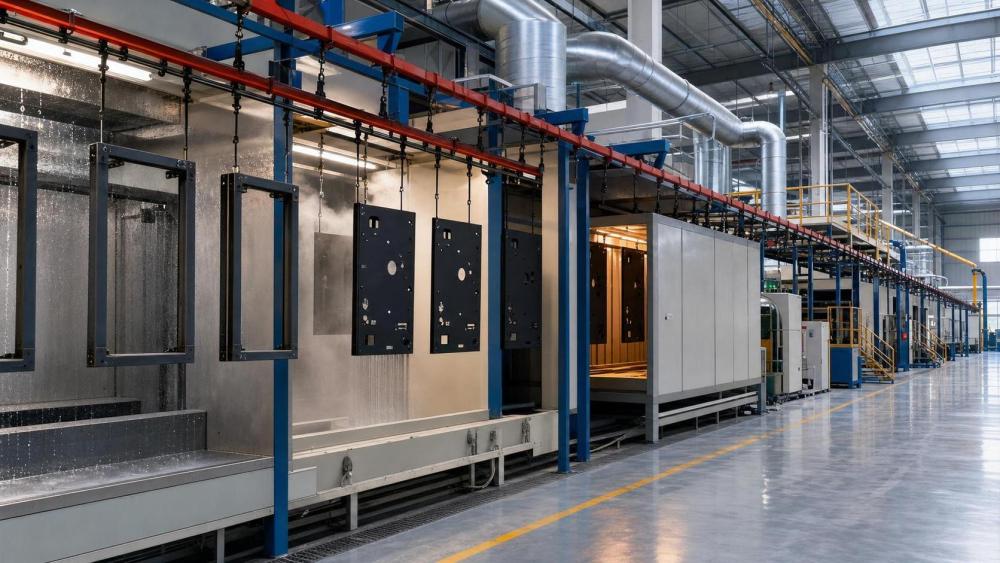
The powder coating process steel lines depend on is really a chain of controlled steps, not a single coating event.
A clean-looking steel part can still carry oil, weld smoke, rust bloom, stamping residue, or salts from handling.
If those contaminants stay on the surface, the powder may still melt and look smooth at first.
The real problems appear later as poor adhesion, edge failure, blistering, uneven gloss, or premature corrosion.
That is why industrial process platforms such as GIAS often treat surface treatment and electrostatic coating as linked disciplines.
In practical production, coating quality is tied to cleaning precision, line stability, traceability, and curing consistency.
A stable powder coating process steel operators can trust usually starts with three questions.
- What is on the steel surface before pretreatment?
- Is the pretreatment matched to the steel grade, shape, and service environment?
- Can the curing stage repeat the same film performance every shift?
When those three points are controlled, coating appearance and corrosion resistance become much easier to predict.
What surface preparation actually matters most for steel parts?
Most failures in the powder coating process steel applications face can be traced back to pretreatment quality.
The exact route depends on part geometry, oil load, rust condition, and final durability requirements.
Still, the logic stays consistent: remove soil, create a stable surface, and keep it clean until coating.
Is degreasing enough on its own?
Usually no. Degreasing removes oils and shop dirt, but it does not solve mill scale, oxidation, or flash rust.
Alkaline cleaning, spray washing, or ultrasonic cleaning may be used, depending on contamination level and part complexity.
For recessed or precision steel parts, cleaning blind spots are a common reason for random coating defects.
When is blasting the better choice?
Abrasive blasting is often preferred for heavy rust, scale, or coatings that must survive mechanical abuse outdoors.
It improves anchoring, but roughness must stay controlled.
If the profile is too sharp, the powder coating process steel shops use may thin at peaks and edges.
Why does conversion coating still matter?
Iron phosphate, zinc phosphate, or zirconium-based systems add corrosion support and improve paint bonding.
For indoor steel products, lighter pretreatment may be enough.
For outdoor cabinets, fencing, fabricated frames, or transport components, skipping conversion coating raises failure risk.
A simple visual check is not enough.
Water-break tests, conductivity checks, bath control records, and contamination tracking provide better process confidence.
How do spraying and film build affect the final result?
Once steel is properly prepared, application settings decide whether the finish is merely acceptable or consistently strong.
The powder coating process steel parts need is sensitive to grounding, gun distance, electrostatic settings, and part presentation.
Poor grounding reduces transfer efficiency and causes thin spots.
Excessive voltage may create back-ionization, orange peel, or uneven wrap on corners and recesses.
In actual line conditions, one frequent mistake is treating all steel parts as if they accept powder the same way.
Thin sheet, heavy fabricated sections, perforated components, and welded frames behave differently in the booth and oven.
A useful control habit is to monitor film thickness by location, not just by part average.
- Check flat faces, edges, corners, and deep recesses separately.
- Compare top, middle, and bottom positions on hanging parts.
- Watch for overbuild near hooks and underbuild behind weldments.
This is also where traceability becomes valuable.
If a defect trend appears, batch records, powder lot data, and parameter history shorten root-cause analysis.
What does correct curing really look like?
Curing is not just oven temperature on the display.
It is the combination of metal temperature, time at temperature, air circulation, and part loading pattern.
That distinction matters because thick steel parts heat more slowly than thin ones, even in the same oven.
What happens if the coating is undercured?
Undercured powder may look acceptable but remain soft, chemically weak, or vulnerable to early adhesion failure.
The powder coating process steel components require should meet the powder supplier’s cure schedule at metal temperature, not ambient air temperature.
Can overcuring create defects too?
Yes. Overcuring can shift color, reduce gloss, embrittle the film, or damage performance on sensitive formulations.
Dark colors may hide the issue visually, while mechanical tests reveal the change later.
How should curing be checked in production?
More reliable lines use data loggers, temperature probes on steel parts, and periodic cross-checks with impact or solvent resistance tests.
For mixed-product lines, cure verification should follow the heaviest and hardest-to-heat geometry, not the easiest sample.
Which common powder coating defects on steel are easiest to prevent?
Most recurring defects are easier to prevent than to rework.
The key is to connect each defect with the stage where it actually starts.
Why do pinholes or outgassing marks appear?
Porous castings, trapped oils, moisture, or contamination in the steel can release gases during cure.
Pre-baking, better cleaning, and powders designed for outgassing can reduce the problem.
What usually causes orange peel?
Orange peel may come from excessive film build, poor flow, wrong gun settings, or unsuitable substrate roughness.
It is often a process balance issue rather than a single fault.
Why does the coating chip at edges first?
Edges receive less powder naturally, and sharp geometry intensifies this weak point.
Rounded design edges, controlled film build, and pretreatment quality all improve edge retention.
What about blistering after outdoor exposure?
Blistering usually points to contamination, trapped moisture, pretreatment failure, or corrosion beginning beneath the film.
If the powder coating process steel structures use is intended for exterior service, pretreatment discipline becomes non-negotiable.
How can a steel coating line stay consistent from shift to shift?
Consistency comes from routine controls, not occasional troubleshooting.
The strongest powder coating process steel operations use combines equipment checks with simple process records.
A short daily checklist is often more valuable than a thick procedure that nobody follows on the floor.
- Confirm cleaner concentration, rinse quality, and pretreatment bath condition.
- Inspect grounding points, hooks, and powder delivery stability.
- Measure film thickness on representative steel locations.
- Verify cure with part-temperature data, not oven display alone.
- Separate defect records by part type, powder batch, and line setting.
This broader view matches how advanced manufacturing support systems are evaluated across GIAS content.
Small auxiliary variables often control the final quality outcome more than the main coating step suggests.
If the current line shows unstable results, start by mapping the full powder coating process steel parts move through.
Then compare actual cleaning, pretreatment, spray, and cure conditions against the defects appearing most often.
That approach usually reveals whether the real issue is contamination, film build, oven response, or handling between stages.
Once those checkpoints are visible, corrective action becomes faster, cheaper, and more repeatable.