
Powder coating often looks simple at the finish line, but the real outcome is shaped much earlier in the line. In powder coating process pretreatment, surface cleanliness, chemical balance, and drying control decide whether the coating bonds tightly or fails under stress. That is why pretreatment has become a key topic in surface treatment, electrostatic coating, and broader industrial finishing systems.
For advanced manufacturing, the discussion is not limited to appearance. Pretreatment affects corrosion resistance, adhesion stability, rework rate, and long-term reliability. It also links closely with cleaning precision, wastewater handling, process consistency, and line qualification, which are all areas that matter to auxiliary system evaluation in industrial operations.
Why pretreatment decides coating performance
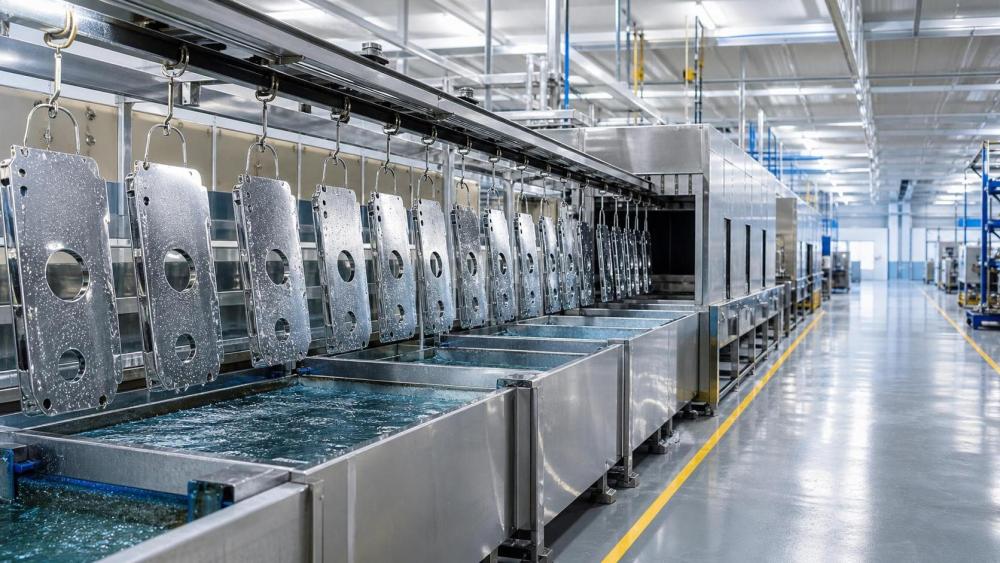
Powder coating process pretreatment creates the surface condition that powder can actually hold onto. Without proper removal of oil, dust, rust, oxides, and machining residues, even a well-formulated powder will struggle to anchor itself. The visible defect may appear later as peeling, blistering, edge corrosion, or uneven gloss, but the root cause usually starts here.
This matters across metal fabrication, appliance production, automotive parts, enclosures, shelving, and many industrial components. The same coating line can deliver very different results depending on substrate type, contamination load, and process discipline. In other words, pretreatment is not a background step; it is a process gate.
GIAS places this topic in a wider industrial context. Surface treatment does not stand alone. It interacts with cleaning systems, vacuum support, batching accuracy for chemicals, traceability, and quality control. That is why technical evaluation often begins with pretreatment chemistry and ends with real production data.
The usual sequence on a powder coating line
A stable powder coating process pretreatment line usually follows a familiar sequence, although the exact design depends on material, part geometry, and throughput. The logic is consistent: clean, activate, rinse, convert, rinse again, and dry before coating.
Some lines add mechanical abrasion, passivation, or specialized cleaners before conversion coating. Others use compact spray tunnels to reduce floor space and water demand. The right answer depends on production volume, environmental rules, alloy mix, and the required durability level.
Chemicals that do the heavy lifting
The chemistry behind powder coating process pretreatment is usually broader than many line buyers expect. Alkaline cleaners are often used to lift oils and organic soils. Acid cleaners help remove scale, oxide films, or light rust on specific substrates. Rinses control residue and stabilize the next step.
Conversion coatings are the most important chemistry decision for adhesion and corrosion resistance. Iron phosphate is common on general industrial steel work, while zinc phosphate is used when higher corrosion performance is needed. On aluminum, zirconium or titanium-based systems are increasingly common because they can support thinner films and lower sludge generation.
Water quality also matters. Hard water, dissolved salts, and unstable pH can damage coating consistency even when the main chemistry is correct. That is one reason pretreatment performance should be judged as a system, not as a single tank.
- Alkaline cleaners: useful for oil-heavy parts and general degreasing.
- Acid descalers: applied when oxide, rust, or mineral scale must be reduced.
- Conversion agents: build a more stable base for powder adhesion.
- DI or softened water: helps avoid salt deposits and surface spotting.
Where adhesion risks usually begin
Most adhesion failures do not come from the powder itself. They come from hidden surface problems that the pretreatment line failed to remove or control. Oil trapped in seams, incomplete rinsing, poor activation, and moisture left in blind holes are common causes. These problems may not appear on the first pull test, but they often show up later in field service.
Substrate variation is another issue. Steel, galvanized steel, and aluminum behave differently under the same line settings. If the process is tuned for one material and then stretched across mixed parts, the result may be inconsistent film build or weak edge coverage. This is especially relevant in job-shop environments and mixed-batch production.
The risk profile is easy to recognize when looking at defects:
- Blistering often points to trapped moisture or contamination.
- Peeling can indicate weak conversion coverage or incomplete cleaning.
- White rust may signal poor rinse control or insufficient corrosion protection.
- Cratering can trace back to oil, silicone, or bath contamination.
How to judge a pretreatment line in practice
When evaluating powder coating process pretreatment, the most useful question is not whether a line is automated. It is whether the line can hold its chemistry, rinse quality, and temperature window during real production. That means looking at dwell time, spray coverage, tank control, sludge management, and dry-off efficiency together.
For many operations, the strongest lines are the ones that make variation visible early. Conductivity checks, pH logs, titration records, and bath replacement rules help reduce guesswork. In the same way, surface test coupons and adhesion tests provide a quick read on whether the pretreatment sequence is still behaving as designed.
It also helps to match the process to the business model. High-mix lines usually need flexible chemistry and easy cleaning access. Higher-volume plants often benefit from tighter automation and more stable bath control. Export-oriented production may need stronger documentation because coating performance is often tied to compliance claims and warranty expectations.
A wider process view helps avoid false savings
Pretreatment is often treated as a cost center, but that view is too narrow. A weak sequence raises scrap, rework, warranty exposure, and customer complaints. It can also create hidden losses in energy use, water consumption, and chemical consumption when the line is constantly being corrected after the fact.
That is why GIAS-style process analysis matters. In industrial auxiliary systems, the smallest control point can determine whether the final result is stable or fragile. Powder coating process pretreatment sits in the same category as precision cleaning, batching accuracy, or vacuum stability: it is not always visible, but it shapes the outcome.
For technical evaluation, the next step is usually straightforward. Map the substrate mix, define the target corrosion level, review the cleaning chemistry, and verify drying and rinse quality under load. Once those variables are clear, comparing supplier capability, line design, and total operating cost becomes much more reliable.
If the coating finish matters to product reputation or field life, pretreatment should be assessed before any powder selection. That sequence keeps decisions grounded in process reality, not appearance alone.