
Powder Coating Engineering for Electrostatic Coating: Why Line Design Decides Finish Quality
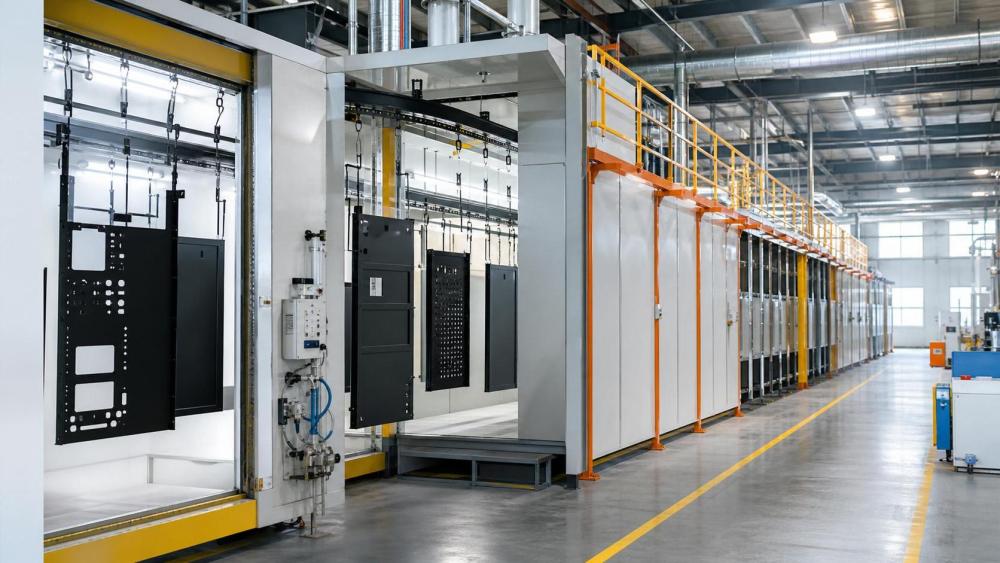
In Powder Coating Engineering for electrostatic coating, finish quality starts with line design, not with the spray gun alone.
That point is becoming more important as manufacturers expect thinner films, tighter color control, and lower rework.
A well-designed electrostatic coating line supports transfer efficiency, stable film build, clean appearance, and predictable curing.
A weak design does the opposite.
It creates edge pullback, contamination, pinholes, poor adhesion, orange peel, and avoidable powder waste.
From a project perspective, Powder Coating Engineering is not only about equipment selection.
It is about building process stability into the line before production ramps up.
This also means early decisions on airflow, grounding, conveyor routing, oven balance, and cleanliness will shape long-term coating performance.
For operations that handle metal furniture, appliances, enclosures, auto parts, or industrial components, those details affect both cost and customer acceptance.
Airflow Control in Powder Coating Engineering for Electrostatic Coating
Airflow is one of the most underestimated design variables in Powder Coating Engineering.
In electrostatic coating, powder particles are light, mobile, and easy to disturb.
If booth airflow is too aggressive, powder can drift away from the target surface.
If airflow is uneven, one side of the part may build film differently than the other.
That creates visible variation after curing, especially on large flat panels.
Booth extraction must capture overspray without disturbing the powder cloud around complex geometries.
This is especially critical around corners, recesses, and Faraday cage areas.
In practical projects, airflow design should be checked together with booth size, gun arrangement, and part presentation.
- Keep booth airflow stable across the working envelope.
- Prevent cross-drafts from doors, fans, or nearby conveyors.
- Match extraction rate to part size and spray volume.
- Review reclaim airflow when frequent color change is required.
When these points are ignored, electrostatic coating quality often looks inconsistent even when operators follow the same settings.
Grounding and Electrical Stability Shape Transfer Efficiency
Grounding is the heart of electrostatic coating performance.
Powder Coating Engineering must ensure that charged powder sees a clear path to the grounded part.
If hangers, hooks, or conveyor contact points build up cured powder, grounding resistance increases quickly.
Then transfer efficiency drops, film build becomes erratic, and operators often overcompensate by increasing voltage or spray time.
That usually adds more defects instead of solving the root problem.
A good line design supports reliable metal-to-metal contact through every production cycle.
It also makes inspection and cleaning straightforward.
- Design hooks for repeatable contact and easy stripping.
- Minimize hidden surfaces that trap cured powder.
- Check conveyor continuity across joints and turns.
- Monitor grounding resistance as a routine line metric.
In many factories, finish complaints are first blamed on powder quality.
More often, the issue starts with grounding discipline inside the electrostatic coating line.
Conveyor Layout Affects Film Uniformity and Throughput
Conveyor design looks mechanical, but its impact on finish quality is direct.
Part spacing, hanging angle, line speed, and orientation all influence powder deposition in electrostatic coating.
If parts are too close, the electric field changes and powder cloud access becomes restricted.
If the hanging angle is wrong, drain points, hidden recesses, and visual faces may not receive balanced coverage.
This matters even more for mixed-product lines.
A layout optimized for small brackets may fail when larger cabinets or frames enter the same booth.
That is why Powder Coating Engineering should model the product family, not just one ideal sample.
- Group parts by geometry, mass, and visible finish demand.
- Set spacing rules for both coating access and oven airflow.
- Align hanging method with drainage and appearance priorities.
- Reserve adjustment range for future product changes.
A flexible conveyor strategy protects throughput without sacrificing finish consistency.
Pretreatment and Contamination Control Are Non-Negotiable
Electrostatic coating cannot hide poor surface preparation.
In fact, better powder films often make contamination defects easier to see.
Oil, dust, weld residue, moisture, and pretreatment carryover can trigger craters, adhesion failure, blistering, or corrosion underfilm.
This is where line design and process discipline must work together.
A rushed layout often places dirty operations too close to coating zones.
That raises contamination risk even before powder application starts.
Strong Powder Coating Engineering separates pretreatment, drying, coating, and curing with clear environmental control.
- Validate pretreatment chemistry for the substrate mix.
- Confirm complete drying before entering the booth.
- Control dust from grinding, packing, and nearby traffic.
- Use layout barriers to reduce airborne cross-contamination.
For high-appearance parts, contamination control often becomes the difference between stable yield and chronic rework.
Oven Balance and Cure Window Must Match Product Reality
A smooth powder film still fails if curing is not controlled well.
In Powder Coating Engineering, oven design must match part mass, line speed, coating chemistry, and load variation.
Light parts heat quickly.
Heavy weldments do not.
Mixed loads can push one product into overbake while another remains undercured.
Both cases hurt finish quality and long-term performance.
Undercure may reduce adhesion, hardness, and corrosion resistance.
Overbake may affect gloss, color stability, or mechanical properties.
This also means cure verification should rely on actual metal temperature, not air temperature alone.
In electrostatic coating projects, oven design should always be reviewed as a quality system, not just a heating asset.
Booth Recovery, Color Change, and Powder Management
Powder management has a major influence on finish repeatability.
If reclaimed powder is not controlled well, particle size distribution and contamination risk may shift over time.
That can change flow behavior, charge response, and final appearance.
For plants with frequent color changes, booth cleanability is not a minor detail.
It directly affects downtime, contamination events, and schedule reliability.
Recent market shifts toward smaller batch sizes make this even more relevant.
In actual operations, the best electrostatic coating line is often the one that stays clean under production pressure.
- Set clear virgin-to-reclaim powder ratios.
- Reduce dead zones inside booth and recovery paths.
- Choose surfaces that clean quickly during color change.
- Separate sensitive colors from high-volume dark shades.
These measures support better coating consistency and lower hidden quality costs.
A Practical Review Framework for Line Design Decisions
When reviewing Powder Coating Engineering for electrostatic coating, it helps to use a simple decision framework.
The goal is to connect design choices with finish quality, throughput, and maintenance reality.
- Define visible quality standards by product type.
- Map defect risks to each process zone.
- Test grounding, airflow, and cure balance before full launch.
- Build cleaning access into hooks, booth, and recovery equipment.
- Plan for future product variation, not only current demand.
That last point matters more than many teams expect.
A line that performs well for today’s parts but lacks flexibility may become a bottleneck very quickly.
In contrast, a line designed around electrostatic coating fundamentals usually delivers stronger long-term value.
It reduces troubleshooting, supports repeatability, and protects finish quality as product demands evolve.
For any new installation or upgrade, the most effective next step is a disciplined line audit focused on airflow, grounding, contamination control, conveyor geometry, and cure verification. That is where better Powder Coating Engineering turns electrostatic coating capability into consistent finish performance.