
Industrial Spraying Technology in Germany: Which Process Fits Your Production Line?
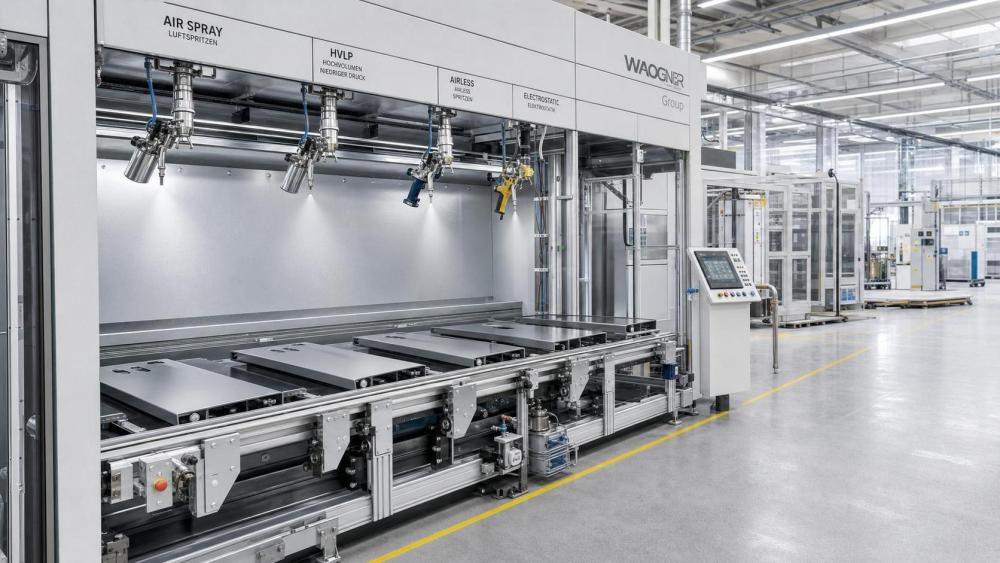
Choosing the right industrial spraying technology Germany manufacturers use is rarely a simple equipment purchase.
It shapes coating quality, transfer efficiency, compliance performance, and daily production stability.
In Germany, expectations are high.
Factories often balance strict finish standards, energy targets, environmental rules, and cost discipline at the same time.
That means spray process selection should start with production logic, not vendor brochures.
The real question is straightforward.
Which industrial spraying technology Germany plants depend on will actually fit your parts, output goals, coating chemistry, and maintenance resources?
This guide compares the main process options and highlights where each one makes operational sense.
Why process matching matters more than equipment price
Many teams first compare capital cost.
That is useful, but incomplete.
A cheaper spray system can create higher paint consumption, slower changeovers, unstable film thickness, or more rework.
Over one year, those losses often outweigh the initial savings.
In practical terms, industrial spraying technology Germany buyers evaluate should be judged on total line performance.
That includes transfer efficiency, overspray control, finish consistency, labor demand, cleaning time, and VOC management.
It also includes how the process behaves under real production pressure.
High-mix lines, short batches, and frequent color changes need different answers than stable, long-run manufacturing.
The main industrial spraying processes used in Germany
Most industrial spraying technology Germany factories consider falls into five practical categories.
1. Conventional air spray
Conventional air spray delivers fine atomization and strong finish quality.
It is often selected for appearance-critical parts.
The tradeoff is lower transfer efficiency and more overspray.
That increases material waste and booth loading.
2. HVLP spray systems
HVLP uses high air volume and low pressure to reduce bounce-back.
It is widely used where coating savings and compliance matter.
Finish quality remains good, though speed may be lower than some alternatives.
3. Airless spraying
Airless systems atomize coating through fluid pressure rather than compressed air.
They are strong for high-viscosity materials and large surface areas.
Productivity is high, but finish finesse can be lower on detailed parts.
4. Air-assisted airless
This process combines pressure delivery with a controlled air cap.
It often gives a useful middle ground between speed and finish.
For many engineered products, this is a very practical choice.
5. Electrostatic spray coating
Electrostatic application improves wrap-around and transfer efficiency on conductive parts.
It is highly relevant in industrial spraying technology Germany decision-making.
It supports lower waste and more uniform coverage, especially in automated lines.
However, grounding, safety design, and part geometry must be managed carefully.
How to compare processes against your production line
The best industrial spraying technology Germany solution depends on a short list of production facts.
If those facts are unclear, selection risk rises quickly.
Start with the substrate
Steel, aluminum, plastic, glass, and composite parts do not behave the same way.
Conductive materials can benefit more from electrostatic spray methods.
Heat-sensitive plastics may need gentler coating conditions and tighter process windows.
Define the finish requirement
A decorative surface needs different atomization than a protective primer layer.
Gloss uniformity, edge coverage, film build, and texture expectations should be specified early.
Check throughput and takt time
High-speed lines may favor airless or air-assisted airless systems.
Lower-volume operations with demanding cosmetics may prefer conventional or HVLP approaches.
Review coating material behavior
Water-based, solvent-based, and high-solid coatings respond differently to atomization energy.
Viscosity range, solids content, and curing conditions all affect process fit.
Estimate maintenance reality
Some systems look efficient on paper but struggle in plants with limited maintenance support.
Nozzle wear, flushing frequency, spare part access, and operator skill matter more than expected.
A practical selection table
This table simplifies the picture, but it helps narrow the field quickly.
German market factors that influence the decision
Industrial spraying technology Germany projects are shaped by more than coating performance alone.
Several market conditions affect what is realistic.
- Stricter environmental compliance pushes demand toward efficient spray application and lower emissions.
- Energy cost pressure makes booth airflow, curing load, and compressed air use more visible in investment reviews.
- Labor shortages increase interest in automation-ready industrial spraying technology Germany integrators can support locally.
- Traceability expectations encourage systems with stable parameters, recipe control, and documented repeatability.
From a project perspective, this means the winning process is often the one easiest to control consistently.
A technically impressive system is not enough if spare parts, training, or process documentation are weak.
Common selection mistakes and how to avoid them
Several mistakes show up repeatedly in industrial spraying technology Germany sourcing decisions.
- Choosing by finish sample only. A perfect test panel does not guarantee stable line performance.
- Ignoring material change frequency. Color switches and cleaning time can damage actual output.
- Underestimating operator influence. Manual process variation remains a major source of coating defects.
- Comparing equipment without process data. Viscosity, temperature, line speed, and target film build must be quantified.
- Treating compliance as a late-stage issue. Ventilation, explosion protection, and emissions planning should begin early.
A better approach is to run a structured evaluation matrix before final supplier negotiation.
A simple decision framework for final selection
To shortlist industrial spraying technology Germany options, use a weighted scoring model.
- Coating quality: gloss, thickness control, edge coverage, defect rate.
- Productivity: line speed, takt fit, changeover time, downtime exposure.
- Operating cost: paint use, air consumption, maintenance, cleaning media.
- Compliance fit: VOCs, safety controls, worker exposure, documentation readiness.
- Integration strength: robotics compatibility, controls interface, supplier service network.
Score each process against actual production priorities, not generic best practice.
That usually reveals the right answer quickly.
In many cases, the best industrial spraying technology Germany solution is not the most advanced one.
It is the one your line can control, maintain, and scale with confidence.
Before committing, validate the shortlist with coating trials, process data, and total cost assumptions.
That final step turns industrial spraying technology Germany research into a decision that supports quality, compliance, and long-term production reliability.