
How to Choose a Curing Oven for Powder Coating Lines Based on Part Size and Throughput
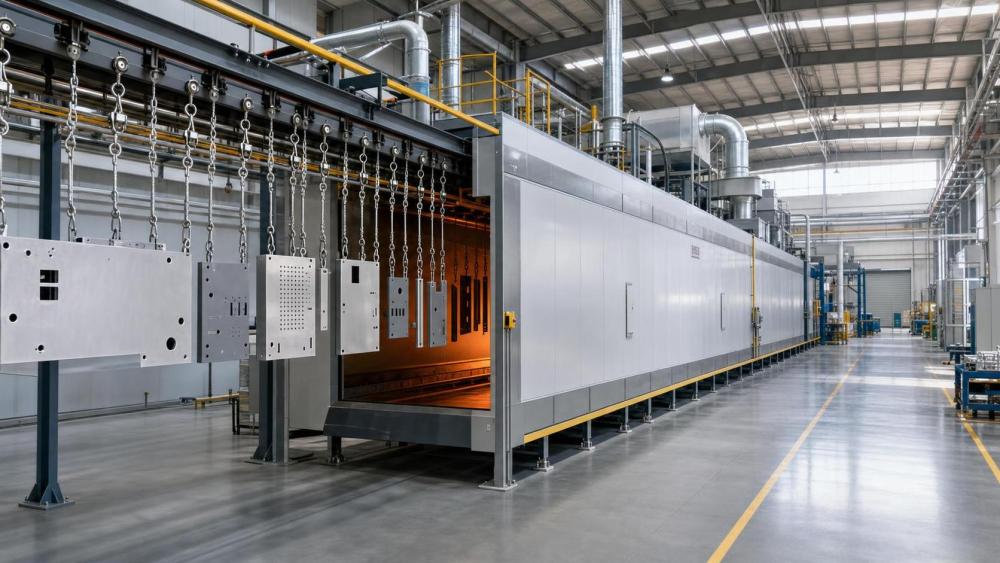
Choosing the right powder coating lines curing oven is critical when part dimensions, production speed, and coating consistency all affect project performance.
The oven has to support present output targets while leaving enough room for process stability and future expansion.
That sounds straightforward, but many line decisions fail because oven sizing is treated as a simple heating question.
In practice, a powder coating lines curing oven affects line speed, coating appearance, energy cost, maintenance, and project risk.
A small mismatch between part geometry and curing window can create rework, bottlenecks, or uneven finish quality across batches.
This guide explains how to evaluate curing oven configurations using part size, dwell time, airflow, loading pattern, and operating efficiency.
The goal is not only to choose equipment that works, but to choose a system that keeps the whole coating line balanced.
Start with the Real Part Envelope
The first sizing step is the actual part envelope, not the drawing size listed in a product file.
For a powder coating lines curing oven, usable space depends on the largest moving part after hanging, fixturing, and spacing are included.
Hooks, carriers, rotation clearance, and conveyor swing can all increase the required oven profile.
Long parts are especially tricky because they may fit the chamber width but still disturb airflow or create uneven metal temperature.
Heavy fabricated parts also store heat differently from thin sheet metal components, even when outside dimensions look similar.
That is why oven selection should begin with three measurements:
- Maximum loaded height, width, and length
- Typical part weight and wall thickness
- Mix of small, medium, and oversized parts
If the line handles a mixed product family, use the production-weighted average and the worst-case part together.
This gives a more realistic basis for powder coating lines curing oven evaluation than a single nominal product dimension.
Match Throughput to Required Dwell Time
Once the part envelope is clear, the next step is throughput.
A powder coating lines curing oven must provide enough dwell time at curing temperature, not just enough tunnel length.
Powder suppliers usually specify a cure schedule such as 10 minutes at metal temperature or 20 minutes at a lower setpoint.
What matters is the total time required for parts to heat up and then remain within the cure window.
If line speed is set only by target output, undercure becomes likely.
If the oven is oversized without clear need, energy use and floor-space cost rise quickly.
A practical calculation should include these elements:
- Required metal temperature and hold time
- Part heat-up time by mass and thickness
- Conveyor speed under normal production loading
- Spacing between parts and fixture pitch
- Planned hourly output with peak demand margin
In real projects, peak throughput should not be the only design condition.
A powder coating lines curing oven also needs enough operating flexibility for low-volume orders, product changes, and maintenance windows.
That usually means designing for stable curing across a practical speed range instead of a single ideal number.
Evaluate Oven Type by Production Pattern
Different oven layouts suit different line conditions.
For continuous powder coating lines, a conveyorized curing oven is often the preferred choice because it supports stable takt time.
For mixed parts, irregular schedules, or lower output, a batch oven may provide better flexibility and lower initial investment.
The decision should reflect production reality, not only equipment preference.
When comparing a powder coating lines curing oven configuration, check how each option handles:
- Single large parts versus dense small-part loading
- Frequent color or product family changes
- Daily operating hours and shift pattern
- Available installation length and plant layout constraints
- Future conveyor speed increases or added hanging points
A straight conveyor oven is not always the best answer if the plant lacks floor length.
In those cases, a vertical or serpentine arrangement may help preserve dwell time within a tighter footprint.
That said, layout complexity should be weighed against maintenance access and airflow consistency.
Do Not Underestimate Airflow and Temperature Uniformity
This is where many oven comparisons become too simplistic.
A powder coating lines curing oven is not selected by chamber size alone.
Uniform airflow determines whether all surfaces reach cure temperature evenly, especially on deep recesses, boxed sections, and heavy weldments.
Poor air distribution can produce gloss variation, weak adhesion, orange peel, or inconsistent hardness.
These problems are expensive because they often appear after coating, packaging, or even field use.
Ask suppliers how the powder coating lines curing oven manages recirculation, burner placement, fan capacity, and temperature mapping.
Request data, not just general claims.
Useful verification points include:
- Temperature uniformity across the work zone
- Heat-up time under loaded conditions
- Air velocity pattern around typical parts
- Performance with heavy and light products on the same line
- Recorded oven survey or trial curing data
For decision-making, this is often more valuable than headline heating power alone.
Check Energy Use, Controls, and Operating Risk
Energy cost matters more as line utilization grows.
A powder coating lines curing oven should be judged on total operating behavior, not just purchase price.
Good insulation, efficient recirculation, burner control, and zone management all influence long-term running cost.
For plants with variable loading, independent control zones can reduce waste during partial production.
Controls also affect quality assurance.
Trend logging, alarm history, temperature recording, and recipe management help maintain repeatable cure results.
This is increasingly relevant where traceability, export standards, or customer audits are part of normal business.
A short review table can keep evaluations grounded:
A lower-cost oven can become the more expensive choice if downtime, unstable cure, or service delays are overlooked early.
Build a Selection Framework That Supports Expansion
The best powder coating lines curing oven usually fits both today’s product mix and tomorrow’s production plan.
That means comparing options with a structured decision framework instead of relying on nameplate ratings alone.
A useful approach is to score each supplier against the same project criteria.
Typical criteria include part envelope fit, cure stability, throughput margin, energy efficiency, controls, maintenance, and installation support.
It also helps to separate non-negotiable requirements from preferred features.
In actual procurement work, the most common mistake is buying for average demand without checking the business case for growth.
If new product sizes, export programs, or second-shift production are likely, the powder coating lines curing oven should not become the expansion bottleneck.
Before final approval, confirm these points:
- The largest loaded part clears the full oven path safely
- Cure time is validated at planned conveyor speed
- Temperature uniformity is documented under realistic load
- Controls support quality records and troubleshooting
- Utility demand and maintenance access suit the site
- Future throughput growth has a practical upgrade path
A well-chosen powder coating lines curing oven protects coating quality, stabilizes project timelines, and reduces avoidable capital mistakes.
For industrial teams comparing suppliers, the strongest decisions come from measured data, realistic loading assumptions, and clear output targets.
When part size, throughput, and curing performance are reviewed together, oven selection becomes more predictable and far more defensible.