
Electrostatic adsorption coating sits at an important point in modern surface treatment. It improves finish quality, supports material efficiency, and helps manufacturers control overspray, consistency, and compliance across varied production environments.
That matters because coating quality is rarely only about appearance. In many sectors, it affects corrosion resistance, product identity, downstream assembly, and how reliably a part performs after shipment or long-term use.
For information research, the key question is not only how electrostatic adsorption coating works. It is also where it works best, what limits it, and which substrate conditions make results stable rather than unpredictable.
How the process creates attraction between coating and part
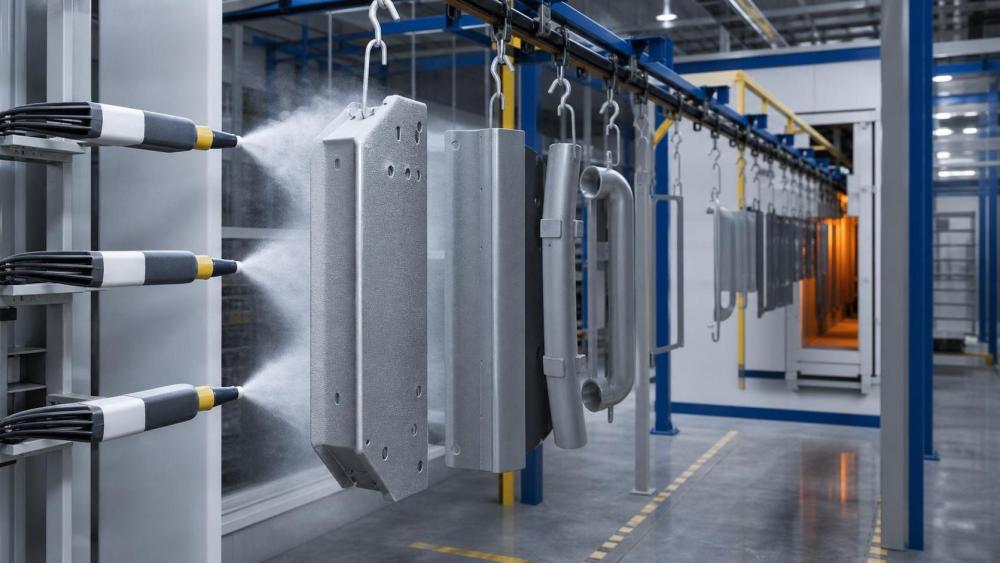
At its core, electrostatic adsorption coating uses an electric field. Coating particles are charged as they leave the spray device, while the target surface is grounded or given an opposite electrical condition.
Because of that charge difference, particles are drawn toward the part instead of drifting freely into the surrounding air. This attraction improves transfer efficiency and helps form a more even coating layer.
The effect is especially useful on complex shapes. Charged particles can wrap around edges and recessed areas better than conventional spraying, although geometry still influences the final result.
In powder applications, the powder clings to the surface before curing. In some liquid applications, the same principle helps atomized droplets land more precisely and reduce waste.
Simple in concept, the method depends on careful process control. Voltage, gun distance, airflow, grounding quality, particle size, humidity, and pre-treatment all shape coating behavior.
Why electrostatic adsorption coating draws industry attention
Surface treatment is no longer judged only by visual appearance. Manufacturers increasingly track coating thickness, adhesion, corrosion resistance, rework rate, and volatile emissions as measurable production indicators.
Electrostatic adsorption coating answers several of those concerns at once. It can reduce paint loss, support cleaner production lines, and improve repeatability when the substrate and process settings are matched correctly.
This is also why platforms such as GIAS give attention to coating technologies alongside cleaning, vacuum, marking, and batching systems. Auxiliary processes often decide whether final product quality is merely acceptable or commercially reliable.
A coated part may look fine on day one yet fail in storage, transport, or outdoor service. That gap usually comes from poor surface preparation, weak substrate compatibility, or unstable electrostatic conditions rather than from color choice alone.
Substrates that usually deliver the best results
The best substrates for electrostatic adsorption coating are generally conductive materials with clean, dry, and stable surfaces. Conductivity helps charge distribution, while surface cleanliness supports adhesion and film uniformity.
Metals remain the strongest fit
Steel, stainless steel, aluminum, and galvanized substrates are common choices. They are widely used in appliance housings, automotive components, metal furniture, cabinets, machinery frames, and architectural hardware.
These materials respond well because they can be grounded effectively. Once cleaned and pre-treated, they allow powder or liquid coating particles to deposit with strong attraction and predictable coverage.
Pre-treated metal performs better than bare metal
Conductivity alone does not guarantee a good coating. Oil, oxide scale, dust, and residual moisture interrupt adhesion and create thin spots, pinholes, craters, or premature corrosion under the film.
That is why cleaning and pre-treatment are inseparable from electrostatic adsorption coating. Degreasing, rinsing, conversion coating, and controlled drying often determine final quality more than spray speed does.
Some non-metal materials can work with extra measures
Certain plastics, composites, MDF, and glass can be coated electrostatically, but the process window is narrower. These materials are less conductive, so they may need conductive primers, surface activation, or specialized system design.
Their thermal limits also matter. If the coating requires curing at elevated temperature, the substrate must resist distortion, bubbling, or dimensional change during the oven cycle.
Where the process adds business value
Electrostatic adsorption coating is widely used where visual consistency and protective performance need to scale together. Typical examples include metal enclosures, shelving systems, tools, outdoor fixtures, and consumer product housings.
In export-oriented production, coating quality can influence more than product appearance. It affects weather resistance, scratch tolerance, packaging cleanliness, and whether parts maintain a uniform brand finish across batches.
The process also supports environmental targets when compared with less controlled spraying methods. Better transfer efficiency means less wasted material, lower booth contamination, and a clearer basis for process standardization.
That said, the value appears only when the entire chain is aligned. Cleaning systems, drying, grounding fixtures, curing ovens, and inspection routines all influence whether electrostatic adsorption coating performs as expected.
What usually causes unstable coating results
Many coating problems are blamed on spray equipment, but the root cause often begins earlier. Surface contamination is a common issue, especially when oils, polishing residue, or handling dust remain on the substrate.
Poor grounding is another frequent problem. If the part, rack, or conveyor path has high resistance, the electric field weakens and electrostatic adsorption coating becomes less efficient and less uniform.
Humidity can also shift performance. Excess moisture changes charge behavior, powder flow, and curing response. In practical terms, the same settings may work one day and drift the next if environmental control is weak.
Part geometry matters more than many people expect. Deep recesses, sharp internal corners, and enclosed cavities create Faraday cage effects, making some areas difficult to coat evenly without process adjustment.
- Check substrate cleanliness before adjusting spray voltage.
- Verify grounding resistance across fixtures and hanging points.
- Match coating chemistry to curing limits of the substrate.
- Review part geometry for recessed zones and wraparound requirements.
- Track film thickness and adhesion with repeatable inspection methods.
How to judge substrate fit before scaling production
A useful starting point is to separate technical fit from commercial fit. A substrate may accept electrostatic adsorption coating in a lab setting, yet still fail cost, throughput, or durability requirements in production.
Look at the whole process chain
The coating line should be reviewed together with cleaning, drying, handling, curing, and inspection. GIAS often frames industrial auxiliary systems this way because coating success depends on upstream and downstream discipline.
Test performance, not just appearance
Visual smoothness matters, but it is not enough. Adhesion, impact resistance, salt spray behavior, thickness distribution, and edge coverage provide a better picture of whether the substrate-process match is truly reliable.
Use sample runs to expose hidden constraints
Pilot trials often reveal fixture marks, grounding blind spots, curing distortion, or excessive powder recovery loads. Those details are hard to see in specification sheets, yet they strongly affect line economics.
A practical way to move forward
Electrostatic adsorption coating works best when substrate conductivity, surface condition, and curing compatibility are understood as one system. Metals usually provide the most reliable base, while non-metal options require closer validation.
For deeper evaluation, it helps to compare substrate properties, pre-treatment steps, coating chemistry, and inspection targets side by side. That approach makes it easier to judge whether a promising finish can become a stable manufacturing process.
The next useful step is to build a short decision matrix around part material, geometry, cleanliness, environmental conditions, and curing limits. That usually reveals whether electrostatic adsorption coating is the right fit or needs process adaptation first.