
Choosing between electrostatic coating and conventional spray painting is rarely a simple equipment decision. It affects coating transfer efficiency, finish stability, overspray levels, rework risk, and practical line throughput across many manufacturing environments.
In surface treatment, small process differences often shape larger business results. A coating method that looks acceptable in trials may struggle once part variety, grounding limits, cure windows, and output targets are introduced.
That is why electrostatic coating remains a frequent point of comparison on industrial lines. The right answer depends less on broad claims and more on how parts behave in real production conditions.
Why this comparison matters on modern production lines
Across advanced manufacturing, auxiliary systems influence yield as much as primary machines. Surface protection, appearance control, compliance, traceability, and downstream assembly quality are often linked to coating consistency.
GIAS focuses on these process-support technologies because they shape final product reliability. In that context, electrostatic coating is not only a finishing method. It is part of broader process control.
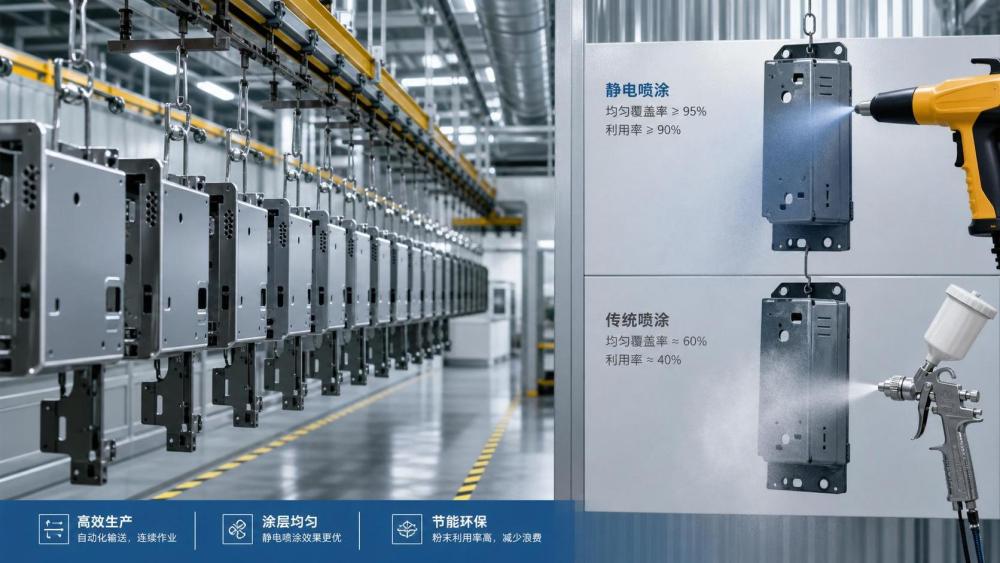
When coating performance is unstable, other systems feel the impact. Cleaning quality, masking precision, line balancing, cure scheduling, packaging appearance, and defect tracking can all become harder to manage.
Conventional spray painting still has a clear place. It can be flexible, familiar, and effective on many substrates. But in high-volume or material-sensitive operations, electrostatic coating may offer a stronger process window.
The basic difference between the two methods
Conventional spray painting atomizes liquid coating and directs it toward the part with air pressure or fluid pressure. Adhesion depends mainly on spray pattern control, part presentation, and operator or robot consistency.
Electrostatic coating adds an electrical charge to paint particles. A grounded part attracts those particles, improving deposition efficiency and helping the coating wrap around exposed surfaces more effectively.
That difference sounds straightforward, but its consequences are practical. Better attraction can reduce paint loss, improve coverage uniformity, and lower booth contamination. It can also introduce new limits when grounding is poor.
In other words, electrostatic coating is not automatically better. It performs best when the substrate, fixture design, paint chemistry, and line controls support the charging and grounding relationship.
Where electrostatic coating usually gains an advantage
The strongest case for electrostatic coating usually appears when material cost, finish consistency, and repeatability are under pressure. Those conditions are common in metal parts production, appliance components, and automotive supply chains.
Higher transfer efficiency is often the first reason. More coating lands on the part instead of the booth walls or extraction system, which can improve paint utilization and reduce cleanup frequency.
Finish appearance is another factor. Electrostatic coating can support a more even film build on suitable geometries, especially when line setup is stable and pretreatment has been controlled carefully.
Environmental compliance may also become easier to manage. Lower overspray can help reduce waste handling volume and support tighter control of solvent use, emissions, and housekeeping inside the coating area.
- Reduced paint waste on conductive parts with reliable grounding
- More consistent film distribution across repetitive production runs
- Lower booth loading and potentially fewer contamination events
- Stronger economics when coating cost per part is closely monitored
When conventional spray painting may fit better
Conventional spray painting remains useful where part mix is wide, geometry is difficult, or substrates are not ideal for electrostatic attraction. It can also be more forgiving during frequent color or product changeovers.
Very deep recesses, shielded cavities, and Faraday cage areas can reduce the effectiveness of electrostatic coating. In those zones, charged particles may avoid interior corners and favor easier external surfaces.
Some non-conductive substrates require special preparation or adapted process settings. If the line cannot provide stable grounding or suitable part support, the expected efficiency gains may not materialize.
For low-volume work, repair operations, or highly variable custom parts, conventional spray painting may offer simpler setup logic. A less optimized but more flexible process can sometimes outperform a sensitive one.
Part geometry and substrate decide more than marketing claims
Part shape is one of the clearest decision points. Flat panels, frames, enclosures, brackets, and external metal housings are often good candidates for electrostatic coating.
Complex assemblies with pockets, internal channels, or overlapping edges need closer review. The process may still work well, but only after fixture position, gun angle, voltage setting, and airflow are validated together.
Surface cleanliness matters just as much. Residual oil, dust, and pretreatment inconsistency reduce adhesion and appearance regardless of method. That links coating decisions to upstream cleaning and handling control.
This is where an auxiliary-systems view becomes useful. Ultrasonic cleaning, vacuum support, process monitoring, and identification systems can all strengthen coating repeatability beyond the spray stage itself.
A practical comparison matrix
Throughput is not only about spray speed
Many comparisons stop at gun output, but throughput depends on the whole line. Rehang rates, flash-off timing, cure balance, reject handling, and color change losses often outweigh nominal spray speed.
Electrostatic coating can support faster stable throughput when rework is reduced and transfer efficiency stays predictable. Less waste can also mean fewer interruptions for booth cleaning or filter maintenance.
Conventional spray painting may still hold line speed when product variety is high. A process that changes over quickly can produce better daily output than one with better coating physics but more setup dependency.
The useful question is not which method is faster in theory. It is which method preserves acceptable quality at the output level the line must hold every shift.
Points worth checking before committing to a process
A reliable comparison should move beyond brochure claims. Trial parts, grounded fixtures, coating specifications, and defect data should all be reviewed under realistic production conditions.
- Verify substrate conductivity and grounding continuity at fixture contact points
- Measure film build on edges, flats, recesses, and hidden zones
- Compare transfer efficiency using actual paint consumption per accepted part
- Track defect modes such as orange peel, thin spots, and back-ionization
- Assess cleaning, pretreatment, and curing as part of the same process chain
- Model color change frequency and downtime, not only steady-state operation
This fuller view aligns with how GIAS frames industrial decision-making. Final coating quality is rarely isolated from upstream cleanliness, process traceability, and downstream consistency requirements.
How to move from comparison to decision
The most effective next step is to rank the decision variables before comparing equipment. Part geometry, accepted defect rate, coating cost, line volume, changeover rhythm, and compliance targets should be weighted clearly.
If conductive parts, repeatable fixtures, and stable high-volume output define the line, electrostatic coating often deserves serious priority. Its value becomes clearer when waste and rework are measured honestly.
If the process must handle mixed substrates, irregular shapes, or frequent short runs, conventional spray painting may remain the better operational fit. Flexibility can be more valuable than peak transfer efficiency.
A strong evaluation framework compares both methods as complete production systems, not isolated spray guns. That makes the final choice easier to defend, scale, and improve over time.