
If you are comparing quotes right now, the first thing to know is this: electrostatic coating systems price is rarely defined by the spray gun alone. Two suppliers can offer what looks like the “same” system and still land far apart on budget because one quote includes pretreatment integration, recovery efficiency, controls, compliance safeguards, and installation support, while the other does not. That gap is where many purchasing mistakes start.
In practical terms, buyers usually want one clear answer: what will this system really cost to buy, run, and maintain over the next few years? That is the more useful question. A low entry quote can become expensive if transfer efficiency is poor, color change is slow, spare parts are hard to source, or local compliance upgrades are needed after delivery.
What actually shapes electrostatic coating systems price
The biggest cost driver is system scope. A basic manual setup for simple parts is very different from a conveyorized line with automated guns, powder recovery, curing coordination, and process monitoring. Many people search for a price expecting a universal number, but electrostatic coating is too application-specific for that.
At minimum, the quote is influenced by:
- Coating type: powder coating or liquid electrostatic coating
- Part size and geometry
- Target throughput per hour or per shift
- Required finish quality and film consistency
- Automation level
- Recovery and reclaim requirements
- Environmental, safety, and compliance needs
- Site conditions, utilities, and installation complexity
A short answer, if you need one: electrostatic coating systems price tends to rise when the process has to be faster, cleaner, more automated, more traceable, or easier to maintain across multiple product types. The equipment is only part of the budget; engineering and operating fit matter just as much.
That is why experienced buyers do not ask only, “What is the machine price?” They ask, “What process capability is included in that number?”
The price range problem: why headline quotes can mislead
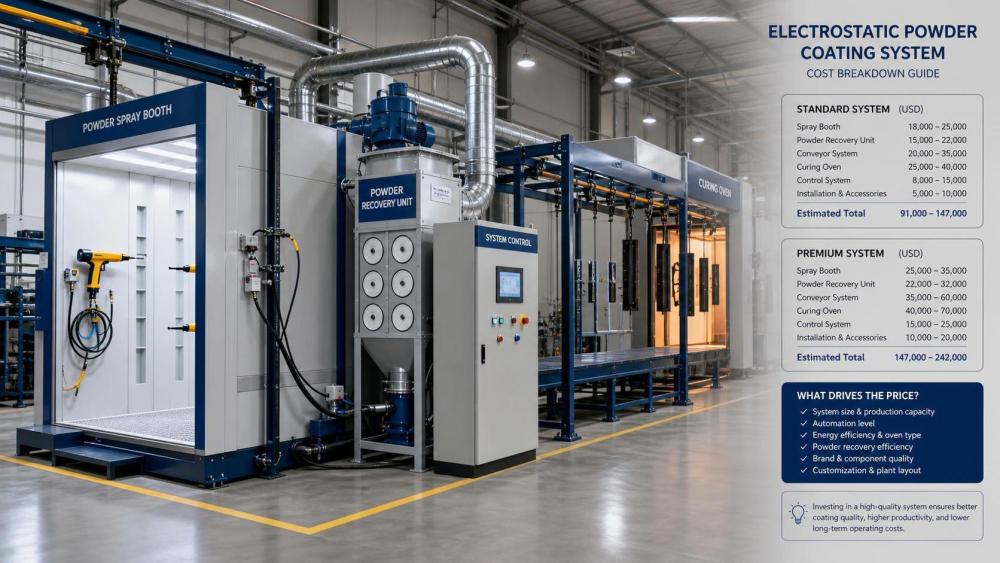
Suppliers often present starting prices, and those can be useful for orientation, but not for final budgeting. A “starting from” figure may exclude conveyor systems, booths, ovens, curing support, reclaim modules, safety interlocks, exhaust treatment, or controls integration. It may also assume a standard part profile that does not match your production reality.
In actual sourcing work, a quote becomes unreliable when it leaves out three things: process assumptions, boundary of supply, and post-installation responsibility. If those are vague, the price is vague too.
Common examples:
- A low-cost manual powder coating package looks attractive until labor cost and rework rates are added.
- An automated system appears expensive until you compare material savings and stable finish quality over high-volume production.
- An imported system seems competitive, but local commissioning, electrical adaptation, and spare parts lead time add hidden cost.
This is where procurement and engineering need to align early. A cheap quote that cannot consistently hit coating thickness, edge coverage, or transfer efficiency is not cheap in operation.
System configuration changes the budget more than brand names do
Brand matters, especially for controls reliability, spray technology, and after-sales support. But in many projects, configuration has a bigger effect on investment than the logo on the cabinet.
A few configuration choices drive cost quickly.
Manual vs. automatic spraying
Manual systems cost less upfront and can make sense for low-volume production, irregular parts, or frequent product changes. They are often the right fit for job shops or operations with unstable batch sizes.
Automatic systems need more capital, but they become easier to justify when output is predictable and finish consistency matters. They also make more sense where labor availability is a problem or where coating quality has direct commercial consequences, such as export products, branded consumer goods, or corrosion-sensitive components.
Powder recovery and reclaim
For powder coating lines, reclaim capability is not a small detail. It affects booth design, cyclone systems, filters, cleanliness, color change time, and usable powder efficiency. A reclaim-capable line usually costs more than a simple non-recovery setup, but it may pay back quickly in higher-volume production.
That said, reclaim is not automatically the right answer. If you run frequent color changes, small lots, or premium finishes where contamination risk is critical, a simpler setup with less reclaim complexity may be the better commercial choice.
Conveyor and line integration
Standalone spray equipment is one thing. A fully integrated finishing line is another budget category. Once conveyors, curing stages, loading/unloading ergonomics, and line balancing enter the picture, project cost rises because you are no longer buying a spray unit. You are buying production flow.
This is one of the most common buyer blind spots. Teams compare a standalone quote from one supplier to an integrated quote from another and assume one is overpriced. In reality, they are quoting different problems.
The hidden costs that matter after purchase
Most budget overruns do not come from the initial equipment price. They come later, through operating friction.
These are the cost areas worth checking before you approve the purchase order:
- Transfer efficiency: Lower efficiency means more wasted coating material and more booth contamination.
- Compressed air and power demand: Utility consumption should be checked against your site capacity.
- Spare parts availability: Delayed consumables and wear parts can stop a line faster than buyers expect.
- Cleaning and color change time: Slow changeovers reduce usable production time.
- Training needs: A system that operators do not fully understand will not deliver quoted performance.
- Maintenance access: If filters, pumps, gun components, or control modules are difficult to service, labor cost goes up and uptime goes down.
There is also the compliance layer. Depending on your region and coating chemistry, ventilation, grounding, fire protection, VOC management, dust handling, and operator safety requirements can materially affect project cost. Those items should be confirmed against local regulations and official guidance rather than assumed from a vendor brochure.
How to budget without guessing
A workable budget starts with process definition, not supplier outreach. Before requesting quotations, lock down the core operating conditions. If you skip this step, every supplier will fill in the blanks differently and the quotes will be hard to compare.
Use a simple pre-RFQ checklist:
- Part material, dimensions, and weight range
- Required finish type and film thickness expectations
- Daily or hourly throughput target
- Number of colors and expected changeover frequency
- Available floor space and plant utilities
- Existing pretreatment, drying, or curing assets
- Local safety and environmental requirements
- Planned operating shifts and labor model
Once that is clear, ask each supplier to separate costs into visible layers: equipment, installation, commissioning, training, optional upgrades, and expected annual consumables. This sounds basic, but many quote packages still hide these items inside general totals or leave them out entirely.
A useful procurement habit is to build two budgets, not one. The first is the acquisition budget: equipment, logistics, installation, integration, and startup. The second is the operating budget: coating material loss, utilities, labor, maintenance, and planned downtime. This approach makes it easier to defend a higher upfront investment when it clearly reduces long-term cost.
When the cheaper system is the wrong buy
Some purchases fail because the system was too expensive. Many more fail because it was too cheap for the production requirement.
A lower-cost electrostatic coating system may be the wrong choice if:
- Finish consistency is tied to customer acceptance or export quality standards
- You run high volume and material waste has a measurable cost impact
- Downtime disrupts upstream or downstream automated production
- You need traceable, repeatable process settings across shifts
- Local technical support is limited and reliability matters more than headline savings
On the other hand, it is also possible to overbuy. A highly automated line is not always justified for low-volume, high-mix production with frequent setup changes. Buyers sometimes pay for automation that looks impressive in a proposal but does not fit daily production reality.
The right question is not whether the system is advanced. It is whether the system matches the economics of your part mix, labor model, quality risk, and maintenance capability.
What a good supplier conversation looks like
Good suppliers usually ask uncomfortable questions early. They want to know part geometry, grounding challenges, rejection rates, pretreatment condition, booth cleanliness expectations, and whether your team is optimizing for cost per part or throughput. That is a positive sign.
Be cautious when a supplier gives a quick price without asking much about the process. Electrostatic coating performance is highly dependent on application details. Fast pricing with thin technical discovery often means assumptions are being made on your behalf.
It can also help to use neutral technical resources before shortlisting vendors. Platforms such as GIAS are useful here because they organize coating and auxiliary process topics in a way that helps buyers compare technologies, supplier positioning, and application fit without relying only on sales presentations. That is especially valuable when the coating system has to work as part of a wider production environment rather than as a standalone purchase.
FAQ
Is electrostatic coating systems price usually quoted per machine or per project?
In most serious industrial purchases, it should be treated as a project price. Machine-only quotes often exclude installation, line integration, utilities adaptation, and startup support.
Should I prioritize lower capital cost or lower operating cost?
If the line will run regularly, operating cost usually deserves more weight. Material waste, labor, downtime, and maintenance can overtake the initial price faster than many teams expect.
Does automation always reduce total cost?
No. Automation helps when throughput is stable and quality consistency matters. For low-volume or frequently changing jobs, manual or semi-automatic setups may be more economical.
How many quotes are enough for a fair comparison?
Three well-scoped quotes are usually more useful than five vague ones. The important part is that all suppliers are quoting the same process conditions and supply boundaries.
What should I confirm before approving a supplier?
Confirm scope of supply, local compliance fit, spare parts lead time, commissioning responsibility, training coverage, and expected operating assumptions. Those details often decide whether the project stays on budget.
In the end, electrostatic coating systems price only makes sense when it is tied to process requirements, not just equipment labels. Buyers who define the application clearly, separate upfront and operating costs, and challenge incomplete quotes usually make better decisions and face fewer surprises after installation.
Image Placeholder List
- — Suggested placement: after the section discussing misleading headline quotes and before deeper configuration analysis. Suggested image content: comparison diagram showing standalone unit cost vs. full project cost components such as booth, recovery, controls, installation, and compliance items. Suggested alt text: “Electrostatic coating system cost breakdown for procurement comparison.”
Internal Link Anchor Text Suggestions
- Powder coating line selection guide: guide page about comparing coating line configurations
- Industrial surface treatment process overview: educational page on pretreatment and finishing support processes
- How to evaluate industrial equipment suppliers: procurement checklist or supplier assessment page
- Factory compliance considerations for coating systems: compliance or EHS-focused resource page
- Auxiliary systems that affect coating quality: category page covering related industrial support equipment
External Authority Source Suggestions
- Government occupational safety and environmental regulator pages covering spray finishing, grounding, dust, VOC, or fire safety requirements
- Industry association technical guides on powder coating, finishing efficiency, and line design
- Official technical documentation from established electrostatic coating equipment manufacturers