
Electrostatic Coating Equipment Price Breakdown: What Affects System Cost?
Understanding electrostatic coating equipment price is essential when comparing systems for different production goals.
A low quote may look attractive first.
Still, the real cost often depends on throughput, finish quality, compliance, and maintenance needs.
This is why electrostatic coating equipment price can vary from a compact manual package to a fully automated line.
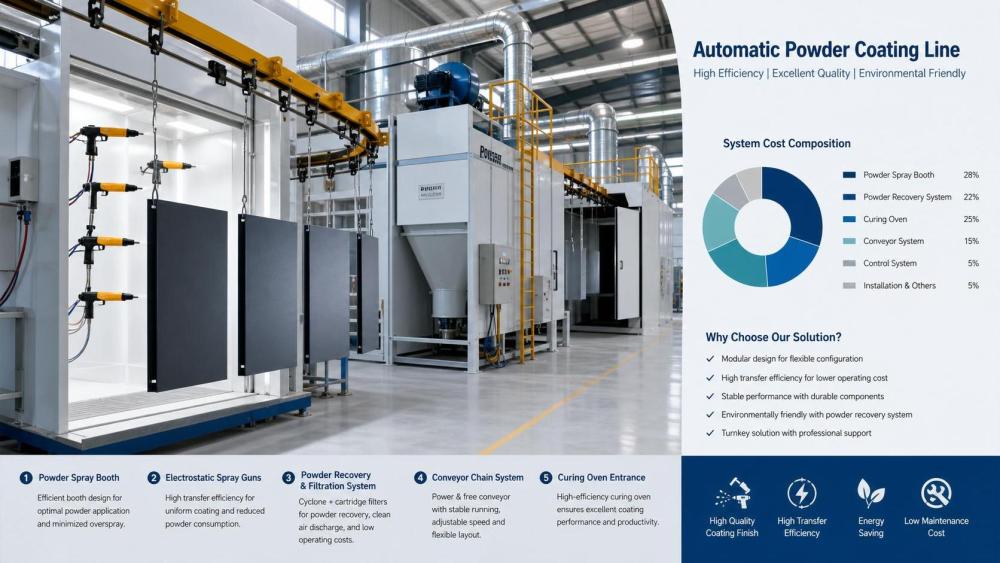
In practical buying decisions, the right question is not only “What does it cost?”
It is also “What drives the cost, and what value comes with it?”
That shift helps avoid under-specifying a system or overpaying for features the factory will never use.
Why Electrostatic Coating Equipment Price Varies So Much
Electrostatic coating systems are not a single standard product.
They are usually configured around part size, coating material, line speed, finish targets, and environmental controls.
A workshop coating metal cabinets needs a different setup from a plant coating automotive parts or appliance panels.
That also means electrostatic coating equipment price reflects process complexity, not just machine dimensions.
From recent buying patterns, the bigger price jumps usually come from automation, recovery systems, and compliance-driven upgrades.
Typical System Cost Tiers
While pricing differs by region and supplier, most projects fall into several broad ranges.
These ranges help frame budget discussions before detailed engineering starts.
These figures are directional, not fixed market quotes.
They show why electrostatic coating equipment price should be reviewed against output, reject rate, and operating cost.
The Biggest Cost Drivers
1. Automation Level
Automation often has the strongest influence on electrostatic coating equipment price.
Manual guns cost less upfront, but output depends heavily on operator skill.
Automatic guns, reciprocators, and programmable recipes increase capital expense.
However, they usually improve transfer efficiency, film consistency, and labor productivity.
2. Booth Size and Construction
Larger booths require more material, airflow design, and filtration capacity.
Stainless steel or quick-color-change booth designs cost more than basic fabricated structures.
This matters for manufacturers handling multiple colors or frequent production changes.
3. Spray Gun and Control Technology
Not all electrostatic guns perform the same way.
Voltage control, current limitation, powder feed stability, and smart presets affect coating quality.
Higher-end control systems reduce Faraday cage issues and support more repeatable application.
That can justify a higher electrostatic coating equipment price in quality-sensitive production.
4. Powder Recovery and Filtration
Powder recovery design has both capital and operating cost impact.
Cartridge filters, cyclone recovery, and dense-phase systems add cost upfront.
But they may reduce powder waste, lower housekeeping effort, and support cleaner recirculation.
In high-volume operations, this becomes a major total-cost advantage.
5. Pretreatment and Curing Integration
Many buyers focus only on the spray booth.
In reality, pretreatment and curing can represent a large share of project cost.
Wash stages, drying ovens, curing ovens, and conveyors may cost more than the guns themselves.
So electrostatic coating equipment price should be evaluated as a system, not a standalone component.
Hidden Costs Buyers Often Miss
A more complete budget goes beyond the supplier quotation.
This is where many procurement teams find late-stage surprises.
- Freight, crating, and import duties for large fabricated assemblies
- Installation, commissioning, and operator training charges
- Plant utilities, including compressed air, gas, power, and exhaust
- Spare parts packages, wear items, and filter replacement cycles
- Civil work, ducting, safety guarding, and fire protection integration
- Validation runs, color-change losses, and startup scrap
These items do not always appear clearly in early quotations.
That is why electrostatic coating equipment price must be checked against total installed cost.
Compliance, Safety, and Regional Standards
Compliance requirements can raise electrostatic coating equipment price more than expected.
ATEX-related design considerations, fire suppression compatibility, grounding integrity, and emissions control all matter.
Export-oriented factories may also request CE-related documentation or additional safety interlocks.
In actual projects, cheaper non-compliant equipment often becomes expensive after retrofits.
A compliant design usually reduces long-term operational risk, insurance issues, and approval delays.
How to Compare Supplier Quotes Properly
Two proposals with similar pricing may deliver very different value.
A structured quote comparison helps make electrostatic coating equipment price easier to judge.
- Define part dimensions, target output, coating thickness, and color-change frequency.
- Request a full equipment scope, not only the booth and guns.
- Ask for powder transfer efficiency and compressed air consumption data.
- Confirm included controls, spare parts, training, and documentation.
- Check warranty terms, service response time, and local technical support.
- Review expected maintenance intervals and yearly operating cost.
This process usually reveals whether a lower electrostatic coating equipment price is genuinely competitive or simply incomplete.
When Paying More Makes Financial Sense
The lowest equipment price is not always the lowest ownership cost.
A more advanced system may deliver faster color change, lower powder loss, and fewer reject parts.
It may also reduce dependency on highly skilled manual operators.
For plants with tight finish requirements, that performance gap is often worth the premium.
More clearly now, electrostatic coating equipment price should be linked to cost per acceptable coated part.
A Practical Buying Checklist
Before approving a project, keep the evaluation simple and measurable.
- Match system size to current demand and realistic expansion plans
- Prioritize finish consistency if product appearance affects brand value
- Estimate powder savings from better recovery before rejecting a higher quote
- Verify local service capability before selecting imported equipment
- Treat compliance documentation as a cost saver, not only a formality
- Compare total installed cost and annual operating cost side by side
A strong decision usually comes from balancing price, process stability, and after-sales support.
If the quote review follows that logic, electrostatic coating equipment price becomes easier to defend internally.
Start with a clear production brief, request complete scope details, and compare suppliers on total value rather than sticker price alone.