
On August 4, 2026, the European Commission adopted an amendment to REACH, Regulation (EU) 2026/1389, adding stricter Annex XVII controls on the use of PFAS in powder coating lines, plasma surface treatment equipment, and electrophoretic coating systems. From February 2027, manufacturers exporting industrial equipment to the EU that contains PFAS-functional coating components must provide shipment-level PFAS content declarations verified by ISO/IEC 17025 laboratories, together with an explanation of alternative technologies. This matters not only for equipment makers, but also for compliance teams, procurement functions, testing providers, and cross-border delivery operations because the change reaches both CE compliance work and customs clearance procedures.
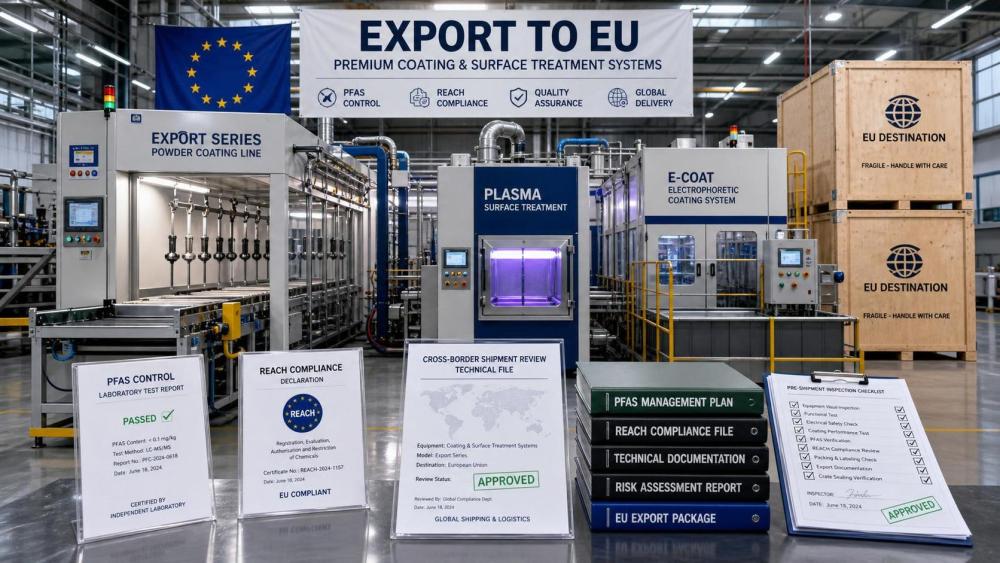
What the New Restriction Requires
The confirmed change is that PFAS used in powder coating lines, plasma surface treatment equipment, and electrophoretic coating systems has been brought under stricter control through Annex XVII of REACH by way of Regulation (EU) 2026/1389.
The confirmed implementation point is February 2027. From that date, industrial equipment manufacturers exporting to the EU with PFAS-functional coating components must provide two specific items with the shipment: a PFAS content declaration verified by an ISO/IEC 17025 laboratory, and a description of alternative technologies.
The information provided also confirms that this requirement directly affects the CE compliance pathway and customs clearance process for Powder Coating Lines and Plasma Surface Treatment equipment.
Where the Pressure Will Appear First
Export documentation moves closer to the point of shipment
From an industry perspective, exporters are likely to feel the impact first because the new requirement is tied to goods being shipped to the EU. The practical pressure point is no longer limited to internal material review; it now extends to whether the shipment package includes a laboratory-verified PFAS declaration and supporting technical explanation. That raises the importance of document completeness at the delivery stage.
Equipment manufacturing teams face a narrower compliance path
Analysis shows that manufacturers of Powder Coating Lines and Plasma Surface Treatment equipment may need to reassess how coating-related components are documented within existing CE compliance work. The key issue is not only whether PFAS is present, but whether the supporting records are organized in a way that aligns with the new REACH restriction and can travel with the equipment as part of an export file.
Procurement and supplier coordination become more sensitive
Observably, procurement teams and supplier managers may be affected where coating components are sourced externally. If PFAS-functional parts are included in the delivered system, the manufacturer will still need verified content information and an alternative-technology explanation for the final shipment. That makes supplier-side material transparency, test readiness, and technical file coordination more important than before.
Testing and clearance support functions gain a larger role
What deserves closer attention is the role of laboratories and trade support functions. Because the declaration must be verified by an ISO/IEC 17025 laboratory, testing arrangements become a practical compliance step rather than a secondary supporting task. In parallel, customs-facing documentation review may become more consequential for shipments involving the affected equipment categories.
What Companies Should Review Now
Check whether coated components fall into the affected scope
Analysis shows that exporters should first identify whether their equipment includes PFAS-functional coating components within the product categories named in the amendment. This is a threshold question for compliance preparation, especially for systems sold into the EU market after the February 2027 implementation point.
Prepare technical files for both compliance and shipment use
Companies should pay close attention to whether their existing technical documentation can support both CE compliance review and customs submission. Based on the confirmed information, the requirement is not limited to a general statement of conformity; it specifically refers to a laboratory-verified PFAS content declaration and a description of alternative technologies.
Review supplier evidence and testing timelines
Observably, businesses using externally sourced coated parts should examine whether supplier documents, material disclosures, and laboratory arrangements can support shipment timing. The input does not provide execution detail on review timelines or acceptance practice, so this should be treated as a point to monitor rather than an established procedural outcome.
Watch for changes in tender and delivery requirements
It is more appropriate to understand this as a rule change that may begin to flow into commercial paperwork, customer specifications, and delivery conditions. Where EU-bound projects involve affected equipment, companies should watch for updated bid documents, purchase specifications, or contract clauses that begin to reference PFAS declarations, laboratory verification, or alternative-technology statements.
Why This Looks Like an Execution Signal
Analysis shows that this development is more than a general policy direction because it combines a formal legal amendment, a defined implementation date, and concrete shipment documentation requirements. At the same time, the input does not provide the detailed enforcement wording that market participants often need for day-to-day execution, such as review practice, documentary format, or acceptance criteria. For that reason, it is more appropriate to understand the news as a clear execution signal with follow-up details still worth tracking.
From an industry perspective, the most important near-term question is not abstract policy intent but how quickly this requirement is reflected in compliance files, customs-facing document checks, procurement terms, and customer technical expectations for EU-bound equipment.
How This Update Is Best Understood
The immediate significance of this REACH Annex XVII amendment is that PFAS control is moving into a more operational phase for certain industrial equipment exports to the EU. The confirmed requirement links substance control to laboratory verification, shipment documentation, CE compliance work, and clearance procedures. A measured reading is that the change is already concrete enough to require preparation, while some execution details still need continued observation through future regulatory clarification, market practice, and industry feedback.
Basis of This Article
This article is based on the user-provided news title, event date, and event summary. For developments of this type, relevant source categories typically include official regulatory releases, notices from supervisory authorities, customs or trade administration updates, industry association communications, standard-setting documents, and reporting by authoritative trade media.
No specific official source link was provided in the input, so the exact official publication link still needs to be verified on an ongoing basis. Further observation is also needed regarding detailed policy interpretation, certification execution practice, tender document changes, industry feedback, and how companies implement the requirement in export operations.