
Switching a coating line from dry PU to PVC is rarely a simple material substitution. The resin system changes, the solvent and thermal profile change, the way the base fabric behaves can change, and quality risks move to different points on the process. For technical evaluators, that matters because line suitability is not decided by coating chemistry alone. The practical question is whether the same production line can deliver stable thickness, surface appearance, adhesion, and throughput after the switch without creating hidden losses in energy use, scrap, or rework.
In artificial leather manufacturing, dry PU and PVC can both produce coated textiles with similar end-use categories, but they do not ask the same thing from the equipment. A line that performs well with one system may need meaningful adjustments in coating head setup, oven zoning, web tension strategy, exhaust handling, and final inspection criteria before it performs acceptably with the other.
Where the process starts to diverge
On paper, both processes look familiar: unwind the substrate, apply coating, pass through heating sections, cool, and rewind. On the shop floor, the governing mechanism differs. Dry PU relies on solvent evaporation and film formation under controlled drying conditions. PVC coating behavior is more tied to plastisol or related compound fusion and gelation under heat. That difference affects nearly every line parameter that a technical team needs to validate.
With dry PU, drying is not only about removing volatiles. The rate of evaporation influences surface uniformity, pore structure where relevant, and the risk of defects such as pinholes, skinning, or uneven gloss. If drying is too aggressive at the front of the oven, the top layer may set before underlying solvent escapes efficiently. If it is too mild, tackiness, poor layer stability, or long dwell requirements may limit output.
With PVC, heat history becomes the more dominant concern. Incomplete fusion can leave the coated layer weak, underdeveloped, or unstable in later converting steps. Excessive heat may damage the hand feel, surface design, or even the substrate, especially on lighter fabrics. The line therefore needs a thermal path that matches the compound behavior, not just a generic “hotter or cooler” adjustment.
Coating station changes: knife, gap, viscosity, and laydown control
The first visible difference usually shows up at the coating head. Dry PU and PVC compounds often differ in viscosity profile, flow behavior, and sensitivity to shear. A setup optimized for one material may not give the same coat weight stability with the other.
Technical evaluators usually focus on four questions here:
- Can the coating method hold the required wet laydown consistently across the working width?
- How sensitive is the material to gap variation, speed change, and temperature drift?
- Does the substrate require a different backing support or tension window to avoid distortion?
- Can the line handle single-pass and multi-pass constructions without compromising registration or surface quality?
Dry PU systems may demand tighter control of solution condition and more attention to leveling before entering the oven. PVC compounds can place more emphasis on maintaining compound uniformity and preventing local thickness variation that later appears as uneven fusion or texture inconsistency. In both cases, the coating station should not be judged only by nominal compatibility; it should be judged by repeatability under actual operating speed.
That is why many evaluators review a dedicated artificial leather coating line in terms of coating mode, heating arrangement, and stenter compatibility rather than only checking the headline material name. If the line architecture is intended to process both dry PU and PVC, the real value lies in how it accommodates different process windows with controllable and repeatable settings.
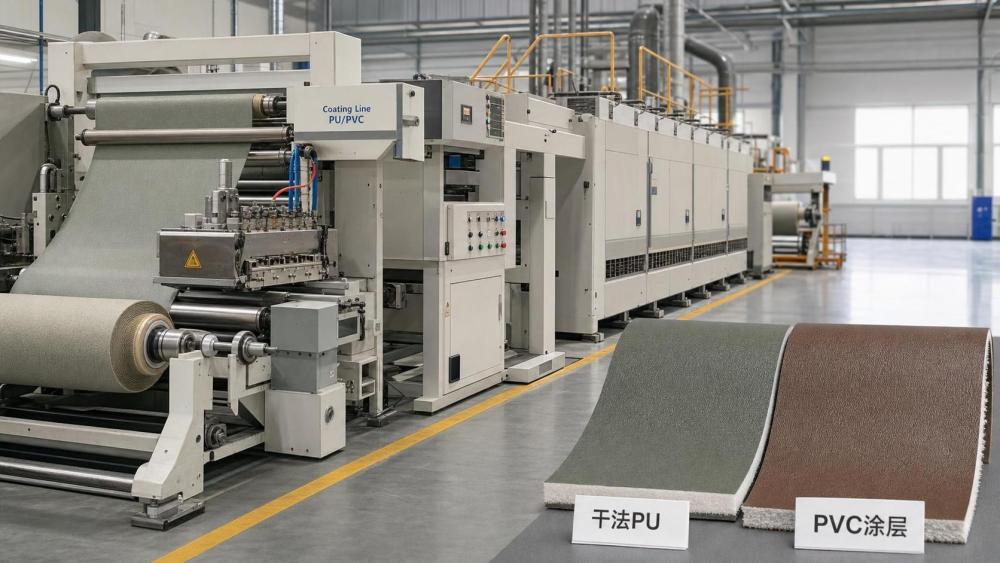
Oven behavior is not the same thing as “drying capacity”
One of the most common procurement mistakes is to compare lines by total oven length or installed heating power alone. For dry PU versus PVC, the shape of the thermal curve matters more than a single capacity number.
Dry PU often needs staged solvent removal. Early zones may need to avoid surface sealing, middle zones drive evaporation, and later zones complete film stabilization. Air volume, exhaust balance, and web travel all affect the result. If zone control is coarse, the process window can become narrow, especially when changing coat weight or surface style.
PVC generally puts more emphasis on achieving consistent heating through the thickness of the coating so that fusion is complete and uniform. Poor temperature uniformity across the width can show up as hand-feel differences, variable emboss response, or adhesion inconsistency after cooling.
For evaluation, this leads to a more useful checklist than basic heating power:
This is also where technical teams should ask whether line trials are evaluated using the exact substrate, target coat weight, and production speed range expected in real orders. A line may pass a demonstration at reduced speed but struggle once thermal load and exhaust balance rise at normal output.
Web handling and stenter function become more important than they look
Artificial leather quality is highly sensitive to what happens to the substrate while it is heated. Fabric width control, dimensional stability, and edge behavior can all shift as the chemistry changes. In some constructions, the coating adds enough stiffness to mask a handling problem until later converting or inspection. In others, the problem appears immediately as wrinkles, bowing, edge curl, or local coating weight variation.
This is why a stenter-equipped line deserves close review. The role is not only width setting. It can influence heat exposure uniformity, edge control, and the stability of the web path through critical sections. For dry PU, poor width and tension coordination can combine with solvent release effects to create visible surface defects. For PVC, unstable web travel through heating can produce nonuniform fusion or appearance differences across the width.
Evaluators should not assume that higher tension gives better flatness. In many coated textile applications, over-tension can distort the base fabric, alter final hand feel, and complicate downstream embossing or lamination. The useful question is whether the line can maintain a stable and appropriate tension window across different substrate types, including woven, knitted, and nonwoven backings where applicable.
Quality checkpoints move when the resin system changes
A common source of confusion in line conversion projects is that teams keep inspecting the same output variables but fail to move the process checks upstream. Dry PU and PVC may share final tests such as appearance, adhesion, and thickness, yet the points where defects originate are different.
For dry PU, process checks often focus on:
- Solution condition and consistency before coating
- Wet film uniformity at application
- Oven zone progression and exhaust balance
- Signs of trapped volatiles, pinholes, or surface sealing
- Blocking tendency and winding condition after cooling
For PVC, process checks often focus on:
- Compound homogeneity and laydown stability
- Heating profile sufficient for full fusion
- Cross-width consistency in surface and hand feel
- Post-heating adhesion behavior
- Embossing or secondary finishing response if required
These checks influence acceptance planning. If a buyer only specifies final thickness tolerance and visual appearance, line suitability may be overestimated. Technical evaluation should include intermediate observations such as how the coating behaves after the first oven zones, whether edge areas respond differently from the center, and how stable the process remains during speed changes or restart conditions.
Throughput comparisons can be misleading
Dry PU versus PVC is often discussed as a cost issue, but line economics are driven by more than resin price or nominal speed. Different thermal requirements, exhaust demand, start-up losses, and defect modes can change the real cost per acceptable meter.
A line may run PVC at a speed that looks competitive, yet if fusion is marginal at the edges, the result is either reduced usable width or a slower operating window. Dry PU may deliver the target surface quality, but if solvent removal requires conservative zoning and longer stabilization, practical output can fall below the planning assumption. In both cases, the hidden cost is usually process instability rather than the core chemistry itself.
Technical evaluators should ask for line assessment in terms of:
- Stable speed range, not peak speed
- Changeover time between constructions
- Start-up scrap and restart scrap
- Sensitivity to coat weight changes
- Consistency over long runs, not only short trial samples
That approach often reveals whether the line is genuinely versatile or simply capable of producing acceptable samples under narrow conditions.
Environmental and operational controls cannot be treated as secondary
When comparing dry PU and PVC on the same production platform, supporting systems deserve as much attention as the coating and heating sections. Exhaust management, air balance, cleaning routine, and maintenance access influence both product quality and operating discipline.
Dry PU processing typically brings more attention to solvent-related handling and the consequences of poor evaporation control. Residue buildup, airflow imbalance, or inconsistent oven conditions can become quality problems before they become maintenance problems. PVC processing shifts more attention toward heat consistency, compound cleanliness, and avoiding contamination that marks the surface or affects fusion.
For buyers and plant engineers, this means the qualification process should include practical questions such as how quickly the line can be cleaned between material systems, whether inspection access is adequate in critical zones, and whether process settings can be repeated reliably by different operators. A line that can technically run both chemistries but requires extensive manual correction each shift may be less attractive than a narrower platform with stronger repeatability.
What technical evaluators should compare before approving a line
When dry PU and PVC are both in scope, the most useful comparison is not “which material is better,” but “which line configuration maintains control when process windows change.” The answer usually depends on the intended product mix, substrate range, target finish, and the plant’s tolerance for trial-and-error tuning.
A practical review should cover:
- Coating compatibility: whether the coating head and delivery system can handle the required rheology range without unstable laydown.
- Thermal flexibility: whether heating and exhaust can be tuned by zone rather than treated as one fixed profile.
- Web control: whether tension, width, and edge behavior remain stable across substrate types.
- Quality monitoring: whether process checks are built around the likely defect mechanisms for each chemistry.
- Repeatability: whether the line returns to the same result after stoppage, changeover, or operator shift change.
The line changes because the process physics change. Dry PU and PVC may share a production route, but they do not stress the same parts of that route in the same way. A sound technical decision comes from mapping those differences onto actual line behavior—coating stability, thermal control, web handling, and defect prevention—rather than assuming that a line suitable for one coated artificial leather construction will transfer to the other without consequence.