
Coating adhesion failures become expensive long before a part is rejected. Blistering after humidity exposure, edge lifting during assembly, peeling beneath a fastener, or poor tape-test results can trigger rework, delayed shipment, added inspection, and disputes over responsibility. When selecting a coating adhesion supplier, the practical question is whether the supplier can support a repeatable coating system under the actual substrate, pretreatment, application, cure, handling, and service conditions involved.
A data sheet is necessary, but it rarely answers that question on its own. Adhesion is a system result. The same coating may bond well to blasted steel and fail on polished stainless steel; a formulation that performs reliably on a small flat panel may behave differently on a welded enclosure with sharp edges, oily seams, and varying film thickness. Supplier evaluation should therefore move from claimed coating properties to evidence that the supplier understands the complete process window.
Start with the failure mode and the substrate condition
“Poor adhesion” describes a visible outcome, not a single cause. Before comparing suppliers, define where separation occurs. Failure between the metal and pretreatment points toward cleaning, conversion coating, oxide condition, or substrate contamination. Separation between primer and topcoat suggests an intercoat compatibility or recoat-window problem. A cohesive tear inside the coating film may indicate that bonding is stronger than the film itself, while still raising questions about cure, brittleness, or chemical resistance.
Ask for technical discussion around the actual base material rather than a generic statement such as “suitable for metal.” Carbon steel, galvanized steel, aluminium, stainless steel, cast iron, copper alloys, plastics, composites, and die-cast parts each create different adhesion conditions. Aluminium can carry oxides and residual lubricants. Galvanized surfaces may present passivation residues. Castings may release oils or gases during heating. Plastic substrates can vary by resin grade, filler content, mould-release residue, and surface energy.
Fabrication history matters as much as material designation. Laser-cut edges, weld spatter, grinding dust, machining coolant, fingerprints, transport oils, and temporary protective films can all change local bonding. A capable supplier asks about these details early because coating selection without surface-preparation information produces misleading qualification work.
Useful questions at the quotation stage
- Which substrates and pretreatment routes were used to generate the stated adhesion results?
- Can the coating be applied over phosphate, chromate-free conversion layers, blasted profiles, anodized surfaces, or a specified primer system?
- What surface-cleanliness assumptions apply, including residual oil, salt contamination, abrasive dust, and handling residues?
- Are there known exclusions involving galvanizing, thermally sprayed metal, high-silicon castings, low-surface-energy polymers, or parts containing plasticizers?
Answers should be specific enough to expose limits. Broad compatibility claims without a defined preparation method are weak evidence, especially where the final component will see outdoor exposure, chemical contact, thermal cycling, or repeated washing.
Read adhesion data in context, not as a standalone number
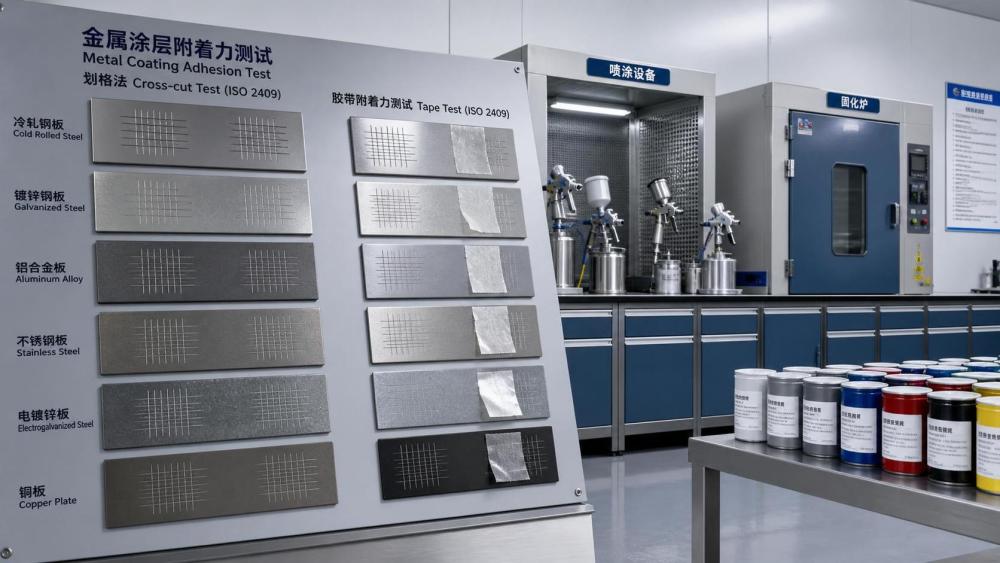
Cross-hatch, tape pull, bend, impact, pull-off, and scratch tests each reveal different aspects of coating attachment. A supplier that quotes one result without identifying the substrate, film build, cure schedule, conditioning period, and test method leaves too much uncertainty. A coating can pass an initial cross-hatch test yet lose adhesion after immersion, salt exposure, thermal shock, or a humidity cycle. Conversely, a result that appears modest on a severe test panel may still be acceptable for a controlled indoor application if the expected service conditions are limited.
Request the test sequence, not simply the final rating. The most useful records show panel preparation, coating thickness, application method, oven temperature or ambient cure conditions, time before testing, and environmental exposure preceding the test. This helps distinguish a material limitation from a process mismatch.
Film thickness deserves close attention. A thicker layer can improve coverage and appearance while increasing solvent entrapment, internal stress, sagging, or incomplete cure. An overly thin coating may show acceptable initial adhesion but leave edges and corners poorly protected. Powder coating, liquid paint, e-coat, thermal spray, and electrostatic application routes each have different thickness-control concerns. The supplier should be able to define an operating range and explain what happens outside it.
Assess the supplier's ability to support the whole coating stack
Coating adhesion often depends on materials supplied by more than one source: cleaner, pretreatment chemical, conversion coating, primer, topcoat, thinner or reducer, hardener, masking material, and repair paint. Compatibility across this stack is more useful than isolated product performance. A topcoat supplier that cannot comment on common primer or pretreatment interactions may leave critical validation work unresolved.
Particular attention is needed when changing one component in an established line. Replacing a solvent blend, hardener, powder batch, pretreatment stage, or cleaning chemistry can alter wetting, flash-off, conductivity, cure response, and intercoat bonding. The visual finish may remain acceptable while long-term adhesion deteriorates. A supplier should identify which changes require requalification and which process variables must remain controlled.
For liquid systems, clarify mixing ratio, induction time where relevant, pot life, viscosity adjustment, flash-off, spray equipment requirements, humidity sensitivity, and allowable recoat interval. A short pot life may be manageable in a tightly scheduled line but create waste and variation in low-volume work. For powder systems, ask about storage conditions, reclaim compatibility, fluidization behavior, charge response, and whether reclaimed powder has limits when color, gloss, or adhesion performance must remain stable.
Technical support should be visible before an order is placed
Technical support is often described in general terms, yet its value is easiest to evaluate through the supplier's qualification approach. Useful support begins with targeted questions and ends with documented decisions. This may include reviewing part drawings, identifying recesses and Faraday-cage areas, examining weld geometry, assessing fixture contact points, proposing a test matrix, or helping interpret a failure surface.
A supplier should be able to separate coating adhesion from related defects that look similar. Cratering often points to contamination or surface-energy disturbance. Pinholes can arise from porosity, outgassing, moisture, or excessive film build. Orange peel is usually an appearance and flow issue, although process changes made to correct it can affect cure. Delamination around an edge may come from inadequate edge coverage, mechanical damage, corrosion creep, or pretreatment breakdown rather than a simple adhesion defect.
Ask what happens after a nonconformance is reported. A credible response process includes retention of batch information, review of application and cure records, examination of failed parts or representative panels, and a clear distinction between preliminary observations and confirmed root cause. Immediate replacement material may address continuity, but it does not establish why the failure occurred.
Evidence of useful application knowledge
Application experience should match the relevant operating challenge, not merely the broad industry label. A coating used on indoor fabricated cabinets does not automatically demonstrate suitability for agricultural equipment, battery enclosures, food-processing frames, offshore components, or high-temperature electrical housings. Similar-looking steel parts may encounter very different washdown chemicals, UV exposure, impact loads, temperature ranges, and corrosion mechanisms.
Ask for examples of comparable technical conditions without requesting confidential customer details. Relevant evidence may include experience with complex geometries, rapid cure lines, multilayer systems, galvanised assemblies, frequent chemical cleaning, outdoor weathering, electrically sensitive parts, or components requiring post-coating assembly. The objective is to establish whether recommended parameters arise from practical experience rather than from a laboratory panel alone.
Quality control must connect raw material to the applied finish
Supplier quality systems matter most when they create traceability that can be used during an investigation. Each delivered batch should be identifiable through documentation that links product designation, batch or lot reference, manufacture date, shelf-life status, and applicable inspection information. For multi-component liquid products, the base and curing agent must remain traceable as a matched system.
Consistency is not limited to color and gloss. Relevant release controls may include viscosity, solids content, particle-size distribution, gel time, cure response, density, conductivity, moisture, or other characteristics appropriate to the coating technology. The exact parameters vary, but the supplier should explain which ones are controlled because they affect application and adhesion.
Storage and transport deserve the same attention. Freeze-thaw exposure can damage some waterborne materials. Excess heat can shorten the usable life of reactive products. Powder exposed to unsuitable humidity or temperature may flow poorly and charge inconsistently. Packaging should protect against contamination, leakage, moisture ingress, and mistaken component selection. Delivery performance is therefore not only about arriving on time; it includes arriving in a condition that preserves the qualified process.
Confirm cure requirements against the real thermal profile
Many adhesion problems attributed to coating chemistry are actually cure problems. Oven air temperature is not the same as part-metal temperature. Heavy sections heat more slowly than thin sheet, while densely loaded racks, sheltered cavities, and large thermal masses can create temperature differences within the same batch. If a coating needs a defined metal-temperature dwell, that requirement must be demonstrated on representative parts rather than assumed from conveyor speed or oven display readings.
Undercure can leave a coating soft, chemically vulnerable, and poorly bonded over time. Excessive cure can cause discoloration, embrittlement, loss of flexibility, or reduced intercoat adhesion. This is especially relevant where one assembly contains mixed materials, heat-sensitive seals, electronic components, adhesives, or pre-installed hardware. The supplier's proposed cure window needs to fit the component's thermal limits as well as the coating's technical requirement.
Where ambient-cure systems are used, temperature and humidity during cure should be considered alongside handling time. A surface that feels dry is not necessarily ready for stacking, machining, packing, chemical exposure, or tape testing. Premature handling can produce damage that later appears as an adhesion issue.
Compare total process cost rather than unit coating price
The lowest quoted material price can become costly when it increases cleaning demands, rejects, masking complexity, changeover time, energy use, rework, or inspection frequency. A higher-priced formulation may be justified when it reaches required performance at a practical film build, reduces the number of coats, tolerates a validated pretreatment route, or fits an existing cure profile. The reverse can also be true: paying for a premium coating is unnecessary when a simpler system meets the defined service condition with stable application.
Build the comparison around the applied part, not the container. Include transfer efficiency or overspray loss, reclaim practices where applicable, mixing losses, usable pot life, coverage at target thickness, cleaning and flushing needs, scrap exposure during color change, and the labor needed for touch-up. Material consumption per finished part is meaningful only when the same specification, geometry, and process assumptions are used.
Lead time should be evaluated with batch size, shelf life, minimum order constraints, color matching requirements, and contingency arrangements. A coating with a long nominal shelf life still creates operational risk if required hardeners, reducers, or approved primers are unavailable on the same schedule. When coating is tied to product release, a missing ancillary component can stop production as effectively as a missing topcoat.
Use a controlled trial before committing to broad release
A representative trial should include production-like surface preparation, actual application equipment, realistic part geometry, target film thickness, normal cure loading, and handling after cure. Flat coupons remain useful for comparison, but they should not be the only basis for approval. Include edges, recesses, weld zones, masked areas, fastener interfaces, and locations likely to collect moisture or cleaning chemical.
Agree in advance on acceptance criteria, inspection timing, retained samples, and the actions triggered by a failed result. This prevents later disagreement over whether a visible defect is cosmetic, process-related, or a coating-system failure. When several variables are changing, stage them where possible. Introducing a new coating while altering pretreatment, spray equipment, and cure settings at the same time makes root-cause analysis unnecessarily difficult.
The strongest supplier choice is supported by evidence that the recommended coating will adhere under the defined process and service conditions, with traceable material control and timely technical response when conditions drift. That level of fit reduces the chance that an apparently minor surface issue becomes a recurring production cost.