
Surface treatment technology Japan stands out because it connects material science with disciplined process control. In high-precision manufacturing, even a slight variation in surface condition can change corrosion behavior, friction, bonding strength, conductivity, or visual quality.
That is why Japanese production environments often treat surface finishing as a performance stage, not a cosmetic afterthought. For precision parts, the selected process affects service life, inspection stability, export readiness, and downstream assembly consistency.
Why surface treatment remains a critical precision issue
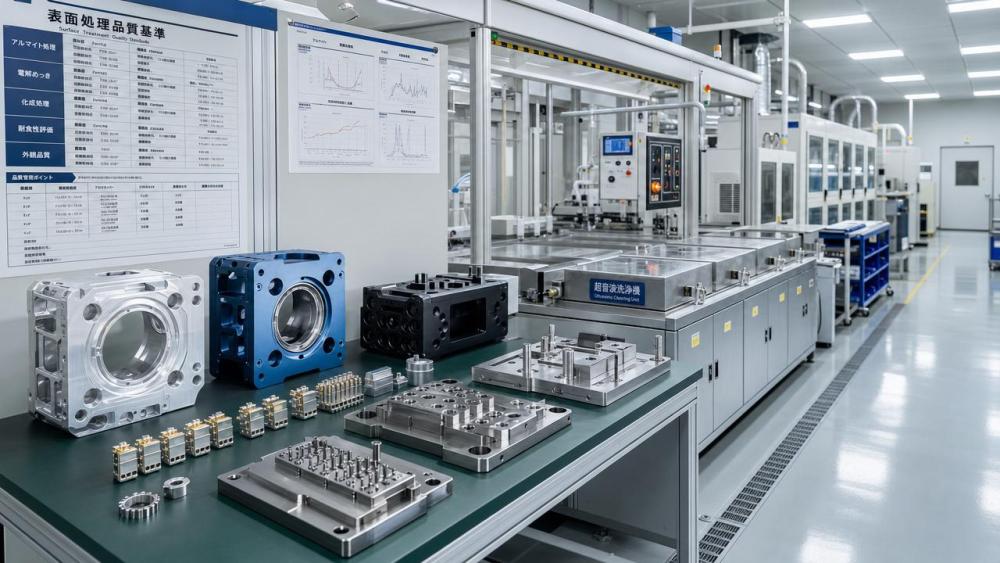
A high-precision part is rarely judged by dimensions alone. Its surface must also meet strict limits for roughness, adhesion, cleanliness, hardness, reflectivity, or chemical stability.
In sectors such as electronics, automotive, medical components, tooling, optics, and battery production, surface defects can lead to premature wear, coating failure, contamination, or weak joining performance.
Surface treatment technology Japan is closely associated with this mindset. The goal is not simply to add a protective layer. The goal is to create a controlled interface between the part and its operating environment.
This matters even more when production depends on auxiliary systems. Cleaning, vacuum handling, coating control, laser marking, and quality verification all interact with the final surface condition.
That broader process view is also why industrial intelligence platforms such as GIAS pay attention to surface protection alongside cleaning precision, traceability, and coating consistency.
The main processes used for high-precision parts in Japan
There is no single best method. Japanese manufacturers choose processes according to substrate material, end-use environment, tolerance sensitivity, and required functional outcomes.
Plating for conductivity, corrosion resistance, and wear control
Electroplating and electroless plating remain central in surface treatment technology Japan. Nickel, zinc, chromium, copper, silver, gold, and tin finishes are used in different combinations.
Electroless nickel is especially valued for uniform thickness on complex geometries. It supports wear resistance and dimensional stability, which are important in precision mechanical parts and molds.
Precious metal plating appears in connectors and electronic components where conductivity, low contact resistance, and long-term reliability matter more than appearance alone.
Anodizing for aluminum precision components
Anodizing is widely used for aluminum housings, frames, fixtures, and lightweight mechanical parts. It builds an oxide layer that improves corrosion resistance and can also increase surface hardness.
In high-precision applications, anodizing is often selected because it balances protection with clean appearance. Hard anodizing is favored when abrasion resistance is a key requirement.
Chemical conversion treatments for stable preparation
Chemical conversion coatings are commonly applied before painting, bonding, sealing, or additional finishing. They improve adhesion and create a more controlled reaction layer on metal surfaces.
For exporters and compliance-sensitive supply chains, the shift toward environmentally safer chemistries has become a major issue. Hexavalent chromium alternatives receive particular attention.
Polishing and micro-finishing for functional smoothness
Mechanical polishing, buffing, lapping, barrel finishing, and electropolishing are used when micro-scale smoothness directly affects performance. This is common in molds, optical parts, and sanitary components.
The target is not always mirror finish. In many cases, the required result is a repeatable roughness profile that supports sealing, sliding, coating adhesion, or contamination control.
Painting, powder coating, and functional films
Surface treatment technology Japan also includes high-performance coatings designed for weather resistance, insulation, anti-static behavior, chemical resistance, and brand-level appearance control.
Electrostatic coating systems are used where transfer efficiency and film uniformity are important. In practice, coating quality depends heavily on pretreatment, cleanliness, and curing control.
How process selection changes by part function
Looking at applications helps explain why surface treatment technology Japan is so process-specific. The same substrate may receive different finishes depending on operating demands.
This is where simple price comparisons often fail. A cheaper finish may increase rework, shorten field life, or create inspection inconsistency later in the supply chain.
What makes Japanese surface finishing distinct in practice
The reputation of surface treatment technology Japan comes from execution discipline as much as from the process names themselves. Several practical factors explain that difference.
Tighter control before the coating step
Pretreatment is often managed with unusual care. Degreasing, ultrasonic cleaning, rinsing, drying, and particle control are treated as measurable quality variables.
If contamination remains at micron level, even a well-designed coating can fail. For high-precision parts, preparation quality often decides final yield.
Greater emphasis on uniformity and traceability
Japanese factories often link treatment records with lot control, thickness checks, bath management, and visual inspection standards. This supports consistent output across repeat production.
When laser marking or coding is added later, the surface must also remain compatible with readable identification. That link between finishing and traceability is increasingly important.
Closer alignment with compliance and export expectations
Material restrictions, environmental standards, and customer-specific approval requirements continue to shape process choices. Surface treatment technology Japan increasingly reflects this compliance-first direction.
In other words, the finish must perform technically and remain acceptable across audits, certifications, and overseas market requirements.
How to evaluate a treatment route more accurately
A useful evaluation starts with the part’s real working conditions, not with the finishing catalog. The right questions usually sit at the interface between material, environment, and downstream process.
- What failure mode matters most: rust, wear, peeling, conductivity drift, staining, or visual inconsistency?
- How sensitive is the part to thickness build-up and edge effects?
- Will the surface later be bonded, welded, marked, sealed, or assembled in a clean environment?
- Does the process meet RoHS, REACH, customer specifications, or sector-specific restrictions?
- Can the supplier control bath chemistry, rinsing quality, drying, and inspection repeatability?
These questions are especially useful when reviewing surface treatment technology Japan for sourcing or benchmarking. They help separate functional value from surface-level claims.
Why the broader auxiliary process chain also matters
A finish does not exist in isolation. Cleaning systems, vacuum conditions, coating equipment, weighing accuracy for chemical dosing, and inspection methods all influence final stability.
That is one reason GIAS frames surface technology within a wider industrial support ecosystem. Better output often comes from coordinating several smaller process controls rather than changing only one machine.
For example, an ultrasonic cleaning stage may improve adhesion. A controlled vacuum environment may reduce contamination during coating. Accurate batching may keep treatment chemistry within acceptable limits.
Seen this way, surface treatment technology Japan is not just about finishing knowledge. It is about building a reliable chain from part preparation to protected final performance.
A practical next step for comparison and decision-making
When assessing surface treatment technology Japan, start by mapping the part material, service environment, appearance target, and compliance constraints in one sheet.
Then compare candidate processes by thickness control, pretreatment demands, inspection method, repair difficulty, and long-term field risk. That approach usually gives a clearer result than comparing finish names alone.
For ongoing research, it is also useful to follow how surface treatment connects with cleaning precision, electrostatic coating, vacuum support, and traceable identification. Those links often explain why one production route remains stable while another becomes costly over time.