
Surface Coating Treatments for Plastics: Which Methods Improve Paint and Bonding Performance?
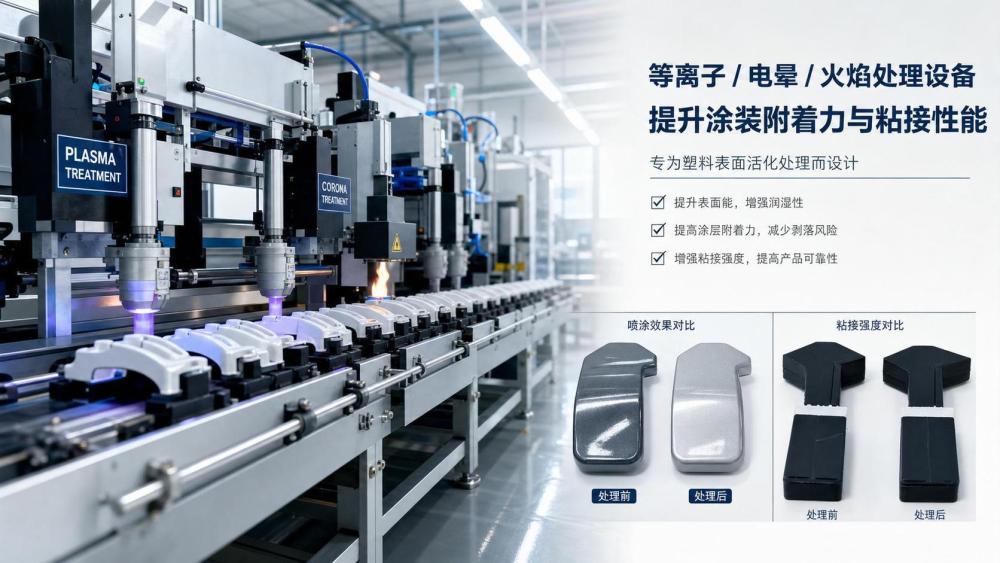
Choosing the right surface coating treatments for plastics often decides whether a painted or bonded part performs well or fails early.
That matters even more in automotive, electronics, medical devices, packaging, and consumer goods, where consistency is closely watched.
Many plastics have low surface energy. Paint, ink, or adhesive may bead up instead of wetting the surface properly.
This is why surface coating treatments for plastics are not just a finishing step. They are process enablers.
In practice, the best method depends on resin type, part geometry, contamination level, line speed, coating system, and required durability.
The most common options include plasma, corona, flame, chemical etching, primers, and mechanical roughening.
Each treatment changes the plastic surface in a different way. Some raise surface energy. Others create micro-anchoring or remove weak boundary layers.
A sound technical evaluation starts with one question: what failure mode must the treatment prevent?
Why Plastics Need Surface Preparation Before Paint or Bonding
Most untreated plastics are chemically stable and hard to wet. That is useful for molding, but difficult for coatings and adhesives.
Polypropylene, polyethylene, PTFE, and some engineered polymers are especially challenging because their surface energy is very low.
Even when a coating looks acceptable at first, poor pretreatment can cause peeling, blistering, edge lift, or weak lap shear strength later.
Mold release residues, oils, dust, silicone contamination, and moisture make the problem worse.
That is why surface coating treatments for plastics usually sit beside cleaning, handling control, and process validation.
A treatment that improves dyne level but ignores contamination may still produce unstable results.
Key performance targets
- Higher surface energy for better wetting
- Stronger chemical interaction with paint or adhesive
- More stable adhesion after heat, humidity, or chemical exposure
- Uniform treatment across complex part shapes
- Reliable output at the required production speed
How the Main Surface Coating Treatments for Plastics Work
The leading surface coating treatments for plastics do not all solve the same problem. Their mechanisms are different, and that affects selection.
Plasma treatment
Plasma activates the surface by introducing polar functional groups. It can also remove light organic contamination.
Atmospheric plasma is popular for inline manufacturing. Low-pressure plasma is stronger for precision parts, but needs vacuum equipment.
It works well on PP, PE, ABS, PC, PA, PEEK, and blended materials when process windows are controlled.
Corona treatment
Corona creates ionized discharge near the surface. It raises surface energy efficiently on films, sheets, and simpler molded parts.
It is common in packaging and label applications. Cost is moderate, and line integration is relatively straightforward.
However, treatment uniformity can drop on deep recesses or highly three-dimensional geometries.
Flame treatment
Flame treatment oxidizes the plastic surface very quickly. It is often used on polyolefins before painting or adhesive bonding.
The method is fast and robust, especially for larger parts. Still, overheating can deform thin walls or alter appearance.
Chemical treatment and primers
Chemical etching, solvent wiping, or adhesion-promoting primers can be very effective for difficult substrates.
They are useful when paint systems demand a specific interfacial chemistry. The tradeoff is environmental, safety, and waste-management complexity.
Mechanical abrasion
Abrasion creates roughness for mechanical interlocking. It helps on some rigid plastics, but rarely solves low surface energy by itself.
For demanding applications, it is usually combined with cleaning or another activation method.
Which Plastic Substrates Respond Best to Each Method
Substrate type should guide every comparison of surface coating treatments for plastics. A method that works on ABS may fail on PP.
Material fillers also matter. Glass fiber, flame retardants, plasticizers, and regrind content can shift treatment response.
This is why lab data from resin suppliers should be treated as a starting point, not a final process guarantee.
What to Measure When Comparing Paint and Bonding Performance
A technical review of surface coating treatments for plastics should rely on measurable outcomes, not visual appearance alone.
Useful validation methods
- Dyne pens or contact angle for surface wettability
- Cross-hatch adhesion tests for painted parts
- Lap shear, peel, or tensile tests for bonded joints
- Heat and humidity aging for long-term reliability
- Salt spray or chemical resistance when required by end use
- Microscopy or surface analysis for failure investigation
Timing also matters. Some activated surfaces lose effectiveness after storage, dust exposure, or handling.
This aging effect is often called hydrophobic recovery, especially with treated polyolefins.
So the test plan should include the real gap between treatment and downstream coating or bonding.
Selection Criteria for Industrial Production
In actual production, the best surface coating treatments for plastics balance adhesion improvement with throughput, safety, maintenance, and traceability.
Practical selection checklist
- Define the substrate grade, additives, color, and molding condition.
- Identify the exact paint, ink, or adhesive chemistry.
- Map the required durability standard and failure criteria.
- Check part geometry and treatment coverage limits.
- Review takt time, automation level, and maintenance capacity.
- Evaluate EHS requirements, emissions, and operator exposure.
- Run pilot trials using production-representative parts.
- Lock process windows with documented inspection points.
A common mistake is choosing only by initial adhesion gain. Stable output across thousands of parts is the real benchmark.
That also means upstream cleanliness, static control, and part handling should be reviewed together with the treatment station.
Common Risks and How to Reduce Them
Even well-chosen surface coating treatments for plastics can underperform when process discipline is weak.
- Under-treatment: low dyne level, poor wetting, early peeling
- Over-treatment: brittle surface, discoloration, distortion, or coating defects
- Contamination return: fingerprints, dust, release agents, packaging transfer
- Poor storage control: activated surfaces decay before painting
- Inadequate monitoring: process drift remains hidden until field failure
The response is usually straightforward. Standardize cleaning, minimize delay, verify energy input, and monitor treatment effectiveness regularly.
For higher-value products, it is worth linking treatment records to batch traceability and downstream quality data.
Final Takeaway
There is no universal winner among surface coating treatments for plastics. The right answer depends on substrate, coating chemistry, part shape, and durability target.
Plasma offers strong flexibility and clean integration. Corona is efficient for films and simpler shapes. Flame remains practical for many polyolefin parts.
Chemical methods and primers still matter when difficult surfaces or strict adhesion demands are involved.
The most reliable path is to match the treatment method to the plastic, confirm performance with realistic tests, and control the full production window.
For industrial teams comparing options, that approach turns surface coating treatments for plastics from a trial-and-error step into a repeatable process decision.