
How to Evaluate an Industrial Surface Treatment Supplier for Quality and Lead Time
Choosing the right industrial surface treatment supplier is critical for manufacturers that depend on coating consistency, corrosion resistance, and on-time delivery.
The real challenge is rarely price alone.
A low quote can look attractive, then fail under production pressure, audit checks, or urgent delivery changes.
That is why a structured supplier review matters.
A capable industrial surface treatment supplier should protect product quality, reduce rework, and keep your factory schedule stable.
This guide explains how to assess quality systems, process capability, lead time control, and total procurement risk.
Start with Process Fit, Not Just Supplier Size
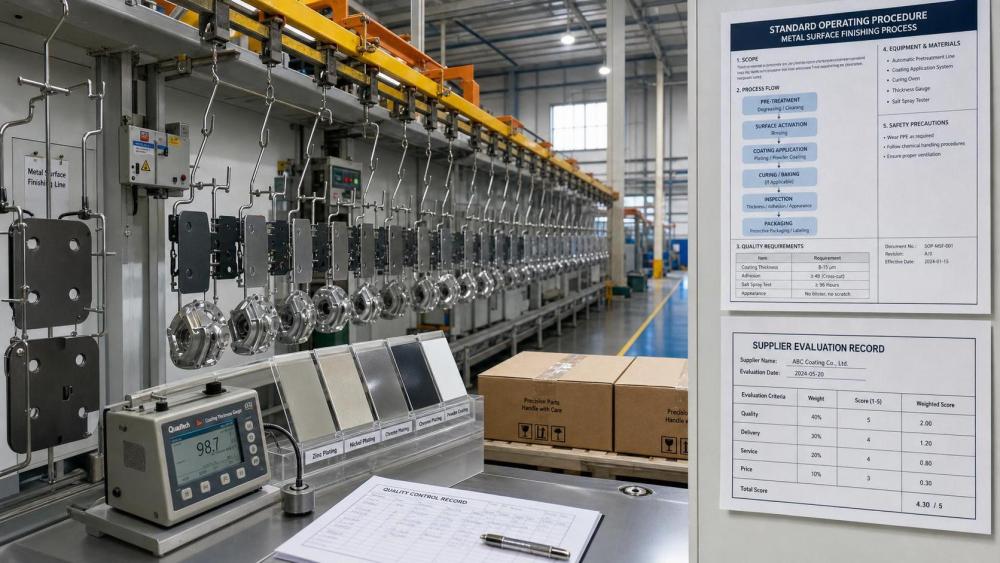
Before comparing quotations, confirm whether the industrial surface treatment supplier matches your actual application.
Surface treatment is not one process.
It may include electroplating, anodizing, powder coating, e-coating, phosphating, passivation, blasting, or specialty anti-corrosion layers.
Each option serves different substrates, performance targets, and compliance needs.
In practical sourcing, the first question is simple: can this supplier process your part, at your required volume, under your target standard?
Check these points early:
- Base material compatibility, such as steel, aluminum, zinc alloy, or engineered plastics.
- Part geometry, including blind holes, threads, sharp edges, and cosmetic surfaces.
- Required coating thickness, adhesion, hardness, and salt spray performance.
- Production volume, batch frequency, and changeover flexibility.
- Industry-specific standards, customer specifications, and export compliance needs.
A strong industrial surface treatment supplier will ask detailed technical questions before giving firm promises.
That is usually a positive sign.
It shows they understand risk at the process level, not just the sales level.
Verify Quality Control Beyond Certificates
Many buyers begin with ISO certifications, audit files, and quality manuals.
That is necessary, but it is not enough.
A qualified industrial surface treatment supplier should prove how quality is controlled on the line, not only how it is described in documents.
Look for evidence of routine process monitoring.
This includes bath chemistry control, pretreatment checks, temperature records, curing verification, and final inspection criteria.
If inspection depends mainly on operator experience, risk rises quickly.
Quality signals worth checking
- Incoming material identification and lot traceability.
- Pretreatment control for cleaning, degreasing, and surface activation.
- Thickness measurement methods and calibration records.
- Adhesion, corrosion, and appearance test reports.
- Nonconformance handling and corrective action records.
- Retention of production data for future claims or audits.
Ask for recent examples, not generic templates.
A reliable industrial surface treatment supplier should provide actual test formats, sample inspection sheets, and root cause analysis cases.
This is where supplier maturity becomes visible.
Assess Lead Time as a System, Not a Promise
Lead time problems usually begin long before the shipment date.
They often come from poor scheduling discipline, unstable pretreatment, overloaded curing capacity, or rework hidden inside normal production.
So when evaluating an industrial surface treatment supplier, ask how lead time is built and protected.
Do not rely on one sales answer.
Review capacity logic instead.
Questions that reveal delivery strength
- What is the normal queue time before processing starts?
- What is the daily or weekly output by process type?
- How are urgent orders inserted without harming existing schedules?
- What percentage of orders require rework?
- Which stages most often create bottlenecks?
- What backup plans exist for equipment downtime or chemistry issues?
A dependable industrial surface treatment supplier can explain lead time in operational terms.
That includes batching logic, inspection flow, packaging, transport coordination, and exception response.
More importantly, they should distinguish standard lead time from realistic rush capacity.
That difference matters for cost planning and customer commitments.
Review Technical Capability Through Samples and Data
A supplier presentation can sound polished.
Real confidence comes from sample parts, pilot runs, and measurable results.
This is especially important when appearance quality and corrosion resistance both matter.
Ask the industrial surface treatment supplier to process representative samples under expected production conditions.
Then review the output against your real acceptance criteria.
Sample review should include failures too.
If the industrial surface treatment supplier discusses limitations openly, that often indicates stronger long-term cooperation.
Hidden weakness is far more expensive than visible constraint.
Examine Compliance, Traceability, and Risk Exposure
From recent market changes, compliance has become a stronger sourcing filter.
Environmental rules, chemical restrictions, and customer audits are directly affecting supplier selection.
An industrial surface treatment supplier must now support both production and documentation readiness.
Review whether the supplier can provide material declarations, process traceability, waste treatment controls, and restricted substance compliance where required.
This also matters for export programs and multinational customer approvals.
Common risk checkpoints
- Can each lot be traced to process date, line, and inspection result?
- Are chemical controls aligned with local and customer regulations?
- Is there evidence of wastewater or emissions management?
- Can the supplier support audit requests quickly?
- Is subcontracting used, and if yes, how is it controlled?
A business evaluator should treat undocumented outsourcing as a warning signal.
It can weaken traceability, stretch lead time, and create quality variation that is difficult to investigate later.
Compare Total Cost, Not Unit Price Alone
This is where many sourcing decisions go wrong.
A cheaper industrial surface treatment supplier may create hidden costs through rejects, delayed launches, sorting labor, complaint handling, and unstable replenishment.
A slightly higher unit price can be more competitive if it protects production continuity.
When comparing suppliers, include these cost elements:
- Quoted processing price and tooling or setup charges.
- Freight, packaging, and damage-related replacement cost.
- Expected reject rate and internal inspection effort.
- Urgent order premiums and flexibility value.
- Claim response time and corrective action effectiveness.
- Commercial stability for long-term volume support.
A practical supplier scorecard helps here.
Weight quality performance, lead time reliability, compliance support, technical communication, and landed cost.
This approach makes the industrial surface treatment supplier comparison more objective and easier to defend internally.
Build a Shortlist with Real-World Validation
The final decision should not come from brochures alone.
Shortlist two or three candidates, then validate them through audits, trial orders, and performance follow-up.
In actual business, this step saves the most trouble later.
A strong industrial surface treatment supplier should perform well across three areas at the same time: stable process quality, predictable lead time, and responsive problem handling.
If one of those areas is weak, the commercial risk grows fast.
The most reliable sourcing decisions come from evidence.
Define your technical requirements clearly, request process data, test sample parts, and compare suppliers using a weighted scorecard.
That method gives you a clearer view of which industrial surface treatment supplier can support cost control without sacrificing manufacturing reliability.
If the next sourcing cycle is approaching, start with a pilot evaluation matrix and use it to screen suppliers before price negotiation begins.