
Choosing a plasma surface treatment machine for plastics and metal parts is rarely a simple equipment purchase. It affects adhesion strength, coating stability, print quality, sealing reliability, and surface cleanliness across many industrial processes.
That is why the evaluation should focus on process fit, not only on machine price. A suitable system supports repeatable production, while a poor match creates inconsistent bonding, rework, contamination risk, and hidden maintenance costs.
Within advanced manufacturing, surface treatment sits beside cleaning, coding, weighing, vacuum handling, and coating as a process-support function. It may not define the production line visually, but it often determines whether final quality remains stable.
Why plasma treatment matters in mixed-material production
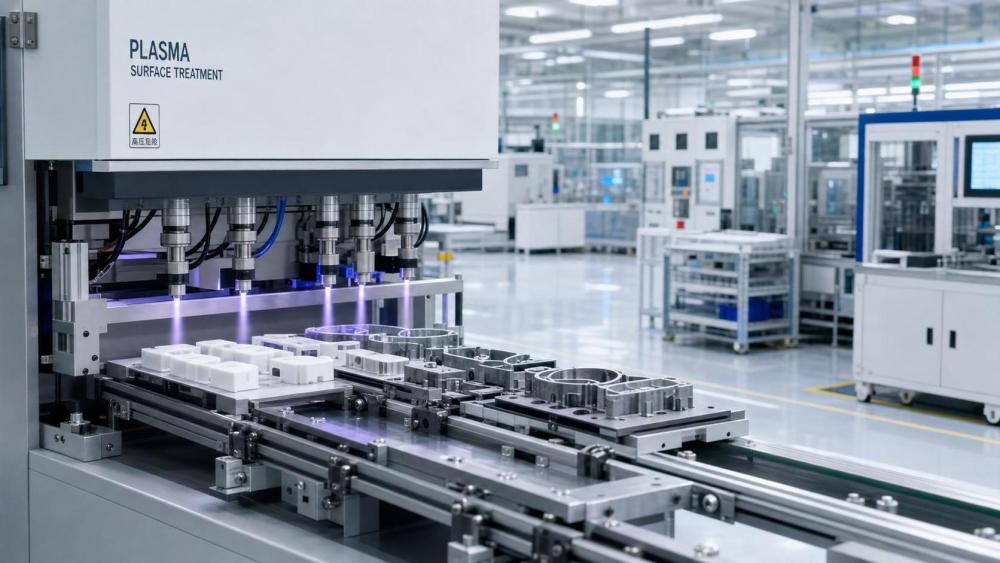
A plasma surface treatment machine modifies the outermost layer of a material. It raises surface energy, removes fine organic residues, and improves the ability of adhesives, inks, coatings, or sealants to attach correctly.
This is especially valuable when production includes low-surface-energy plastics, stamped metals, anodized parts, or precision components that cannot tolerate aggressive chemical preparation.
From an industrial perspective, the issue is broader than bonding alone. Better surface activation can influence corrosion protection, coating uniformity, traceability marking performance, and defect reduction in downstream assembly.
That broader view aligns with how process-support systems are evaluated across manufacturing. Microscopic control often shapes visible product quality, even when the treatment step takes only a few seconds.
The first decision is process compatibility
Not every plasma surface treatment machine works equally well across all substrates. Plastics and metals respond differently, and the same part family may include varied geometries, additives, finishes, and contamination conditions.
A practical review should begin with three questions. What material is being treated, what process follows treatment, and how long can the activated surface wait before the next operation?
For plastics, surface energy improvement is usually the main target. Polypropylene, polyethylene, PTFE blends, and filled engineering polymers often need activation before printing, gluing, laminating, or overmolding.
For metal parts, the emphasis may shift toward fine cleaning, oxide conditioning, or preparing the surface for coating, sealing, or precision bonding. The expected outcome should guide machine selection from the start.
Key compatibility factors
- Material family, including fillers, coatings, and prior surface finish
- Target process such as bonding, painting, printing, or sealing
- Part geometry, especially recessed areas, narrow channels, and complex edges
- Production takt time and allowable treatment window before the next step
- Sensitivity to heat, electrostatic effects, or particle contamination
Usually, the best machine is not the one with the highest power. It is the one that delivers the required surface result consistently on the real part, within the actual line conditions.
Uniformity is often more important than headline speed
Many treatment problems come from uneven exposure rather than insufficient treatment. If one area of a part receives less activation, bond strength and coating appearance can vary even when average settings look acceptable.
This is why a plasma surface treatment machine should be judged on treatment uniformity across the full working area. Nozzle design, electrode configuration, part handling, and stand-off distance all matter.
In automated lines, variation can also come from indexing accuracy, conveyor vibration, robot path drift, or fixture inconsistency. A machine may test well in isolation and still perform poorly in production.
In practice, uniformity should be confirmed with application samples, not only with supplier data. Dyne testing, adhesion testing, peel strength checks, or coating performance reviews provide better evidence than brochure claims.
Automation, traceability, and control features deserve close attention
A modern plasma surface treatment machine should fit into the line, not operate as an isolated station. Integration quality directly affects uptime, process traceability, and the ability to hold stable output over time.
This becomes more important when treatment supports high-value products, regulated sectors, or export-oriented manufacturing. Surface preparation may need to be documented just as carefully as coding, batching, or vacuum process conditions.
Features worth checking
- PLC and HMI controls with recipe storage for different part numbers
- Alarm history, parameter logging, and maintenance reminders
- Communication support for MES, SCADA, or plant data systems
- Interlocks for gas flow, power output, part presence, and exhaust status
- Quick changeover support for mixed-product production
A well-integrated system also helps quality investigations later. If coating defects or bond failures appear downstream, recorded treatment data can narrow the root cause much faster.
Operating stability depends on more than the plasma head
It is easy to focus on nozzle design or generator power, but stable performance depends on the entire support environment. Gas supply quality, exhaust design, ambient contamination, and fixture discipline all influence results.
This is one reason surface treatment belongs in the wider family of industrial auxiliary systems. Like cleaning, coding, or vacuum support, its value depends on how well the surrounding process is managed.
For example, if parts arrive with oil residue beyond the machine’s treatment capability, plasma cannot fully replace upstream cleaning. If activated parts sit too long before bonding, the surface benefit can decay.
More attention should also be given to electrode wear, spare part availability, calibration needs, and preventive maintenance intervals. Long-term operating cost is often shaped by these details, not by power consumption alone.
Questions that reveal lifecycle quality
- How often do consumable components require replacement?
- Can maintenance be done in-house without complex recalibration?
- Is local technical support available for urgent downtime events?
- What process alarms indicate declining treatment performance?
- How does the supplier validate repeatability over extended runs?
Application differences between plastics and metal parts
The same plasma surface treatment machine may serve both plastics and metals, but evaluation criteria should still reflect the application. A packaging component and a machined metal housing do not present the same treatment challenge.
For plastics, the concern is often adhesion reliability after molding additives, release agents, or handling contamination. Inks, labels, foams, films, and structural adhesives all respond differently to surface activation levels.
For metal parts, the focus may include pre-coating cleanliness, sealant wetting, micro-contaminant removal, or preparing narrow surfaces for robust assembly. Surface roughness and prior finishing steps should be reviewed closely.
In sectors such as electronics, automotive components, medical assemblies, consumer devices, and industrial equipment, the acceptable failure margin can be very small. That makes sample-based validation essential.
A practical framework for final comparison
When several machines appear similar, a structured comparison usually reveals the better choice. The strongest candidate is the one that combines technical fit, process evidence, and manageable ownership over time.
A useful shortlist should compare real part performance, not just generic specifications. That includes treatment test data, automation readiness, service response, and the supplier’s ability to support line qualification.
- Request trials using production materials, not substitute samples
- Compare pre-treatment and post-treatment quality data side by side
- Confirm how the plasma surface treatment machine handles expected throughput
- Review maintenance plans, consumables, and support response commitments
- Check whether process records can support audits and traceability needs
For organizations following industrial technology trends through platforms such as GIAS, this evaluation approach is consistent with how auxiliary systems should be assessed: by their measurable effect on quality, consistency, and compliance readiness.
The next step is to build a requirement sheet around substrate type, downstream process, line speed, control integration, and maintenance expectations. With that in place, comparing each plasma surface treatment machine becomes clearer, faster, and far more defensible.