
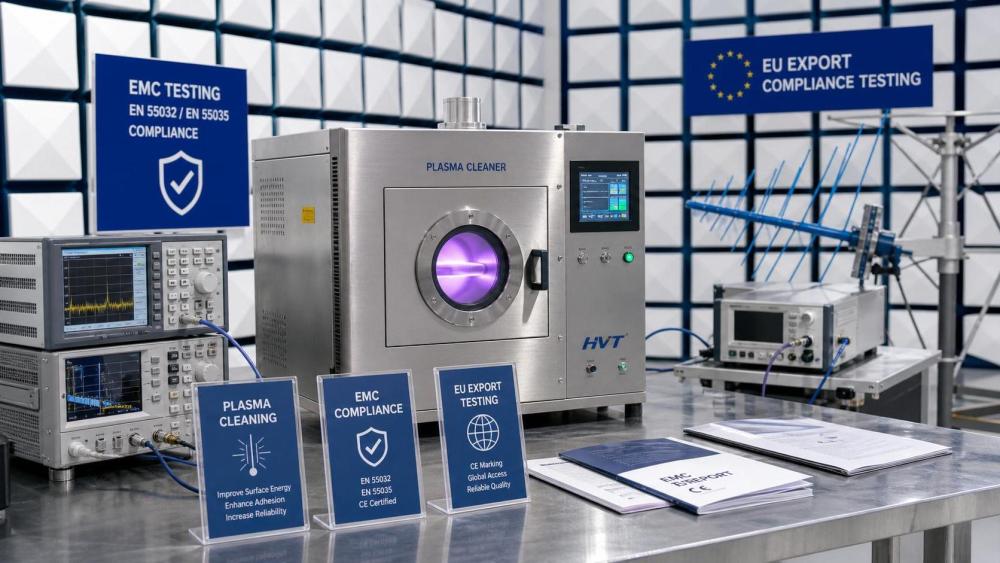
On July 1, 2026, the EU began enforcing the updated EMC standard EN 61000-6-4:2026 for plasma surface treatment equipment, bringing this equipment into the mandatory Class A industrial testing scope. For exporters, buyers, and compliance teams involved in plasma cleaning, activation, and coating systems, this is not just a standards update but a direct market-access requirement because products without the required certification cannot clear for CE marking.
What Has Changed as of July 1, 2026
The confirmed change is that the EU has made the updated EMC standard EN 61000-6-4:2026 mandatory from July 1, 2026. The rule explicitly includes Plasma Surface Treatment equipment within the compulsory testing scope for Class A industrial equipment.
The confirmed consequence is also clear: products that do not obtain the required certification will not be able to clear under the CE marking process. The requirement directly affects Chinese exporters shipping plasma cleaning, activation, and coating systems to the EU market. Buyers are also expected to verify that suppliers can provide the latest test reports and technical documentation before placing orders.
Where the Immediate Pressure Appears in the Supply Chain
Export shipments now face a stricter documentation threshold
For export-oriented manufacturers and traders, the most direct impact is on shipment readiness. If a plasma surface treatment system falls within the updated scope, the ability to move goods into the EU is tied to whether the relevant EMC certification work has been completed and whether supporting documents are available in time for delivery.
Procurement decisions move closer to compliance review
For buyers, the change affects supplier screening and order confirmation. The summary provided makes clear that purchasers should confirm the availability of updated test reports and technical documentation before ordering. In practice, this means procurement is no longer only about price, lead time, or technical configuration, but also about whether the supplier can support the current compliance requirement.
Testing and certification work becomes part of delivery planning
For companies handling certification, quality, or export documentation, the change affects how delivery schedules are assessed. The key concern is whether the required report set and technical file are aligned with EN 61000-6-4:2026 for the covered equipment category. Where that alignment is missing, shipment planning and customs clearance risk may increase.
What Companies Should Check Now
Review whether product scope and report status match the new requirement
From a practical standpoint, companies supplying plasma cleaning, activation, or coating systems should verify whether their equipment has already been assessed against EN 61000-6-4:2026 under the Class A industrial equipment requirement described in the update. The immediate question is not general compliance history, but whether the available certification materials reflect the newly enforced version and scope.
Check whether technical files can support customer and clearance review
What deserves closer attention is the completeness of technical documentation. The provided information specifically highlights the need for updated test reports and technical documents, which means suppliers should be prepared for closer document review during order placement and delivery coordination.
Reassess order timing and handover risk
Analysis shows that contract execution and shipping arrangements may need closer coordination where compliance evidence is still being updated. If purchase orders are placed before document readiness is confirmed, the risk may shift from a technical issue to a delivery and clearance issue.
Track how customers reflect the requirement in commercial documents
Observably, this type of standards change can quickly appear in procurement checklists, supplier qualification reviews, and bid or order documentation. Even where the input does not provide detailed execution language, companies should watch for how buyers begin to reference the new EMC requirement in their document requests and acceptance conditions.
Why This Looks Like an Execution Signal, Not Just a Standards Update
From an industry perspective, this development is better understood as an implemented compliance threshold rather than an early policy discussion. The effective date is already defined, the covered equipment type is identified, and the consequence for non-certified products is tied to CE-related clearance. That gives the change immediate operational relevance for companies already serving the EU market.
At the same time, analysis should remain measured. The input does not provide detailed enforcement practice, document review procedures, or market response across different buyer groups. For that reason, the more cautious reading is that the compliance requirement is already in force, while the exact pace and form of market-side implementation still deserve continued observation.
How the Market Should Read This Development
The clearest takeaway is that this is a rule change with direct consequences for trade execution, procurement checks, and delivery preparation for plasma surface treatment equipment entering the EU. It is more appropriate to understand this as a live compliance condition tied to access to the EU market, while also recognizing that companies still need to monitor how certification expectations, document review, and customer requirements evolve in practice.
Basis of This Article and What Still Needs Verification
This article is based on the user-provided news title, event date, and event summary. For developments of this kind, relevant source types often include official announcements, regulator publications, customs or trade authority notices, industry association updates, standards organization documents, and reporting by established industry media.
No specific official source link was provided in the input, so the exact official reference still needs to be verified on an ongoing basis. What also merits continued follow-up includes any detailed policy wording, certification enforcement interpretation, changes in tender or procurement documents, market feedback from buyers and suppliers, and how affected companies implement the requirement in actual deliveries.