
From December 1, 2026, companies placing industrial equipment with plasma surface treatment functions on the EU market will need to provide PFAS content declarations and third-party test reports for the supporting fluorinated gases used with those systems. The change follows an Annex XVII amendment published by the European Commission on June 5, 2026, and deserves close attention from equipment manufacturers, gas suppliers, importers, compliance teams, and EU-facing distributors because missing documentation will directly affect market access.
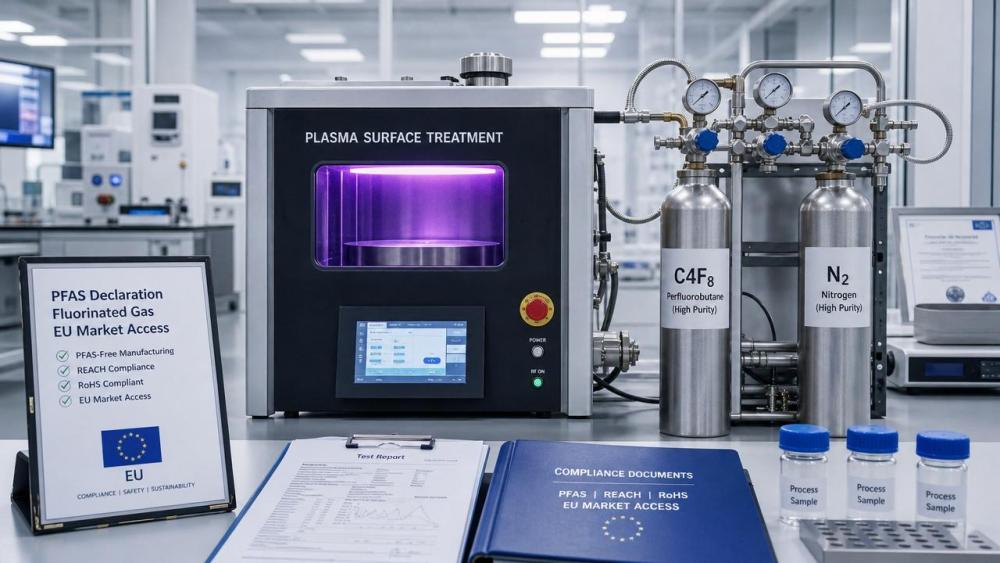
What the REACH amendment explicitly requires
According to the information provided, the European Commission published an update to the REACH restriction list under Annex XVII on June 5, 2026. The update covers industrial equipment that includes plasma surface treatment functions, including Plasma Surface Treatment systems.
For the supporting gases used with such equipment, including examples such as CF₄, C₂F₆, and SF₆, a PFAS substance content declaration and a third-party testing report must accompany the product. The requirement becomes mandatory on December 1, 2026.
The stated consequence is clear: if the required documentation is not provided, the relevant equipment cannot be placed on the EU market.
Where the practical impact is likely to appear
Equipment suppliers shipping into the EU
From an industry perspective, manufacturers and exporters of plasma-enabled industrial equipment are likely to feel the most immediate impact because the rule is tied to whether the product can enter the EU market. The operational pressure is not only on the machine itself, but also on the documentation package tied to the gases used with the system.
Gas sourcing and supporting material flows
Businesses involved in sourcing or supplying fluorinated gases may be affected because the requirement centers on PFAS content disclosure and third-party test evidence. What deserves closer attention is whether existing procurement and supply documentation is sufficient for EU-facing transactions, especially where equipment delivery depends on bundled or specified gas use.
Importers, distributors, and compliance coordinators
Importers, channel partners, and internal compliance teams may face added verification work at the point of market entry and customer delivery. Observably, the main business risk here is not only substance-related, but also document readiness, consistency of declarations, and the ability to demonstrate compliance before the equipment is placed on the market.
What companies should review now
Check whether product scope is affected
Companies should first review whether any industrial equipment in their portfolio includes plasma surface treatment functions and whether supporting gases such as CF₄, C₂F₆, or SF₆ are part of the delivered configuration, specified operating setup, or compliance file for EU sales.
Verify document availability before shipment
Analysis shows that the key compliance issue is not abstract policy awareness, but whether PFAS content declarations and third-party test reports are available in time for placement on the EU market. Teams handling export, technical files, and customer documentation should pay attention to timing, completeness, and consistency.
Align supplier communication and evidence standards
Where gas supply or testing evidence comes from external partners, businesses should focus on how supplier qualifications, document formats, and report validity support actual EU delivery needs. In practice, this is where compliance preparation can turn into a delivery bottleneck if expectations are not aligned early.
Watch for further clarification in implementation
What deserves closer attention is the difference between the headline rule and its day-to-day execution. Companies should continue monitoring whether additional official wording, interpretive guidance, or market-side documentation expectations emerge around the December 1, 2026 enforcement date.
Why this matters beyond a single filing requirement
Observably, this development is more than a paperwork update for companies serving the EU. It links market access for plasma surface treatment equipment to the traceability and disclosure status of the fluorinated gases associated with those systems. Analysis shows that this makes compliance coordination across equipment, materials, and supporting records more important than before.
It is more appropriate to understand this as an already defined near-term compliance change, while also treating it as a longer-term signal that substance-related documentation around industrial process inputs is receiving closer regulatory attention. At the same time, some implementation details may still require continued observation because the input provided does not include further official interpretive material.
How the market is likely to frame this update
At this stage, the industry significance lies in the fact that the requirement has a clear enforcement date and a clear market consequence. A rational reading is that businesses connected to Plasma Surface Treatment equipment should treat document readiness as part of market-entry preparation, not as a follow-up item after shipment planning begins.
Current observation suggests this should be understood both as an immediate compliance task for EU-bound business and as a regulatory signal worth tracking further, especially for companies whose commercial activity depends on technical files, supplier evidence, and cross-border delivery into the EU.
Basis of this article
This article is generated based on the user-provided news title, event date, and event summary concerning the EU REACH restriction update on PFAS disclosure for fluorinated gases used in plasma surface treatment equipment. It does not rely on additional unverified facts beyond the provided input.
For this type of development, relevant source categories typically include official regulatory notices, company compliance statements, industry association updates, authoritative media coverage, and standard-related documentation. The specific official source link was not provided in the input, so further verification remains necessary. Continued follow-up should focus on any additional official clarification, implementation wording, and market-side compliance expectations related to the December 1, 2026 enforcement date.