
On June 22, 2026, the European Chemicals Agency updated REACH Annex XVII to add a new restriction for CMC-based water-soluble aids used in Plasma Surface Treatment and Powder Coating Lines. The change sets an SVHC content limit of no more than 0.1% w/w and requires exporters to provide a full composition declaration together with batch test reports. For companies supplying supporting CMC materials, and for coating equipment manufacturers that use CMC as a process stabilizer, this is a compliance development worth close attention because it directly affects export documentation and shipment readiness.
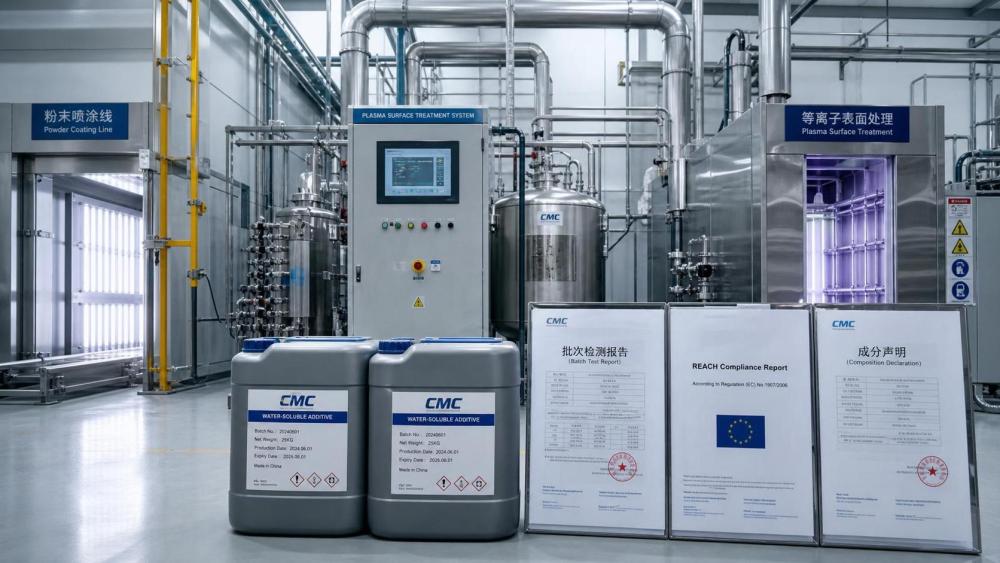
What the REACH Update Specifically Covers
According to the information provided, the update was formally issued by ECHA on June 22, 2026 through an amendment to REACH Annex XVII. The newly added requirement applies to CMC-class water-soluble auxiliaries used in Plasma Surface Treatment and Powder Coating Lines.
The confirmed requirements include an SVHC content threshold of ≤0.1% w/w. Exporters are also required to submit a complete composition declaration and batch-level testing reports.
The information further indicates that this adjustment directly affects supporting CMC suppliers and coating equipment manufacturers that use these materials as process stabilizers in export-related business preparation.
Where the Immediate Pressure May Appear
Material suppliers face a narrower documentation threshold
From an industry perspective, supporting CMC suppliers may be the first group to feel the operational impact. The reason is straightforward: the rule described in the update is tied not only to material content, but also to the ability to document that content through complete declarations and batch testing records. The main impact is therefore likely to appear in specification confirmation, document preparation, and pre-shipment compliance review.
Equipment manufacturers need to revisit embedded material compliance
For coating equipment manufacturers using CMC as a process stabilizer, the issue is not limited to the additive itself. Analysis shows that any export preparation involving Plasma Surface Treatment or Powder Coating Lines may now require closer review of whether the supporting water-soluble aid meets the stated threshold and whether the related paperwork is complete. In practice, this can affect export files, customer submissions, and internal coordination between engineering, purchasing, and compliance functions.
Export-facing teams may see compliance work move earlier in the process
Observably, the new requirement may also affect teams responsible for export execution, supplier coordination, and customer-facing documentation. The likely pressure point is timing: if composition declarations and batch test reports are not assembled early, compliance checks could shift from being a final-step formality to a gate in the shipment preparation process.
What Companies Should Watch Now
Track the exact regulatory wording in practical use
What deserves closer attention is the difference between a rule being published and a rule being applied in day-to-day export review. Companies involved with the covered applications should focus on how the Annex XVII wording is interpreted in product classification, material declarations, and customer requests tied to specific export transactions.
Review product and batch documentation readiness
The update explicitly mentions complete composition declarations and batch test reports. That makes document completeness a practical priority. Companies should therefore pay close attention to whether existing supplier files, internal records, and batch-linked evidence are sufficient for export compliance review under the updated requirement.
Recheck supplier coordination and contractual communication
Analysis shows that this is also a supply chain communication issue. If one party assumes material conformity while another party expects batch-level proof, delays can emerge even before customs or customer review. For firms buying, integrating, or exporting the covered materials, supplier qualification and evidence-sharing workflows now deserve closer review.
Prepare for customer and shipment-level questions
For businesses already selling into the EU market, it is more appropriate to understand this as a prompt to prepare for more detailed compliance questions tied to individual batches and export files. The key concern is not only whether a material is intended to comply, but whether that compliance can be demonstrated consistently at shipment level.
Why This Looks More Like a Compliance Signal Than a Standalone Event
Analysis shows that the significance of this update lies in how it links substance restriction with documentary proof. Based on the provided information, this is not just a technical threshold issue; it also raises the documentation standard for exporters dealing with covered CMC applications.
It is more appropriate to understand this as a concrete compliance signal with immediate operational relevance, while still treating its wider commercial effect as something that requires continued observation. The confirmed facts establish a clear rule change, but the full extent of impact across sourcing, quoting, delivery, and customer acceptance will depend on how market participants implement and verify the new requirement.
How the Industry May Best Read This Development
At this stage, the update is best read as a targeted regulatory change with direct consequences for export preparation in the affected application scenarios. The immediate meaning is clear: material thresholds, composition transparency, and batch-level testing now carry greater weight in CMC-related export compliance for the specified uses.
From a neutral industry standpoint, the most reasonable conclusion is that companies should neither overstate the market impact nor treat the change as routine paperwork. It sits between short-term operational adjustment and a broader compliance signal, which is why continued monitoring remains necessary.
Basis of This Article and What Still Needs Verification
This article is based on the user-provided news title, event date, and event summary. The content has been written from those inputs only and does not add unverified market data, company cases, or external regulatory details.
For this type of industry update, source categories commonly worth checking include official regulatory notices, company disclosures, industry association updates, authoritative media coverage, and relevant standards or compliance documents. A specific official source link was not provided in the input, so the exact document path and subsequent interpretive updates still require ongoing verification.
For continued observation, the most relevant follow-up areas are any further official clarifications on application scope, practical documentation expectations, and how affected exporters and buyers apply the new requirements in transaction-level compliance review.