
On July 14, 2026, the European Chemicals Agency (ECHA) added three new substances to the SVHC Candidate List, including fluorinated surface modification agents and certain azo compounds. For companies involved in Plasma Surface Treatment equipment, this is not just a regulatory update in the abstract: it directly affects export documentation, material review, and supply-chain communication where relevant SVHC content exceeds 0.1% w/w. Manufacturers, exporters, procurement teams, and compliance functions now have immediate reason to reassess how product composition is documented for the EU market.
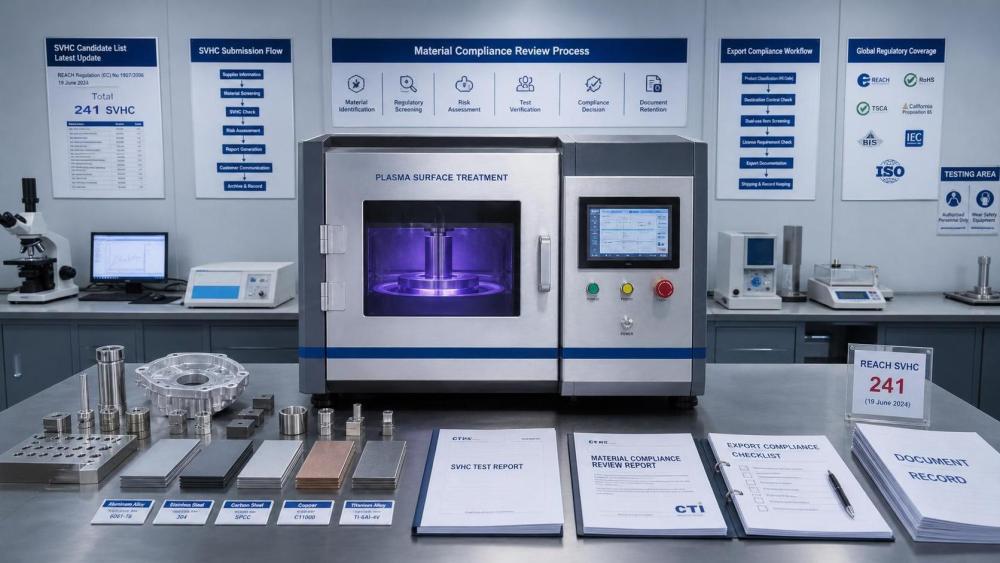
What the July 14 update changes in practical terms
According to the information provided, ECHA formally added three substances to the SVHC Candidate List on July 14, 2026. The substances involve fluorinated surface modification agents and specific azo compounds.
The update has direct compliance implications for industrial equipment that uses Plasma Surface Treatment technology. Where relevant SVHC substances are present in equipment at concentrations above 0.1% w/w, companies must provide a Safety Data Sheet (SDS) and article notification to the EU supply chain.
For Plasma Surface Treatment equipment manufacturers and exporters, the stated requirement takes effect immediately in operational terms: material composition screening needs to be reopened, technical documentation needs updating, and the CE Declaration of Conformity must also be reviewed and revised accordingly.
Which parts of the value chain may feel the impact first
Export-facing equipment manufacturers
From an industry perspective, this group is likely to face the most immediate pressure because the update directly touches the compliance status of equipment entering the EU market. The main effect is likely to appear in bill-of-material checks, technical file review, and outbound documentation control. What deserves closer attention is whether existing product configurations contain any of the newly listed substances above the stated threshold.
Procurement and material sourcing teams
Analysis shows that procurement functions may be affected because composition verification begins upstream. If a Plasma Surface Treatment device includes parts, coatings, treatments, or materials that could involve the listed substance categories, sourcing teams will need clearer declarations from suppliers. The practical issue is less about general purchasing and more about whether supplier material statements remain sufficient after the SVHC list update.
Exporters and supply-chain documentation handlers
For trading entities and teams managing EU shipments, the impact is likely to center on document readiness and timing. Where the threshold condition is met, SDS provision and article-related communication become part of the compliance package. Observably, this can affect handover points between manufacturing, compliance, logistics, and customers, especially when shipment schedules depend on complete technical paperwork.
EU-side buyers and downstream recipients
Buyers and downstream supply-chain participants in the EU may also be affected because the update changes the information they should receive when relevant SVHC content is present. Their main concern is likely to be traceability: whether the supplier has updated disclosures, whether the documentation aligns with the latest list status, and whether any pending orders require revised compliance files.
What companies should review now
Recheck material composition against the new list
The most immediate task is to rescreen materials and components used in Plasma Surface Treatment equipment against the three newly added SVHC entries described in the provided information. This is a practical screening exercise tied to concentration thresholds, not a general policy review.
Update technical files and conformity statements
The provided information specifically points to the need to update technical documentation and the CE Declaration of Conformity. Companies should therefore review whether existing files still match the current substance status and whether document versions used for EU deliveries remain valid after July 14, 2026.
Check supplier declarations and evidence trails
Analysis shows that supplier-side information will become more important where material content is not fully transparent at the equipment maker level. What deserves closer attention is whether current declarations are detailed enough to support renewed SVHC screening and whether internal records can show how the compliance conclusion was reached.
Prepare customer communication for EU deliveries
Where relevant SVHC content exceeds 0.1% w/w, SDS and article notification obligations affect how information is passed through the supply chain. In practice, companies should pay attention to whether EU customers, distributors, or integrators need refreshed compliance statements, revised supporting documents, or advance notice of documentation updates tied to ongoing orders.
Why this matters beyond a single list update
Observation suggests that this development should be understood first as an immediate compliance trigger rather than a distant policy signal. The operational consequence is already clear in the provided information: affected Plasma Surface Treatment equipment exporters must revisit material screening and documentation now.
At the same time, it is more appropriate to understand this as a continuing regulatory watchpoint rather than a fully settled endpoint. The current fact pattern confirms a list update and specific compliance consequences, but the broader business effect will depend on how many products, materials, and supplier declarations fall within the relevant scope once companies complete their screening work.
How to read the development at this stage
At this stage, the update is best understood as a short-term compliance change with longer-term signaling value. In the short term, the issue is document accuracy, substance screening, and EU supply-chain disclosure where threshold conditions are met. In the longer view, the development indicates that exporters of Plasma Surface Treatment equipment need stronger substance-level visibility across their products and suppliers. The prudent interpretation is neither to overstate the market impact nor to treat the change as routine paperwork only.
Basis of this article and points for follow-up verification
This article is based on the user-provided news title, event date, and event summary. For this type of industry update, commonly relevant source categories may include official notices, company disclosures, industry association information, authoritative media reporting, and standard-setting or compliance-related documents.
No specific official source link was provided in the input, so the exact primary reference still requires continued verification. Follow-up attention should focus on any further official wording related to the newly listed SVHC substances, any clarifications affecting documentation practice, and any downstream compliance expectations relevant to Plasma Surface Treatment equipment exported to the EU.