
Zero-VOC Coating Process for Metal Finishing: Where It Works Best
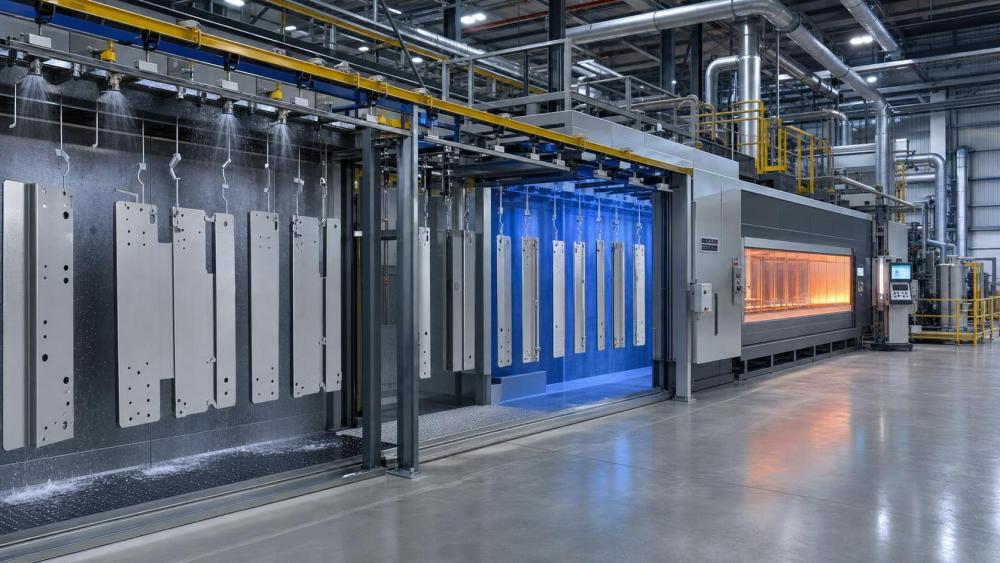
A zero-VOC coating process for metal finishing is moving from pilot projects into real production planning.
The main driver is clear.
Manufacturers need lower emissions without giving up corrosion protection, appearance, throughput, or audit readiness.
That sounds simple on paper.
In practice, success depends on substrate type, pretreatment quality, curing limits, and line design discipline.
This is why a zero-VOC coating process for metal finishing should be treated as a system decision, not only a material substitution.
Recent market changes make this even more relevant.
Buyers increasingly ask for environmental data, export compliance, and stable finish quality in the same conversation.
That also means line upgrades must support both technical performance and documentation control.
Suitable Substrates for a Zero-VOC Coating Process for Metal Finishing
Not every metal behaves the same under a zero-VOC coating process for metal finishing.
Substrate chemistry, surface energy, oxide behavior, and part geometry all affect coating results.
Carbon steel and galvanized steel
These are often the most practical starting points.
With stable pretreatment, powder and other zero-VOC systems can deliver strong adhesion and reliable corrosion resistance.
The key issue is surface cleanliness.
Residual oil, stamping compounds, and weld scale quickly reduce transfer efficiency and film uniformity.
Aluminum and aluminum alloys
Aluminum is also a strong candidate, especially for architectural parts, enclosures, heat sinks, and transport components.
But oxide consistency matters more than many teams expect.
If the pretreatment stage is inconsistent, a zero-VOC coating process for metal finishing can show edge adhesion problems or cosmetic defects.
Stainless steel
Stainless steel can be coated successfully, but it is less forgiving.
Its passive surface often needs more deliberate activation before coating.
This becomes more important when the coated part faces humidity, cleaners, or outdoor exposure.
Castings and mixed-metal assemblies
These are possible, but risk rises quickly.
Porosity, trapped contamination, and uneven thermal mass can complicate curing and appearance.
For mixed-metal products, differential expansion and galvanic exposure should be reviewed before final line selection.
Where the Process Reaches Its Limits
A zero-VOC coating process for metal finishing is not automatically the right answer for every product family.
The most common problems appear when process limits are ignored during early planning.
- Heat-sensitive assemblies may not tolerate curing temperatures.
- Deep recesses and sharp Faraday areas may reduce powder coverage.
- Ultra-thin decorative films can be harder to control on complex parts.
- High-gloss cosmetic finishes may expose every upstream cleaning defect.
- Frequent color changes can lower line efficiency without strong booth design.
This does not mean the process is weak.
It means the application window must be defined with real production data.
In actual operations, line planners often underestimate how much geometry affects transfer and cure consistency.
A coating that works on flat panels may behave very differently on boxed structures or welded frames.
Pretreatment Still Decides the Outcome
The cleaner the substrate, the more predictable the result.
That principle remains true for every zero-VOC coating process for metal finishing.
Pretreatment usually includes degreasing, rinsing, conversion treatment, and controlled drying.
The exact route depends on metal type, corrosion target, and final appearance standard.
More importantly, pretreatment quality should be measured, not assumed.
Water-break checks, conductivity control, bath concentration records, and surface contamination testing all reduce risk.
For export-oriented production, these records also support traceability and customer audits.
This is one area where industrial auxiliary systems directly protect coating performance and compliance credibility.
How Line Design Changes Real Results
Line design has a larger effect on performance than the coating label alone.
A zero-VOC coating process for metal finishing needs coordinated handling, airflow, cure control, and recovery logic.
Part flow and hanging strategy
The way parts enter the line affects grounding, shadow areas, drainage, and final finish uniformity.
Poor racking can turn a capable process into a high-rework line.
Booth and recovery design
For powder-based zero-VOC systems, booth cleaning time and powder recovery strongly affect operating economics.
This becomes critical when batch sizes are small or color changes are frequent.
Oven sizing and curing stability
Cure windows must match the heaviest and lightest parts on the same line.
If thermal balance is poor, one group may under-cure while another discolors.
Inspection and feedback points
A well-designed line includes checkpoints for film thickness, adhesion, cure confirmation, and appearance grading.
Without these controls, problems are discovered too late, often after packing or shipment staging.
A Practical Evaluation Framework
Before approving a zero-VOC coating process for metal finishing, decision teams should compare the full application window.
This structure helps teams avoid a narrow material-only decision.
It also helps align engineering, purchasing, quality, and compliance priorities early.
Common Mistakes During Adoption
Several recurring mistakes slow down a zero-VOC coating process for metal finishing.
- Treating low emissions as proof of line compatibility.
- Skipping substrate-specific pilot tests.
- Using old pretreatment settings for new coating chemistry.
- Ignoring cure mapping across different part masses.
- Underestimating maintenance needs for recovery and airflow systems.
These points are easy to miss when the project is pushed mainly by compliance deadlines.
A better approach is to link environmental targets with measurable production outcomes from the beginning.
What a Strong Rollout Looks Like
A strong rollout usually starts with a controlled application review.
Map substrate families, part geometry, finish targets, and annual volume before selecting line architecture.
Then validate pretreatment, coating, and cure performance using production-like parts, not only coupons.
From there, build inspection points into the line and define acceptance criteria that operators can use consistently.
For many factories, the best result comes from combining process testing with stronger auxiliary systems for cleaning, handling, curing, and traceability.
A zero-VOC coating process for metal finishing can deliver compliance and durable finish quality, but only when substrate fit, process limits, and line design are engineered as one practical solution.