
On July 8, 2026, Vietnam’s Ministry of Industry and Trade issued a technical notice that changes the import condition for Eco-spray Booths and VOCs treatment equipment. From August 15, 2026, imported units will need to arrive with an online VOCs concentration calibration module already integrated, and that module must be certified by STAMEQ with an NIST-traceable standard gas verification report. For exporters, buyers, customs documentation teams, and delivery planners, this is worth close attention because the change affects not only product configuration, but also clearance readiness and shipment execution.
What the new import condition states
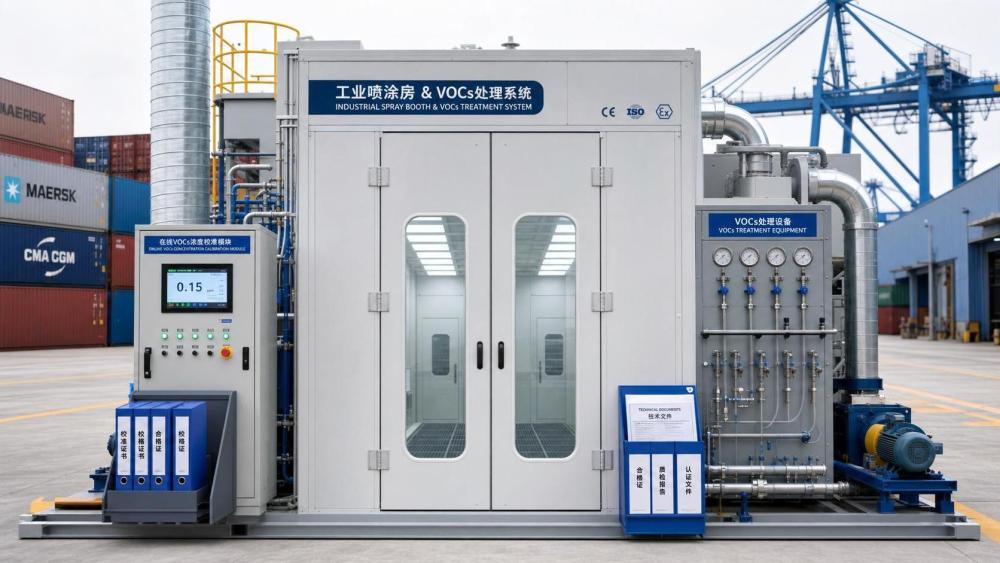
The confirmed information available shows that MOIT issued Technical Notice No. 117/TB-BCT on July 8, 2026. The notice requires all imported Eco-spray Booths and VOCs treatment equipment, from August 15, 2026, to have a pre-integrated online VOCs concentration calibration module.
The module must be certified by Vietnam’s STAMEQ, and the equipment package must include an NIST-traceable standard gas verification report. According to the event summary provided, equipment that does not meet this requirement will be refused unloading at Ho Chi Minh City Port.
The same summary also indicates that Chinese exporters need to adjust both factory configuration and the technical documents used for customs declaration.
Where the pressure will likely appear first in the trade chain
Export configuration moves from optional feature to shipment prerequisite
From an industry perspective, exporters of the covered equipment may be affected first because the rule is framed around import eligibility, not post-arrival modification. That means the integration of the online VOCs concentration calibration module becomes part of shipment readiness. What deserves closer attention is the shift from a product option or project-specific specification to a likely pre-shipment compliance condition for affected equipment entering Vietnam.
The practical impact may appear in product configuration review, factory release checks, packing lists, and technical file preparation. Companies shipping from China in particular need to pay attention to whether their exported model, standard configuration, and declared technical description remain aligned with the new requirement.
Procurement and project buyers may need to revisit technical specifications
For procurement teams and project buyers, the change matters because equipment that lacks the required module and supporting verification record may face a port-level unloading problem. Analysis shows that purchasing documents, technical bid alignment, and acceptance expectations may need review where Eco-spray Booths and VOCs treatment equipment are involved.
The issue is not only whether the equipment can perform its intended function, but whether its calibration-related configuration and supporting documentation match the import rule now referenced in the notice. Buyers may therefore need to check whether current supplier quotations and equipment descriptions explicitly cover the STAMEQ-certified module and the NIST-traceable report.
Customs, logistics, and delivery coordination face document sensitivity
Supply chain service providers, customs support teams, and logistics coordinators may also be affected because the summary links non-compliance directly to refusal of unloading at Ho Chi Minh City Port. Observably, this raises the importance of document completeness before shipment arrival.
The business impact may show up in declaration file review, pre-arrival document matching, and shipment scheduling. Where technical files do not clearly reflect the required module and verification basis, delivery timing and handover planning could become more exposed to disruption risk.
Certification and testing support functions may move closer to the sales cycle
Certification-related service providers and testing support institutions may see more attention from equipment exporters and buyers because the notice refers to STAMEQ certification and an NIST-traceable standard gas verification report. Analysis shows that compliance support may need to move earlier in the order cycle, closer to product design confirmation and export documentation preparation, rather than being handled near final shipment only.
What companies should check before the August effective date
Verify whether current product configurations already meet the notice
Companies dealing in the affected equipment should first review whether their current export models already include the required online VOCs concentration calibration module as a pre-integrated component. Where this is not yet standard, the immediate issue is whether factory configuration, bill of materials, and shipment descriptions can be updated in time.
Recheck certification references and verification documents
What deserves closer attention is the compliance wording attached to the module. The event summary specifically references STAMEQ certification and an NIST-traceable standard gas verification report. Companies should therefore focus on whether their existing technical files, reports, and declarations clearly support those two points, while avoiding assumptions about equivalence that are not stated in the provided notice summary.
Review customs-facing technical files alongside commercial documents
Because the summary explicitly mentions customs technical documentation, exporters should review whether product specifications, declarations, and supporting files describe the equipment in a way that is consistent with the new import requirement. Analysis shows that mismatch between actual configuration and declared documents may become as important as the hardware change itself.
Continue watching for execution wording and market response
The provided information confirms the notice, the effective date, the required module, the certification element, the verification report requirement, and the unloading consequence described for non-compliant equipment. It does not provide further operational detail. For that reason, companies should continue tracking how the requirement is reflected in official implementation language, customs practice, tender specifications, and buyer-side documentation requests.
How this notice is best understood at this stage
Analysis shows that this development is better understood as an execution-facing trade and compliance signal rather than a general policy statement. The wording in the summary ties the requirement directly to import acceptance and port handling, which makes it more immediate for exporters and project delivery teams than a distant regulatory discussion.
At the same time, observably, some parts still require continued monitoring because the provided information does not include fuller implementation detail beyond the core requirement and the stated unloading consequence. That means the market should treat the notice as an active compliance change, while still watching for more precise execution practice and document interpretation.
A rule change with immediate shipment relevance
In practical terms, this notice points to a narrower but concrete rule change: imported Eco-spray Booths and VOCs treatment equipment headed for Vietnam will need compliant pre-integration and supporting documentation from mid-August 2026. For affected businesses, the most reasonable reading today is not broad market speculation, but a near-term need to align product configuration, certification support, and customs-facing technical files with the stated import condition.
It is more appropriate to understand this as a rule already carrying execution significance, while reserving judgment on wider market effects until more implementation feedback, document practice, and buyer responses become visible.
Basis of this article and what still needs verification
This article is generated based on the user-provided news title, event date, and event summary. The core factual basis used here is the stated July 8, 2026 MOIT technical notice, the August 15, 2026 effective date, the requirement for a STAMEQ-certified online VOCs concentration calibration module, the need for an NIST-traceable standard gas verification report, the stated unloading refusal consequence at Ho Chi Minh City Port, and the note that Chinese exporters need to adjust factory configuration and customs technical documentation.
For events of this type, the source categories usually worth checking include official notices, releases from regulatory authorities, customs or trade administration information, industry association updates, standard-setting documents, and reporting by authoritative trade media. A specific official source link was not provided in the input, so it still needs to be verified on an ongoing basis.
Further observation should focus on detailed implementation wording, certification interpretation, customs execution practice, changes in tender or procurement documents, market feedback from affected companies, and how exporters translate the requirement into factory configuration and shipment documentation.