
VOC Reduction Technologies for Powder Coating Lines: What Works Best?
Selecting a VOC reduction technology for powder coating requires more than choosing the highest-rated abatement device. The best option depends on actual emission sources, airflow, oven conditions, production variability, and compliance obligations.
For technical evaluators, the central conclusion is straightforward: powder coating itself usually creates low VOC emissions, but pretreatment, cleaning, flash-off, curing, and ancillary solvents can still create material compliance risks.
A successful VOC reduction technology powder coating strategy therefore begins with source identification. End-of-pipe equipment can be effective, but it cannot compensate for uncontrolled solvent use, poor capture design, or inefficient ovens.
In many facilities, process changes provide the lowest-cost reductions. Water-based pretreatment chemicals, low-VOC cleaners, enclosed solvent handling, and optimized curing profiles can reduce the load before abatement equipment is considered.
When residual emissions require treatment, thermal oxidizers, regenerative thermal oxidizers, catalytic oxidizers, adsorption systems, and hybrid solutions are the main technical options. Each performs differently under changing concentration and airflow conditions.
The right decision should balance destruction efficiency, energy use, maintenance burden, safety requirements, available footprint, heat recovery potential, and the total cost of maintaining compliance over the equipment lifecycle.
Start with the Real VOC Sources in the Powder Coating Line
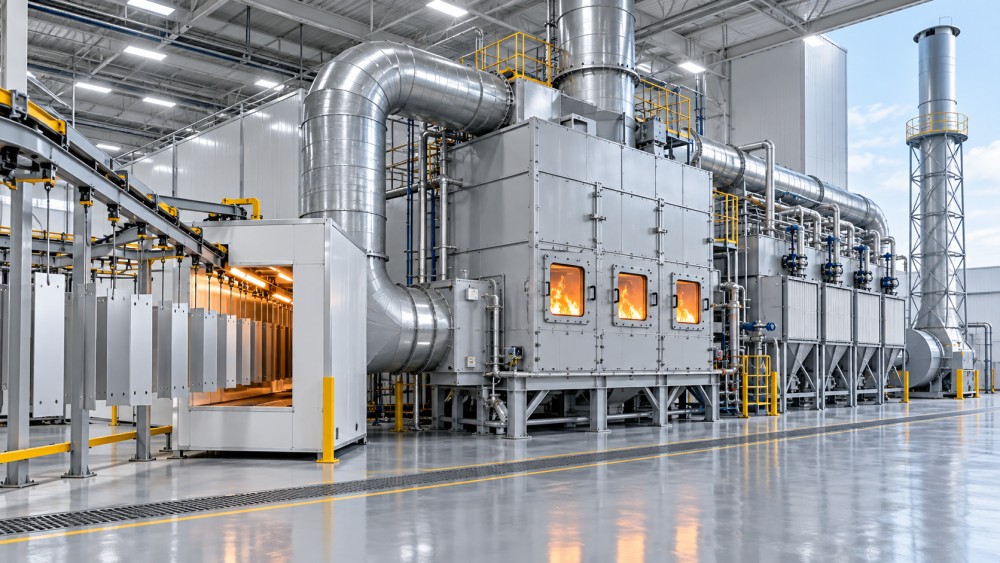
Technical evaluations should begin with a process map rather than an equipment shortlist. Identify all points where volatile compounds enter, evaporate, escape, or are exhausted from the line.
Pure powder coating operations may emit very limited VOCs because powder formulations generally contain no conventional liquid carrier. However, line emissions often originate upstream or downstream of powder application.
Common sources include solvent wipe-down stations, metal cleaning chemicals, pretreatment additives, coating booth cleaning, masking materials, maintenance solvents, oven exhaust, and occasional liquid touch-up coating operations.
Some powder products can also release small quantities of volatile compounds during curing. These may include residual monomers, curing agents, additives, contaminants, or decomposition products generated under excessive temperatures.
Emission testing should distinguish total VOC concentration from hazardous air pollutants, particulate matter, acid gases, formaldehyde, and combustion byproducts. A single total hydrocarbon result does not define every compliance risk.
Capture efficiency is frequently more important than destruction efficiency. A unit rated for 99 percent destruction cannot control vapors that leak from open tanks, poorly sealed ducts, or unventilated work areas.
Measure exhaust flow, temperature, humidity, oxygen concentration, VOC loading, peak emissions, and operating hours. These values determine whether a system will operate efficiently or consume excessive fuel during low-load periods.
Production schedules matter as well. A line operating continuously at stable loading needs different control logic from a batch operation with intermittent ovens, multiple colors, frequent changeovers, and irregular solvent cleaning events.
Before specifying equipment, calculate annual mass emissions and hourly peak loading. This establishes whether the priority is permit compliance, odor reduction, worker exposure control, hazardous pollutant destruction, or energy recovery.
When Source Reduction Delivers Better Value Than End-of-Pipe Treatment
Source reduction should be evaluated before installing oxidizers or adsorption equipment. It reduces emissions at their origin, lowers treatment capacity requirements, and can simplify permitting, monitoring, maintenance, and operator training.
Replacing solvent-intensive cleaning steps with aqueous or semi-aqueous alternatives is often the most direct improvement. The replacement chemistry must still meet cleanliness, corrosion protection, drying, and downstream adhesion requirements.
Closed-loop solvent dispensing reduces evaporation during manual cleaning and maintenance. Metered containers, spring-loaded lids, local extraction, and documented disposal practices can reduce uncontrolled emissions without changing the coating process.
Facilities should review whether liquid touch-up paints are necessary. Where appearance and repair requirements permit, powder-compatible repair methods or low-VOC touch-up formulations may substantially reduce sporadic emission peaks.
Oven optimization can also reduce VOC formation. Excessive cure temperatures, extended dwell times, or poorly balanced airflow may increase off-gassing while wasting energy and creating avoidable coating defects.
Verify cure conditions through part temperature profiling rather than oven setpoint alone. Thick parts, dense racks, varying metal mass, and irregular loading can cause significant differences between nominal and actual curing conditions.
Reducing exhaust volume is another practical measure, but it must be approached carefully. Lower airflow can improve abatement economics while creating risks involving heat buildup, combustible concentrations, humidity, or poor oven uniformity.
Any source-reduction initiative should include validation testing. Evaluate coating adhesion, film thickness, gloss, cure response, corrosion resistance, contamination control, and rework rates after changing cleaners, chemicals, or oven settings.
These measures do not eliminate the need for VOC reduction equipment in every plant. They do ensure that any subsequent control system is sized for a stable, realistic, and financially defensible emissions load.
Thermal Oxidizers: Reliable for High VOC Loads and Difficult Compounds
Direct thermal oxidizers destroy VOCs by heating exhaust gases to elevated temperatures, commonly around 1,400 to 1,600 degrees Fahrenheit, for sufficient residence time and turbulence.
They are suitable for streams containing high VOC concentrations, variable organic compounds, or contaminants that could poison catalysts. Their operating principle is simple, robust, and broadly accepted by regulators.
Thermal oxidation can achieve high destruction efficiency when designed correctly. However, destruction performance must be considered together with capture effectiveness, bypass conditions, startup emissions, and continuous monitoring requirements.
The main drawback is fuel consumption. A conventional thermal oxidizer may require substantial supplemental natural gas when the incoming VOC concentration is too low to sustain combustion efficiently.
Heat recovery can materially improve economics. Recuperative thermal oxidizers use a heat exchanger to preheat incoming exhaust, reducing fuel demand while providing a more compact alternative to regenerative designs.
Thermal oxidizers also require careful assessment of nitrogen oxide formation. High combustion temperatures can increase NOx emissions, potentially creating a separate permitting issue or requiring low-NOx burner technology.
For powder coating lines, direct thermal oxidation is usually justified when emissions include frequent solvent cleaning, liquid coatings, high organic loading, or chemical species unsuitable for catalytic oxidation.
Technical evaluators should confirm turndown capability. A system designed for a high-emission condition may operate inefficiently during idle periods, low-production shifts, or when cleaner materials reduce inlet VOC concentrations.
Maintenance requirements include burner inspections, refractory assessment, duct cleaning, fan servicing, temperature sensor calibration, and periodic review of safety interlocks. These items should be included in lifecycle cost comparisons.
Regenerative Thermal Oxidizers: Often the Strongest Option for Large Exhaust Volumes
Regenerative thermal oxidizers, commonly called RTOs, use ceramic media beds to recover heat from treated exhaust. They typically offer significantly higher thermal efficiency than conventional thermal oxidizers.
RTO systems are particularly effective for large-volume, low-concentration VOC streams. This profile is common where multiple process vents, ovens, cleaning stations, or coating support operations feed a shared exhaust system.
High thermal recovery can reduce fuel demand substantially after startup. Where VOC loading is sufficient, the process may become partially or fully self-sustaining, although this must be proven using actual operating data.
RTOs can deliver high destruction efficiency and tolerate many organic compounds. They are widely used in industrial finishing, printing, chemical processing, automotive operations, and manufacturing lines with variable emissions.
The main engineering concern is media contamination. Silicone compounds, phosphorus, sulfur, halogenated chemicals, aerosols, oil mist, and particulates can foul ceramic beds or create secondary corrosion and maintenance problems.
Powder overspray should never be allowed to enter an RTO without appropriate collection and filtration. Fine particulate can accumulate in ducts, reduce heat-transfer performance, and create safety or fire hazards.
Valve reliability is another critical factor. RTO operation depends on timed flow reversal through ceramic beds, so switching valve leakage, seal wear, and actuator failures can affect emissions performance.
Large RTO installations require meaningful space, structural planning, stack design, duct routing, electrical supply, and controls integration. These issues are manageable but should be evaluated before equipment selection.
An RTO is often the preferred VOC reduction technology powder coating choice when emissions are continuous, airflow is high, concentration is moderate, and recovered heat can support overall energy-performance targets.
Catalytic Oxidizers: Efficient Only When the Exhaust Stream Is Compatible
Catalytic oxidizers use a catalyst to lower the temperature needed for VOC destruction. Lower operating temperatures can reduce fuel consumption compared with direct thermal oxidation under suitable conditions.
They are often attractive for cleaner exhaust streams with stable VOC chemistry. A catalytic unit may be compact, responsive, and energy efficient when contaminants are well understood and carefully controlled.
The major limitation is catalyst poisoning or fouling. Compounds containing sulfur, phosphorus, silicon, heavy metals, halogens, or certain aerosols may reduce catalyst activity and shorten replacement intervals.
Powder coating plants should examine every material that may reach the exhaust. This includes pretreatment chemistry, masking agents, lubricants, maintenance sprays, silicone release products, and liquid repair coatings.
Pre-filtration may protect the catalyst from particles and oil mist. However, filtration systems introduce pressure drop, replacement costs, inspection needs, and potential bypass risks that must be included in the evaluation.
Catalytic performance also depends on inlet temperature and VOC concentration. Cold startup conditions may require preheating, while low concentrations can make the system less economical than expected.
Routine monitoring should track pressure drop, bed temperature, outlet VOC performance, and catalyst condition. A gradual increase in required operating temperature can indicate declining catalytic activity.
Catalytic oxidation is generally best for controlled, relatively clean streams. It is less suitable where incoming chemistry changes frequently or where maintenance practices allow unknown solvent products into the ventilation network.
For technical evaluators, the key question is not whether a catalyst can achieve a laboratory destruction rating. It is whether the plant can protect that catalyst over several years of real operation.
Adsorption Systems and Hybrid Designs for Low-Concentration Emissions
Carbon adsorption captures VOC molecules on activated carbon rather than immediately destroying them. It can be useful for low-concentration streams, intermittent emissions, solvent recovery, or polishing applications.
Adsorption performance depends on compound properties, humidity, temperature, concentration, airflow, and carbon type. High humidity or competing vapors can reduce available adsorption capacity and increase breakthrough risk.
For streams containing recoverable solvents, adsorption may provide an economic benefit through recovery and reuse. This opportunity is usually limited in powder coating lines dominated by mixed or low-value VOCs.
Activated carbon introduces a fire-risk consideration. Some organic vapors, oxidizing chemicals, high temperatures, and spontaneous heat generation conditions require careful engineering, monitoring, and emergency response procedures.
Carbon replacement or regeneration creates an ongoing operational requirement. Evaluators should understand spent-media handling, regeneration contracts, waste classification, shipping costs, and the environmental responsibility for captured compounds.
Zeolite concentrators offer another approach. They can concentrate VOCs from large, dilute airflows into a smaller stream that is treated by an oxidizer, improving overall thermal efficiency.
These hybrid systems are valuable where airflow is very high but VOC concentration is low. They require stable process control, clean incoming air, and a well-designed downstream oxidation unit.
A concentrator-and-RTO configuration can be effective for large finishing operations, but it is not automatically economical. The business case should compare fan energy, pressure drop, maintenance, and capital cost.
Adsorption and concentration technologies are strongest when they solve a specific airflow or concentration challenge. They should not be selected merely because their initial equipment footprint appears smaller than an oxidizer.
How to Compare VOC Control Options Using Practical Selection Criteria
Technical evaluators should compare systems using a consistent decision matrix. Avoid selecting equipment from brochure destruction efficiency alone, because operating conditions determine actual environmental and financial performance.
Start with emission characteristics: total airflow, normal and peak VOC concentration, compound types, temperature, moisture, particulates, oxygen level, and expected future changes in material usage or production volume.
Next, evaluate required capture efficiency. Review hood design, enclosure integrity, duct velocity, exhaust balancing, room makeup air, and potential fugitive sources before sizing downstream treatment capacity.
Calculate annual energy demand under realistic operating schedules. Include startup, shutdown, low-load periods, weekends, seasonal temperature changes, burner fuel, electrical power, fans, controls, and heat recovery opportunities.
Maintenance analysis should include consumables, media replacement, catalyst replacement, valve servicing, burner maintenance, filter changes, refractory work, inspection access, instrumentation calibration, and availability of qualified service support.
Consider compliance monitoring from the beginning. Permits may require temperature records, flow measurements, pressure indicators, alarm systems, operating logs, periodic stack testing, destruction verification, or continuous emissions monitoring.
Safety assessment must address combustible concentration limits, lower explosive limit monitoring, fire detection, explosion relief, emergency shutdown logic, isolation dampers, hot surfaces, dust accumulation, and lockout procedures.
Integration with production equipment is equally important. An abatement system should not destabilize oven pressure, alter cure quality, overload existing electrical infrastructure, or create exhaust constraints during line changes.
Finally, assess supplier capability. Request reference installations with comparable powder coating operations, documented emissions results, utility data, maintenance history, controls architecture, and clear responsibility for performance guarantees.
Recommended Decision Path for Powder Coating Line Evaluators
For most powder coating facilities, the first recommendation is to reduce solvent use and verify whether existing emissions actually require dedicated end-of-pipe treatment. Measurement should guide investment decisions.
Where substantial, continuous VOC exhaust remains, an RTO is commonly the most capable solution for high airflow and variable organic loading, especially when thermal efficiency supports lifecycle economics.
A recuperative or direct thermal oxidizer may be more appropriate for higher concentrations, difficult contaminants, limited operational complexity, or streams where catalyst poisoning is likely.
Catalytic oxidizers can provide lower-temperature treatment for clean, stable exhaust streams. Their value depends on disciplined chemical control and reliable filtration that protects long-term catalyst performance.
Adsorption or concentrator systems deserve close consideration for low-concentration, high-volume streams, particularly when a hybrid arrangement can reduce fuel use or enable solvent recovery.
The best VOC reduction technology powder coating decision is rarely the most generic technology. It is the system matched to measured emissions, verified capture conditions, material chemistry, production schedule, and permit requirements.
Technical evaluators should require a complete lifecycle model before approval. Capital cost matters, but fuel, electricity, uptime, maintenance, compliance testing, spare parts, and future production changes determine the final investment value.
A well-designed system protects more than permit status. It supports stable coating quality, safer operations, predictable operating costs, cleaner production records, and stronger confidence in the manufacturing line’s long-term reliability.