
VOC coating regulations have moved from a narrow environmental topic to a daily control point for finishing operations. Air emission limits, worker exposure rules, and customer expectations now intersect on the same coating line.
That shift matters because compliance is rarely solved by one low-VOC product alone. A line stays compliant when materials, spray settings, ventilation, curing, housekeeping, and records work together without gaps.
In broad industrial manufacturing, this affects metal parts, appliances, electronics housings, automotive components, fabricated assemblies, and export products. Surface quality and regulatory performance are now closely linked.
What VOC coating regulations actually cover
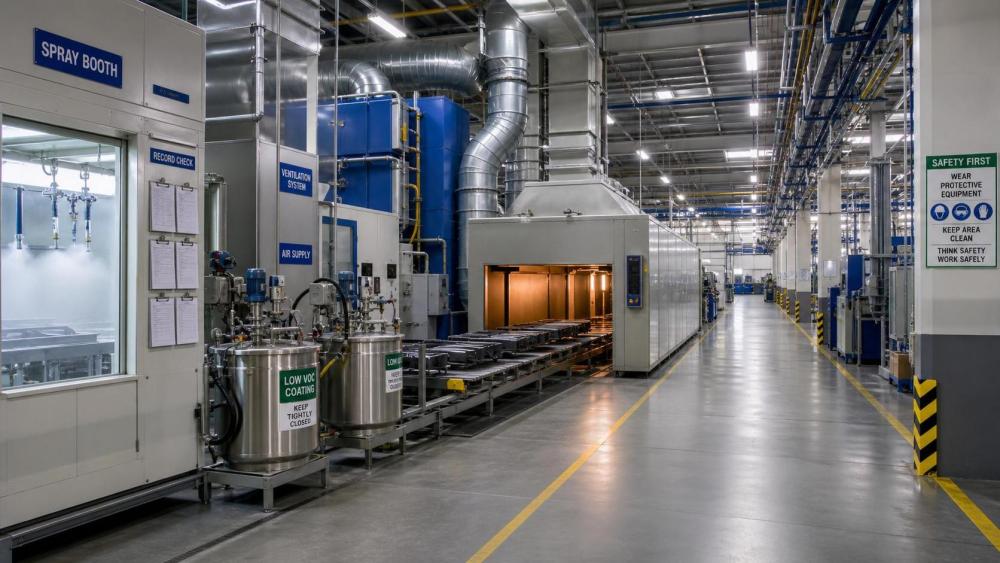
VOC coating regulations govern volatile organic compounds released during storage, mixing, application, flash-off, and curing. They focus on what evaporates into the air, not only what enters the paint kitchen.
Different jurisdictions use different thresholds, test methods, and reporting triggers. Even so, the practical questions on the factory floor are usually similar.
- What is the VOC content of each coating, thinner, cleaner, and touch-up material?
- How much material is actually consumed, lost, or emitted?
- Which booths, ovens, tanks, and exhaust systems affect release levels?
- What operating records prove that the line stayed within limits?
Simple product labels do not always answer those points. Safety data sheets, technical data sheets, local permit terms, and approved calculation methods often need to be read together.
Why finishing lines are under closer scrutiny
The pressure comes from more than environmental enforcement. VOC coating regulations now sit beside fire prevention, occupational hygiene, traceability, and product consistency requirements.
A coating line can pass appearance inspection and still fail a compliance review. The risk appears when solvent additions are undocumented, booth airflow is unstable, or waste handling does not match written procedures.
This is where auxiliary systems become important. Surface treatment quality, weighing accuracy, ventilation stability, and curing control shape both coating performance and emission behavior.
GIAS regularly tracks this overlap across advanced manufacturing. Its coverage of surface treatment, electrostatic coating, industrial weighing, coding, and vacuum-supported processes reflects a broader reality: small process deviations often create large compliance consequences.
The first checks should start with material control
Many compliance problems begin before coating reaches the spray gun. Material selection, storage, and batch preparation determine whether the line can realistically stay within VOC coating regulations.
Check the full chemical set, not only the topcoat
Primers, sealers, adhesion promoters, thinners, hardeners, purge solvents, booth cleaners, and rework materials all count. One overlooked cleaning solvent can distort the total emission picture.
Verify actual mix ratios on the shop floor
A compliant formula on paper can become noncompliant after manual dilution. Measured batching systems reduce that risk and help link each batch to recorded VOC assumptions.
Control storage and shelf life
Improper sealing increases evaporation losses. Expired materials may also change viscosity, forcing extra solvent addition during use.
Process conditions often decide whether paperwork matches reality
VOC coating regulations are enforced through measurable results, but those results depend on process discipline. The same coating can behave differently under different transfer efficiency and airflow conditions.
Application efficiency matters
Poor atomization, wrong gun distance, or unstable electrostatic settings increase overspray. That means more material use, more booth contamination, and often higher effective emissions per accepted part.
Ventilation must be stable, not assumed
Booth capture efficiency depends on airflow balance, filter condition, and maintenance quality. An exhaust system that drifts out of range can affect both exposure control and permit compliance.
Curing and flash-off conditions should be reviewed
Temperature and dwell time influence solvent release patterns. Inconsistent oven control may create defects, extend drying time, or shift emission timing in ways that complicate reporting.
Surface preparation also belongs in this discussion. Inadequate cleaning can trigger repainting, while unstable pretreatment can reduce adhesion and increase scrap, both of which raise coating consumption.
Records are part of compliance, not an administrative afterthought
A finishing line may operate well and still fail an audit if records cannot support its claims. VOC coating regulations usually require proof that inputs, operating conditions, and emissions were controlled over time.
Useful records are specific, current, and linked to actual production. Generic monthly summaries are rarely enough when a regulator or customer asks how a number was derived.
- Approved material list with current technical documents
- Batch logs for mixing, dilution, and issue quantity
- Booth and oven inspection records
- Filter changes, ventilation checks, and repairs
- Waste solvent and residue handling records
- Production volumes tied to coating consumption
Traceability tools can help here. Marking and coding systems, when connected with production records, make it easier to track which parts were processed under specific coating conditions.
Common trouble spots across industrial sectors
The details differ by industry, but several weak points appear repeatedly when VOC coating regulations are reviewed.
Manual solvent additions during shift changes
Operators often correct viscosity quickly to keep output moving. Without controlled measurement, those additions break the assumptions behind VOC calculations.
Untracked cleaning during color changes
Frequent line flushing can consume more solvent than expected, especially in flexible manufacturing with short production runs.
Rework loops caused by surface defects
Dust, oil residue, and pretreatment variation often lead to repainting. In practical terms, compliance suffers because total coating use climbs while sellable output stays flat.
Equipment drift that goes unnoticed
Worn spray components, clogged filters, and unstable pumps gradually change performance. The line still runs, but material usage and booth conditions move out of control.
How to review a finishing line with a compliance lens
A practical review should connect environmental rules with process capability. That means walking the line, checking documents, and comparing reported values with what operators actually do.
A useful starting framework looks like this:
- Map every VOC-bearing material from receipt to disposal.
- Check whether mix ratios are measured or estimated.
- Compare booth airflow records with maintenance history.
- Review rework rates and link them to surface preparation issues.
- Confirm that curing parameters remain within defined windows.
- Test whether production data can support emission calculations quickly.
This approach fits the broader manufacturing view promoted by GIAS. Compliance is strongest when auxiliary equipment, process records, and coating quality are treated as one system rather than separate topics.
What deserves attention next
VOC coating regulations will keep changing as product specifications, regional rules, and sustainability reporting become more detailed. The immediate task is not to chase every headline, but to tighten the line-level facts.
Start with the materials that contribute most to emissions, then review the process conditions that increase waste, rework, or solvent dependence. After that, test whether records can withstand an audit without reconstruction.
For operations comparing coating technologies, ventilation upgrades, batching controls, or surface treatment improvements, the best decisions usually come from linking compliance data with actual production behavior. That turns VOC coating regulations from a reporting burden into a clearer operating standard.