
Solvent Industrial Cleaning Technology: How to Compare Process Safety, Cleaning Power, and VOC Compliance
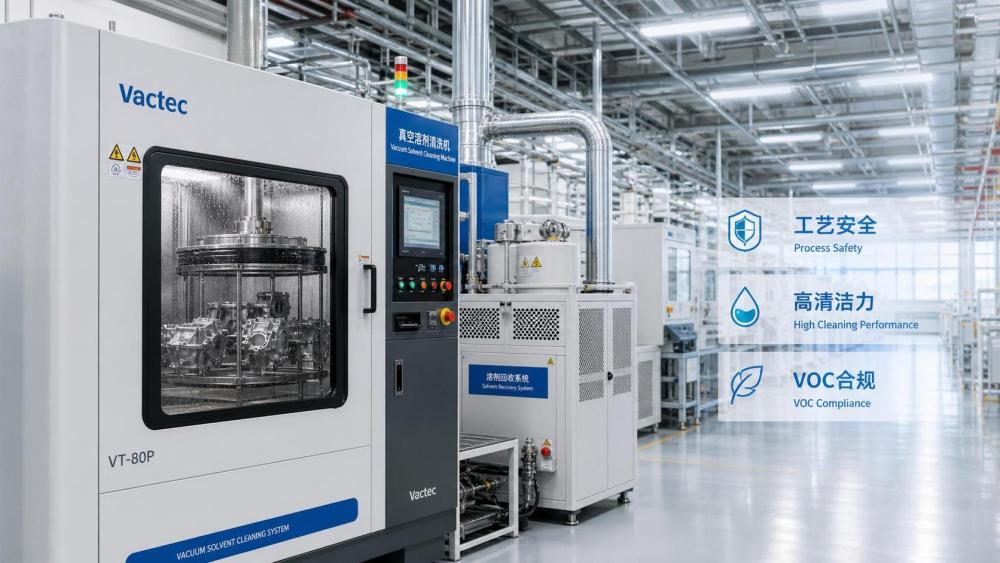
Solvent industrial cleaning technology still matters in high-precision manufacturing.
It becomes critical when oils, waxes, flux residues, and polymer films resist aqueous cleaning.
That is common in electronics, metalworking, medical parts, aerospace components, and coated assemblies.
The decision, however, is no longer about cleaning strength alone.
Today, solvent industrial cleaning technology must also support operator safety, environmental targets, and compliance documentation.
That shift is shaping equipment selection, process validation, and supplier qualification across global manufacturing.
From a technical evaluation standpoint, the best system is not always the most aggressive one.
The better choice is the process that removes contamination consistently without creating a larger safety or VOC burden.
Why Solvent Industrial Cleaning Technology Still Has a Strong Position
Water-based cleaning has improved, especially with ultrasonic systems and engineered detergents.
Even so, some contaminants remain difficult to remove with water alone.
Examples include heavy drawing oils, silicone residues, uncured resins, and no-clean flux byproducts.
In these cases, solvent industrial cleaning technology offers faster dissolution, lower surface tension, and better penetration into small geometries.
It is especially useful for blind holes, fine threads, micro-gaps, and contamination-sensitive surfaces.
Another reason is drying speed.
Many solvent processes reduce drying time, helping throughput and lowering corrosion risk on sensitive metals.
For exporters and regulated manufacturers, that can support more stable downstream quality.
Start with the Contaminant, Not the Cleaner
A sound evaluation begins with contamination mapping.
Without that step, solvent industrial cleaning technology can be over-specified or incorrectly rejected.
The first question is what must be removed.
The second is what level of residue is acceptable after cleaning.
Those two points define the real process window.
- Identify contaminant chemistry: mineral oil, synthetic lubricant, rosin flux, adhesive, wax, pigment, or particulates.
- Measure residue type and load: thin film, thick deposit, trapped contamination, or mixed soils.
- Define the cleanliness target: visual, gravimetric, ionic, nonvolatile residue, or surface energy level.
- Match the target to the next process step: coating, welding, bonding, marking, assembly, or packaging.
This is where many comparisons become more realistic.
A cleaner that performs well on bulk grease may fail on ionic residues before conformal coating.
A solvent with excellent resin removal may also attack labels, elastomers, or plastic housings.
How to Compare Cleaning Power in Real Production Conditions
Cleaning power should be compared under realistic load, geometry, and cycle constraints.
Lab tests are useful, but they often hide production variation.
In practice, solvent industrial cleaning technology performs through a combination of chemistry, mechanics, temperature, and time.
That means one solvent can look strong in a beaker test and weak in a tightly packed basket.
Focus on process variables that affect repeatability:
- Solvency for the target residue.
- Boiling point and evaporation behavior.
- Ability to penetrate narrow features.
- Compatibility with spray, immersion, vapor degreasing, or ultrasonic support.
- Bath life, contamination loading, and ease of recovery.
More importantly, compare results after repeated cycles, not just on fresh chemistry.
A process that loses effectiveness quickly will raise operating cost and audit risk.
That is a common blind spot in solvent industrial cleaning technology assessments.
Process Safety Is a Design Issue, Not a Side Check
The strongest cleaner is not useful if the process becomes difficult to operate safely.
This is where solvent industrial cleaning technology needs disciplined engineering review.
Safety depends on far more than the solvent label.
It depends on enclosure quality, vapor control, ventilation, ignition management, and operator exposure pathways.
Recent procurement trends show stronger preference for closed-loop systems and engineered recovery modules.
That shift is partly driven by compliance, but also by practical risk reduction.
- Check flash point and ignition behavior where relevant.
- Review toxicological data, exposure limits, and required monitoring.
- Confirm local exhaust design and solvent capture efficiency.
- Evaluate transfer, loading, and maintenance tasks where exposure often peaks.
- Verify training, spill response, and waste-handling procedures.
In actual operations, manual handling often creates more exposure than the cleaning chamber itself.
That is why process safety must be reviewed as a full workflow.
VOC Compliance Changes the Economics of Solvent Industrial Cleaning Technology
VOC compliance is no longer a paperwork issue at the end of selection.
It directly affects process design, cost structure, and site approval.
For that reason, solvent industrial cleaning technology should be compared with emissions control in mind from the start.
A solvent with good cleaning power may still become unattractive if air permitting becomes difficult.
The same applies if high makeup consumption pushes total emissions upward.
Key compliance questions include applicable VOC definitions, regional emission limits, hazardous air pollutant status, and waste classification.
This also means data quality matters.
Technical teams should request validated solvent composition, SDS details, consumption rates, recovery performance, and emission estimates.
A lower-emission process can be more competitive even when solvent price is higher.
That broader view often leads to better long-term decisions.
Material Compatibility Often Decides the Real Winner
A technically strong cleaner can still fail the application because of substrate damage.
Material compatibility should therefore be treated as a core part of solvent industrial cleaning technology evaluation.
Metals, elastomers, plastics, adhesives, coatings, and printed marks may all react differently.
Some issues appear immediately.
Others emerge after aging, thermal cycling, or downstream assembly.
That is why sample testing should include both cleaning results and post-cleaning material checks.
- Look for swelling, crazing, discoloration, or stress cracking.
- Check adhesive bond strength after cleaning.
- Confirm that laser marks, inkjet codes, or labels remain readable.
- Test corrosion behavior where water carryover or residue may interact with metal surfaces.
This is particularly important in mixed-material assemblies.
A process tuned for bare metal may not be suitable after marking, coating, or final assembly.
A Practical Comparison Framework for Technical Selection
A useful comparison model should combine performance, risk, and lifecycle cost.
That makes solvent industrial cleaning technology easier to evaluate across multiple stakeholders.
In practical terms, the review can follow five steps.
- Define contamination type, cleanliness target, and production volume.
- Screen solvent industrial cleaning technology options for residue removal and material compatibility.
- Compare equipment concepts, including enclosure, recovery, automation, and maintenance needs.
- Review VOC compliance, operator exposure, and waste-management implications.
- Run production-like trials with measurable acceptance criteria.
Scoring should include cleaning consistency, cycle time, solvent loss, defect reduction, and documentation quality.
That approach creates a more defensible selection record.
It also supports future audits, process changes, and supplier reviews.
Final Takeaway
Solvent industrial cleaning technology remains valuable because some residues still demand its precision and efficiency.
But the right comparison must go beyond cleaning strength.
The stronger signal today is balanced process design.
That means aligning residue removal, safety controls, material compatibility, and VOC compliance in one validated decision.
In real manufacturing, the winning process is the one that stays clean, stable, compliant, and repeatable under daily production pressure.
When solvent industrial cleaning technology is evaluated through that lens, selection becomes more practical, more defensible, and far more useful for long-term process reliability.