
Selecting Filters for Eco-Spray Booths: Airflow, VOC Capture, and Changeout Intervals
An eco-spray booth is often evaluated through its paint transfer efficiency, energy use, waterborne coating compatibility, or emission-control package. Filters can look like a secondary purchasing detail. In practice, they are where several competing requirements meet: stable booth airflow, visible finish quality, overspray retention, VOC control, fan energy, maintenance labor, and environmental compliance.
That is why selecting eco-spray booths filters should not start with a catalog dimension or the filter currently installed. A filter that fits the frame may still create poor air balance. A high-efficiency particulate stage may load too quickly in a high-solids application. Activated carbon may be included in a proposal even though the VOC concentration, humidity, airflow, or solvent mixture makes it unsuitable as the primary control method.
For technical evaluators, the useful question is not “Which filter is best?” It is: “What does each stage need to remove, at what airflow, and for how long before its resistance or capture performance becomes unacceptable?” The answer changes with booth geometry, coating chemistry, production hours, spray method, part shape, local requirements, and the downstream exhaust arrangement.
Start with the air path, not the filter SKU
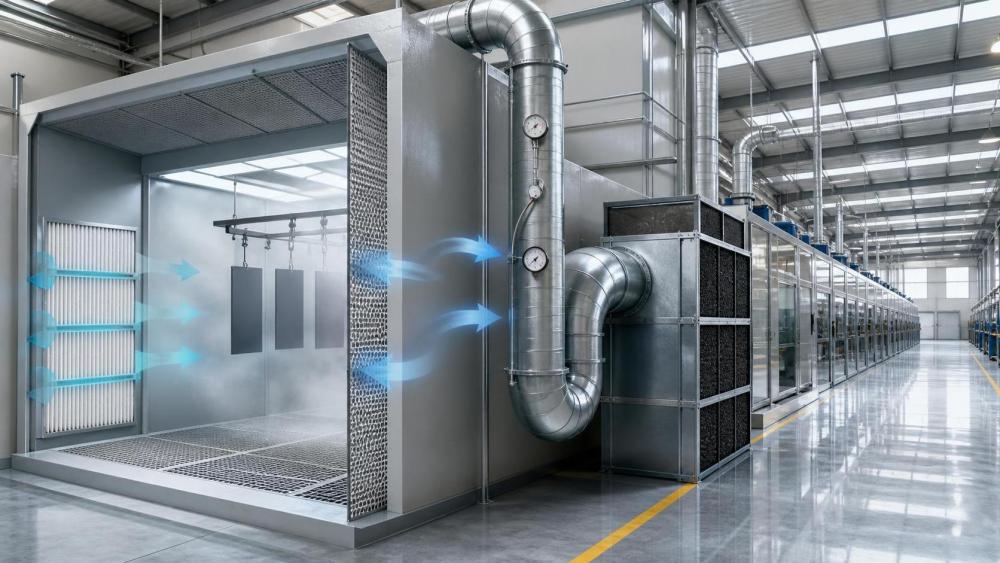
A typical dry-filter spray booth may have intake air filtration, one or more overspray arrestor stages, and possibly an exhaust polishing or gas-phase treatment stage. These are not interchangeable jobs. Intake media protects the coating zone from dust and fibers. Overspray arrestors capture paint particles before they reach the fan, ductwork, roof discharge, or a later control device. VOC treatment addresses vapor-phase contaminants that pass through particulate filters.
Confusing particles and vapors is one of the most expensive specification mistakes. Paint arrestors can be very effective against overspray while having little or no meaningful VOC-removal capability. Likewise, carbon media may adsorb certain organic vapors but will not replace a properly designed particulate arrestor. When suppliers describe a “complete filtration system,” the evaluator should ask for the function of every layer rather than assuming that a larger filter bank equals broader control.
Airflow also needs to be viewed as a system condition, not a fixed fan nameplate number. A booth fan may be capable of a stated airflow when filters are clean, but actual delivery falls as filter resistance rises unless the system uses suitable fan control. The result can be weaker capture at the booth opening, unstable spray patterns, dust ingress, and an increased risk of finish defects. On the other hand, driving the fan harder to maintain airflow can raise energy consumption and may expose duct leakage or poorly balanced make-up air.
Before comparing media, document the booth’s intended airflow, filter face area, fan curve, clean and final pressure-drop limits, make-up air configuration, and operating schedule. If these items are unavailable, that is not a reason to guess. It is a reason to pause the filter-selection exercise and obtain the booth documentation or field measurements.
Airflow stability is a coating-quality issue
Spray booths are designed to move contaminated air away from the operator and the workpiece in a controlled direction. When filter loading becomes excessive, the pressure distribution within the booth changes. Operators may notice it first as overspray hanging in the air, paint settling where it normally would not, or doors that feel different when opened. Quality teams may see more nibs, dirt inclusions, uneven metallic appearance, or rework on parts with demanding cosmetic standards.
The practical concern is not simply “low airflow.” It is whether the booth maintains the air movement and containment intended by its designer. Crossdraft, downdraft, semi-downdraft, enclosed robotic cells, and open-face booths respond differently to a loaded exhaust filter. A compact booth coating small fabricated parts can tolerate a different maintenance pattern from a large enclosure spraying cabinets, automotive components, agricultural equipment, or industrial machinery.
Filter face velocity matters as well. If the same airflow is pushed through a smaller filter area, media velocity rises. This can increase pressure drop and may encourage paint particles to penetrate or migrate differently through the media structure. Increasing filter area can sometimes extend useful life and lower resistance, but it requires enough plenum space and an even air distribution. Adding more media without correcting bypass paths or uneven loading does not solve the underlying problem.
For this reason, pressure gauges across each meaningful filter stage are more useful than a single reading across the entire booth. A differential-pressure trend shows whether intake filtration, overspray arrestors, or a downstream stage is driving the problem. It also gives maintenance teams evidence to distinguish normal loading from a sudden fault such as wet paint carryover, a collapsed filter, incorrect installation, or a damaged gasket.
Choose particulate media by coating behavior, not by appearance alone
Overspray is not a uniform contaminant. Powder coating, liquid solventborne coatings, waterborne coatings, primers, high-solids formulations, and adhesive-like specialty finishes can load arrestors very differently. Droplet size, tackiness, solids content, electrostatic application settings, gun distance, and part geometry all influence where material lands and how deeply it penetrates the media.
A filter that performs well on a relatively dry powder overspray may blind quickly when exposed to a sticky liquid coating. Conversely, a media designed for high paint-holding capacity may not deliver the particulate efficiency required ahead of a sensitive downstream device. Multistage arrangements are common because they allow the first layer to handle bulk loading while a final stage captures smaller carryover particles. The tradeoff is extra initial pressure drop, additional replacement points, and more opportunities for installation errors.
Intake filters deserve the same attention. Their role is not merely to protect the fan. Air entering the booth becomes part of the finish environment. Media shedding, poor frame sealing, moisture exposure, or inappropriate filter efficiency can create defects that are mistakenly blamed on paint, gun settings, or part cleaning. This is especially relevant where surface preparation is tightly controlled. A component can be cleaned effectively upstream, whether through ultrasonic cleaning, solvent washing, or another process, and still acquire contamination from poorly managed booth air.
When evaluating a proposed filter, ask for its intended spray-booth application, initial resistance at the expected airflow, recommended final resistance, paint-holding behavior, construction materials, and disposal considerations. Also ask whether the supplier’s performance information applies to the actual coating type. Generic efficiency language is not enough if the test conditions bear little resemblance to the booth’s operating environment.
VOC capture needs a separate engineering conversation
“Eco” does not automatically mean low-VOC, and waterborne coatings do not automatically eliminate vapor-control needs. Actual emissions depend on the formulation, thinning practice, flash-off conditions, solvent cleaning, production rate, and capture efficiency of the enclosure. The right starting point is an emissions inventory based on the coatings and solvents actually used, supported by safety data and product information where available.
Activated carbon can be appropriate for certain VOC streams, particularly where concentrations, contaminants, airflow, and replacement logistics are compatible with adsorption. But carbon has limits. Its useful capacity depends on the compound mix and operating conditions; moisture and competing vapors can affect performance. A carbon bed that is installed without a realistic monitoring and changeout plan can become a false assurance rather than an emissions-control strategy.
For larger or more variable solvent loads, the viable control route may involve concentration, recovery, oxidation, or another treatment arrangement rather than carbon alone. The correct choice depends on site-specific emission levels, energy availability, operating hours, fire and safety considerations, local permitting conditions, and the condition of the incoming gas stream. Particulate removal ahead of a VOC control unit is often essential because paint fouling can shorten the life or impair the operation of downstream equipment.
Technical reviews should separate three questions: how much overspray is captured in the booth, how effectively the booth captures vapors before they escape to the room, and what happens to the captured exhaust before discharge. These are related, but they are not the same measurement. Treating them as one can leave gaps in both compliance review and day-to-day process control.
Set changeout intervals from evidence, not calendar habit
A fixed weekly or monthly replacement schedule is easy to administer, but it is rarely the most economical or reliable approach on its own. Production can vary sharply by shift pattern, color mix, part size, coating system, and rework volume. One booth may run a light-duty batch job for several days and then process a heavy overspray product that changes loading behavior immediately.
The more defensible method combines the filter manufacturer’s guidance, booth designer limits, differential-pressure readings, airflow verification, visual inspection, and coating-quality observations. The final pressure drop should not be selected casually. It needs to stay within what the fan and booth can support while maintaining intended airflow and safe containment. If the fan has no control margin, waiting for a very high pressure reading may already be too late.
Changeout records should include the media type, installation date, pressure readings, operating hours if available, coating used, and any unusual conditions. This is not paperwork for its own sake. After several cycles, the record can show whether a particular coating family, spray setting, or shift pattern is shortening filter life. It also makes supplier comparisons more meaningful than comparing only purchase price.
Watch for the hidden costs of a “cheap” filter decision
The lowest unit-cost media may create higher total cost through short service life, fan energy, increased disposal volume, paint contamination, duct cleaning, or unplanned downtime. The opposite mistake is equally common: specifying an expensive high-efficiency media where a robust primary arrestor plus a targeted final stage would be more practical. The best arrangement is usually the one that fits the contaminant profile and can be maintained consistently by the actual plant team.
Installation details matter more than they seem. Gaps around frames, poorly seated pads, incorrect airflow orientation, compressed media, and damaged seals create bypass. Once air finds an easier route around the filter, nominal media performance becomes largely irrelevant. During maintenance, personnel should also consider the handling of paint-laden filters, residual solvents, ignition risks, and site waste procedures. These points need to align with the coating materials in use and applicable local requirements.
For operations comparing coating, surface treatment, vacuum, cleaning, marking, and other auxiliary processes, the common lesson is familiar: small control points shape final quality. A spray booth filter is not just consumable media. It is part of the process boundary between a controlled finishing operation and an uncontrolled one.
A practical selection brief for technical review
A sound filter request should describe the booth configuration, airflow requirement, existing fan and make-up air arrangement, coating types, estimated use pattern, current filter stages, known finish issues, and any required emission-control pathway. It should ask suppliers to state pressure-drop assumptions, expected loading behavior, compatibility limits, maintenance recommendations, and what must be verified on site.
Do not accept VOC-capture claims without clarity on the vapor stream and the downstream treatment method. Do not accept long filter-life claims without knowing the coating conditions used to support them. And do not set changeout intervals based on the calendar until pressure, airflow, and quality evidence show that the interval is safe for the actual process.
The strongest decision is usually not a dramatic redesign. It is a well-documented filter train, measured across its service life, with enough operating margin to keep airflow stable when production becomes less predictable.