
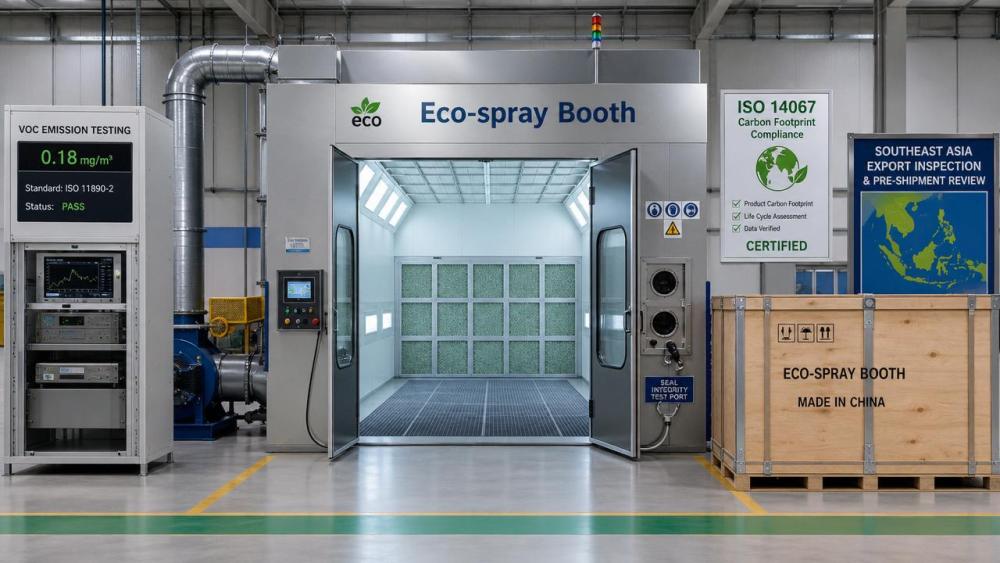
From June 1, 2026, Vietnam, Malaysia, and Thailand are set to apply updated environmental requirements for industrial coating equipment, making third-party environmental certification a market-entry condition for imported Eco-spray Booths. For exporters, buyers, compliance teams, and delivery planners, the development is worth close attention because it links customs clearance directly to ISO 14067 certification, VOC emissions testing, and pre-shipment readiness rather than post-arrival correction.
What the new import threshold now requires
Confirmed information shows that, starting in June 2026, Vietnam, Malaysia, and Thailand will implement revised environmental standards for industrial coating. Under this change, all imported Eco-spray Booths must hold ISO 14067 carbon footprint certification and a VOC escape-rate test report issued by a locally recognized laboratory.
The stated VOC limit is no more than 35g/m³. Equipment without the required certification documents may be detained at the port of entry and may face penalties of up to 200% of cargo value. The provided information also states that Chinese suppliers need to complete localization adaptation and pre-certification before export.
Where the pressure shifts across the supply chain
Export transactions move from shipment-first to document-first
From an industry perspective, exporters of Eco-spray Booths may be affected first because the rule change turns certification and testing documents into a prerequisite for customs entry. The practical impact is likely to fall on quotation review, contract confirmation, shipping release, and handover timing, especially where delivery commitments depend on smooth border clearance.
Procurement teams face a narrower supplier screening process
Buyers and sourcing teams may need to pay closer attention to whether suppliers can present ISO 14067 certification and VOC test reports that match local recognition requirements. Analysis shows that procurement risk is no longer limited to price and lead time; document validity and pre-certification status may become part of vendor qualification and purchase approval.
Testing and certification become part of commercial readiness
For certification-related service providers and testing institutions, the rule change highlights a more direct role in trade execution. What deserves closer attention is that compliance evidence is tied not only to environmental claims but also to import admissibility, which may influence how technical files, test records, and supporting documents are prepared before export.
After-sales and delivery planning may need earlier coordination
Distributors, logistics coordinators, and after-sales teams may also be affected because a detained shipment can disrupt installation schedules and customer acceptance. Observably, the business risk here is concentrated in delivery coordination, document completeness, and whether the equipment configuration has already been adapted for local compliance expectations before dispatch.
What companies should review now
Check whether certification scope matches the actual product to be shipped
Analysis shows that companies should first verify whether the ISO 14067 certification and VOC testing materials correspond to the specific Eco-spray Booth configuration intended for export. Where localization adaptation is required, firms should pay attention to whether product documents, technical descriptions, and test submissions remain consistent across sales, compliance, and shipping records.
Track how local recognition of test reports is applied
The provided information confirms that the VOC report must come from a locally recognized laboratory, but it does not specify the detailed recognition pathway. It is therefore more appropriate to understand this as an area requiring continued monitoring, especially for companies arranging testing schedules, shipment dates, and bid documentation.
Reassess lead times around pre-certification and delivery commitments
Because pre-certification is required before export, exporters and buyers may need to re-examine order planning and dispatch timing. From an industry perspective, the key practical issue is whether certification, testing, and localization steps are treated as front-end milestones rather than parallel tasks handled late in the delivery cycle.
Prepare for tighter document review in trade and handover stages
Companies involved in trade execution should pay closer attention to document packages, including certification files, test reports, technical materials, and any compliance statements submitted during procurement or import processing. The available information does not define a full documentation checklist, so this remains a compliance area that should be watched carefully rather than assumed to be settled.
Why this looks more like an enforcement signal than a routine update
Analysis shows that this development is not only about a new environmental benchmark; it also signals that VOC control and carbon-related certification are being used as operational import conditions for Eco-spray Booths in multiple Southeast Asian markets at the same time. The detention risk and the stated penalty exposure suggest that this should be read as a concrete execution signal rather than a distant policy discussion.
At the same time, observably, several practical details still require follow-up, including how local recognition of laboratories will be interpreted in practice, how procurement documents will reflect the new threshold, and how consistently the requirement will be enforced across transaction stages. For that reason, the market should not treat the current information as a fully complete compliance map.
How the market may need to read this change
At this stage, it is more appropriate to understand the update as a rule change with immediate trade and compliance implications for imported Eco-spray Booths, especially for suppliers shipping into Vietnam, Malaysia, and Thailand from June 2026 onward. The confirmed facts already point to higher pre-export preparation requirements, while the full execution approach still deserves continued observation through certification practice, import review, and buyer-side documentation demands.
Basis of this article and what still needs verification
This article is generated based on the user-provided news title, event date, and event summary. For developments of this type, commonly relevant source categories may include official notices, releases from regulatory authorities, customs or trade administration updates, industry association information, standard-setting documents, and reporting by authoritative media.
No specific official source link was provided in the input, so the exact official publication path remains subject to further verification. What still needs continued checking includes detailed policy language, certification enforcement criteria, local laboratory recognition practice, procurement document changes, market feedback, and how affected companies implement the requirement in actual export and delivery workflows.