
Where VOC Control Decisions Start on Fast Paint Lines
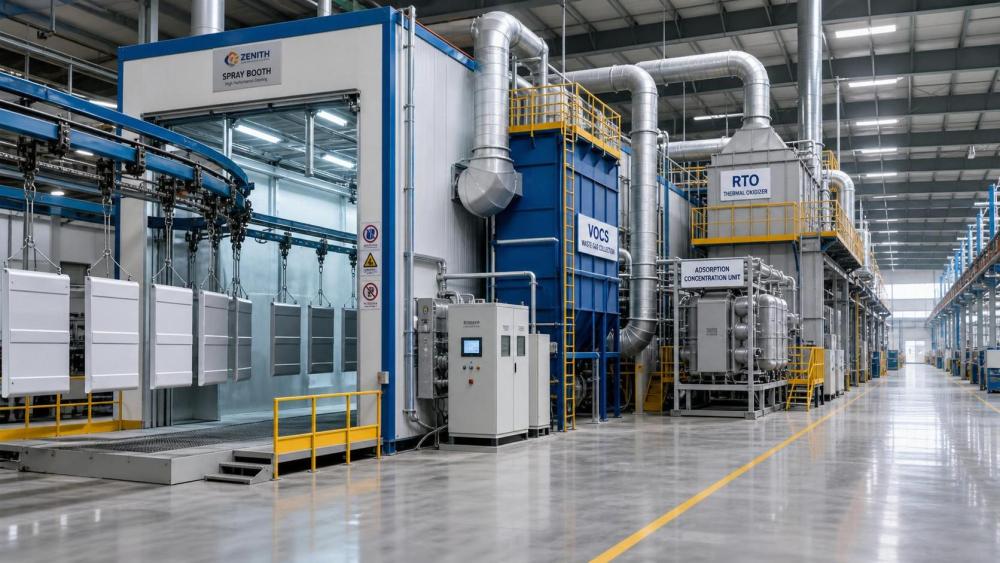
High-throughput finishing rarely fails because of one major machine alone.
More often, the weak point sits in airflow balance, solvent capture, or an under-matched abatement unit.
That is why industrial eco-coating systems deserve the same process attention as spray booths, curing ovens, and part handling.
On fast paint lines, VOC control affects compliance, coating consistency, maintenance windows, and even takt stability.
A system that looks efficient on paper can become expensive if solvent concentration swings with shift changes or product mix.
In practice, the right choice depends less on a generic technology ranking and more on line behavior.
Air volume, solvent type, flash-off temperature, overspray pattern, and uptime targets all change the answer.
This is especially relevant across advanced manufacturing, where surface treatment quality is linked with traceability, cleanliness, and downstream reliability.
Within that broader auxiliary systems view, industrial eco-coating systems are not standalone environmental hardware.
They are process-support assets that shape yield, audit readiness, and long-run operating discipline.
Actual Line Conditions Change Which Option Fits
Two paint lines may use similar coatings yet require very different VOC control strategies.
The reason is simple: solvent load is only one part of the picture.
A conveyorized metal parts line with large booth exhaust behaves differently from a compact enclosure coating small assemblies.
One may have massive airflow with diluted VOC concentration.
The other may have lower airflow but a sharper solvent peak during color changes.
In industrial eco-coating systems, these differences drive equipment sizing, energy use, and maintenance burden.
A useful way to judge fit is to look at four variables together:
- Exhaust airflow volume and its stability across shifts
- VOC concentration profile, including peak and average values
- Solvent composition, especially recoverable versus hard-to-separate mixtures
- Required uptime during production, purge, cleaning, and color transition
Once these are clear, the technology comparison becomes more grounded and far less theoretical.
When Thermal Oxidation Makes Sense
Thermal oxidation is often the stable choice for high-volume paint lines with mixed solvents and strict destruction targets.
It fits operations where predictability matters more than solvent recovery.
That usually includes appliance panels, metal furniture, agricultural equipment, and general fabricated components.
These lines often run long shifts, broad part sizes, and frequent production schedules.
A regenerative thermal oxidizer works well when exhaust volumes are high and VOC concentrations are relatively low but continuous.
The big advantage is resilience against solvent variability.
If coating recipes change over time, thermal destruction usually adapts better than a narrowly optimized recovery process.
The tradeoff is fuel demand, especially during startup or when inlet concentrations stay below autothermal range.
For industrial eco-coating systems, that means heat recovery design is not optional.
It should be reviewed together with oven exhaust integration and booth balancing.
A common mistake is selecting thermal oxidation only by destruction efficiency.
The better question is whether the line can deliver stable loading without forcing excessive auxiliary fuel use.
Adsorption Fits Better When Air Is High but Solvent Is Dilute
Some high-throughput paint lines move huge air volumes just to maintain booth safety and coating quality.
In those cases, direct oxidation can become energy-heavy.
Adsorption systems, often using activated carbon or zeolite, are more attractive when VOC levels are low and capture efficiency matters.
This pattern appears in light industrial products, electronics housings, and powder-liquid mixed finishing areas with variable line loading.
The strongest use case is concentration before final treatment.
A concentrator can shrink the exhaust stream sent to an oxidizer, reducing total energy demand.
That hybrid logic is common in industrial eco-coating systems built for both compliance and operating cost control.
Still, adsorption is not a universal answer.
High-boiling compounds, sticky aerosols, and poor pre-filtration can shorten media life and destabilize pressure drop.
In real plants, maintenance access and media replacement logistics often decide whether this option remains efficient after year one.
Condensation Works in Narrower but Valuable Situations
Condensation is usually more selective.
It performs best when solvent concentration is relatively high, airflow is moderate, and the recovered solvent has value or disposal cost matters.
That can happen in enclosed coating cells, batch finishing, specialty chemical coatings, or lines with limited exhaust and repetitive solvent chemistry.
For high-throughput paint lines, condensation alone is less common.
The reason is that mainstream conveyor operations usually dilute VOCs too much for efficient standalone recovery.
Even so, industrial eco-coating systems can use condensation upstream of another stage when solvent peaks are sharp and predictable.
This is especially useful where recovered material quality can be controlled and reintroduced safely or handled as a defined waste stream.
The key judgment is not whether recovery sounds attractive.
It is whether the thermodynamics and the contamination profile actually support consistent recovery.
Different Paint Line Profiles Lead to Different Choices
The fit becomes clearer when line profiles are compared side by side.
This is where industrial eco-coating systems overlap with the wider auxiliary equipment mindset seen across advanced manufacturing.
The best results come from looking at process support, not just end-of-pipe treatment.
What Gets Misjudged Before Installation
Several errors show up repeatedly when VOC control is chosen too early or with incomplete line data.
- Using nameplate airflow instead of measured operating airflow across actual production modes
- Sizing for average solvent load while ignoring purge cycles and color-change spikes
- Comparing capital cost only, without media, burner, downtime, and cleaning costs
- Assuming similar coatings generate similar abatement conditions despite different booth designs
- Ignoring pretreatment carryover, overspray solids, and moisture that affect downstream equipment
In practical terms, industrial eco-coating systems should be judged with the same discipline used for cleaning, batching, coding, or vacuum support systems.
Small process deviations compound over time.
That is often what separates a compliant line from a stable one.
A More Reliable Way to Match the System
A sound selection path starts with operating evidence, not brochures.
First, map airflow and VOC concentration by product family, shift, and cleaning interval.
Then separate continuous exhaust from short peak events.
That distinction often changes whether thermal, adsorption, condensation, or hybrid logic performs best.
Next, review how the coating line connects with surrounding auxiliary systems.
Pretreatment cleanliness, oven profile, filtration condition, and even identification requirements can influence line stability and rework rates.
For industrial eco-coating systems, the stronger decision is usually the one that protects both compliance and production rhythm.
Before final commitment, confirm five points:
- Peak versus average VOC loading
- Expected solvent recipe changes over the equipment life
- Maintenance access, cleaning frequency, and spare strategy
- Energy integration opportunities with ovens or heat recovery loops
- Permitting limits, monitoring expectations, and future expansion margins
That approach produces a system fit that stays workable after startup, not just during acceptance testing.