
How to Evaluate an Eco-Friendly Coating Supplier for Compliance, Quality, and Cost?
Choosing the right eco-friendly coating supplier is no longer just about price. For procurement teams, the real challenge is balancing regulatory compliance, coating quality, production consistency, and total cost. A reliable supplier should demonstrate verified certifications, stable technical performance, and the ability to support long-term manufacturing goals. This guide explains how to evaluate suppliers more effectively and reduce sourcing risk.
If you are sourcing coatings for metal parts, appliances, automotive components, electronics housings, or industrial equipment, the wrong supplier usually does not fail on day one. Problems show up later: rejected batches, poor adhesion, inconsistent color, VOC documentation gaps, export delays, or higher rework costs than anyone expected during quotation. That is why a useful supplier review has to go beyond catalog claims.
When evaluating an eco-friendly coating supplier, I would treat the process like a risk screen. Not every item carries the same weight, but if several weak points appear together, it is usually a sign to slow down before placing volume orders.
Start with the compliance documents, not the sales pitch
“Eco-friendly” is a loose marketing phrase unless the supplier can connect it to actual regulatory and chemical control documentation. For procurement, the first check is simple: ask what standards and market requirements the coating is meant to meet, and in which countries. A supplier selling into the EU, US, or specific regulated manufacturing sectors should already be used to providing structured compliance files.
At minimum, request and review:
- SDS or Safety Data Sheet for the coating system
- Technical Data Sheet with application conditions and performance claims
- RoHS declaration where relevant
- REACH-related declaration where relevant, especially for SVHC communication
- VOC-related information if the product is sold as low-VOC or water-based
- Any sector-specific restriction statements required by your end market
Do not stop at receiving PDFs. Check dates, revision numbers, legal entity names, and whether the documents actually match the quoted product code. A common sourcing mistake is reviewing a compliance file from a similar product rather than the exact grade being purchased.
Another practical question: can the supplier explain what part of the formulation supports the “eco-friendly” claim? They do not need to disclose proprietary chemistry, but they should be able to state whether the benefit comes from lower VOC content, reduced heavy-metal content, water-based chemistry, powder coating format, or another verified characteristic. If the answer stays vague, treat the claim carefully.
Check whether their coating performance is stable in real production conditions
A coating that looks good on a supplier sample panel may still fail on your line. Procurement should pull technical and quality teams into this step early, because the real issue is not lab appearance. It is repeatability under your substrate, pretreatment, curing window, film thickness target, and throughput.
Useful questions to ask:
- Which substrates has this coating been validated on: steel, aluminum, galvanized steel, plastic, mixed assemblies?
- What pretreatment is assumed before application?
- What curing temperature and dwell time are recommended?
- How sensitive is the finish to line-speed variation?
- What film thickness range is acceptable before appearance or protection drops off?
- What defects are most common in production: orange peel, pinholes, poor edge coverage, gloss drift, poor leveling?
If the supplier has no structured answer here, they may still be a trader rather than a technically capable source. That is not automatically disqualifying, but it changes the risk profile. A trader with weak technical backup often struggles when your line develops field problems.
For critical applications, ask for trial support and define pass/fail criteria before testing. Adhesion, corrosion resistance, hardness, chemical resistance, color consistency, and recoat behavior should be reviewed against your internal standard or customer specification. If a test method is mentioned, confirm the exact method version and acceptance criteria rather than relying on broad claims such as “passes salt spray” or “high durability.”
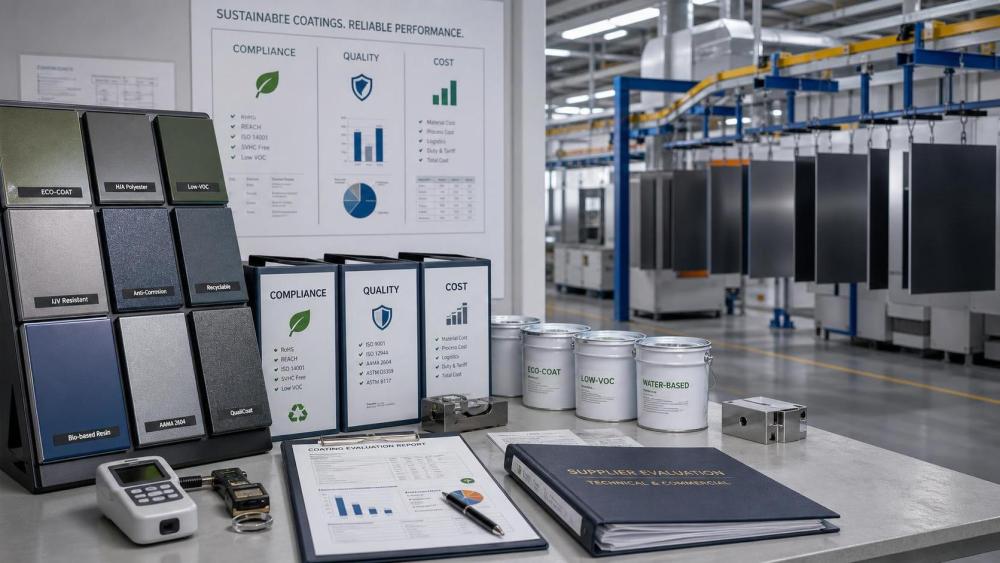
Ask how they control batch consistency
This part is often underestimated. One approved sample does not mean stable supply. The bigger cost problem usually comes from variation between lots. If the eco-friendly coating supplier cannot keep viscosity, color, particle distribution, cure behavior, or solids content within control, your line ends up paying for it.
Ask what they do in production QA. That may include incoming raw material control, in-process checks, retained samples, batch traceability, and release testing. You are not auditing a pharmaceutical plant, but you do need enough discipline to trust repeat orders.
A supplier that can provide batch coding logic, COA format if applicable, and complaint handling workflow is easier to work with when something goes wrong. That matters for export shipments and customer disputes. Traceability is not just a quality topic; it is a cost-control tool.
Look beyond unit price and calculate the real coating cost
A lower price per kilogram can be misleading. Procurement teams usually get better decisions when they compare total applied cost, not just purchase price. Some coatings cost less upfront but require thicker film build, longer cure time, more rework, or tighter environmental control. Those hidden costs can erase any quotation advantage quickly.
This is where experienced buyers usually separate “cheap” from “economical.” If two suppliers are close on product performance, the one with stronger process stability and cleaner documentation often wins over the one offering the lowest nominal price.
Check plant support, not just product support
Coating problems are often process problems wearing a product label. A good supplier knows this. They will ask about substrate condition, line speed, grounding, spray settings, pretreatment quality, oven profile, and ambient conditions. A weak supplier will just send another drum and hope the complaint disappears.
For procurement, this becomes a practical screening point: how quickly can they provide technical support, and in what form? Remote troubleshooting may be enough for routine jobs. For more demanding lines, local application support or distributor-backed field service can reduce downtime and blame shifting.
Also ask who owns problem resolution. Is it the manufacturer, a local agent, or a trading company? That chain matters when trial results are disputed or when a production stop requires fast action.
Do a supply chain reality check
A technically strong supplier can still be the wrong choice if lead times are unstable or export readiness is weak. Eco-friendly coatings often rely on specific resin, pigment, or additive systems, and supply interruptions do happen. You do not need dramatic risk scenarios to justify asking basic continuity questions.
- What is the standard lead time and what causes it to stretch?
- Do they hold safety stock for regular customers?
- Can they support forecast-based ordering?
- Are packaging, labeling, and transport documents suitable for your destination market?
- If a raw material changes, how is the customer notified and requalified?
If your production is tied to an export program, ask directly whether the supplier has experience supporting audited supply chains. Many do, but the quality of their paperwork and response speed can vary a lot.
Watch for claims that sound green but are hard to verify
Procurement teams are now under pressure to source cleaner materials, but that also means more vague environmental language in the market. Be careful with statements such as “non-toxic,” “completely safe,” “zero emission,” or “fully compliant worldwide.” These are too broad to accept without context, and in some cases they are simply not meaningful as technical descriptions.
A better approach is to pin the supplier down to measurable or document-backed points: lower VOC compared with what reference product, restricted substance status for which regulation, and suitability for which end-use market. If they mention third-party testing, request the report scope and issuing body. If anything remains unclear, mark it as 【待核实】 in your supplier evaluation file rather than letting a soft claim become a hard assumption.
Use a short pilot order before committing volume
This is one of the most useful habits in coating procurement. After document review and sample approval, place a controlled pilot order large enough to expose batch handling, delivery performance, and line behavior under normal production rhythm. A tiny lab sample tells you almost nothing about supplier discipline.
During the pilot, track a few points that are easy to compare later: arrival condition, document completeness, application stability, defect rate, operator feedback, and any deviation from the quoted process window. Keep notes from production, not just from sourcing. The people running the line usually notice issues that never appear in meeting slides.
A practical decision frame for buyers
When the shortlist is down to two or three suppliers, the cleanest way to decide is to score them on four things: compliance confidence, process fit, consistency risk, and total operating cost. Price still matters, but only after the first three are believable.
In plain terms, the best eco-friendly coating supplier is usually not the one with the most polished brochure. It is the one that can prove what the product is, explain how it behaves on your line, keep the batches stable, and support the paperwork and troubleshooting that real production requires.
If you are buying for a regulated or export-facing manufacturing environment, keep your checklist disciplined. Verify documents early, test under actual conditions, and calculate cost where it really shows up: on the line, in rework, and in customer-facing risk.